Hacker News new | ask | show | jobs
by error 5190 days ago
In 1798 Thomas Robert Malthus predicted food shortages as population grows geometrically and food arithmetically. but here we are today with plenty of food :) in fact we have so much more that it causes us health problems...

I think these predictions overlook technological advancements just like Malthus did.

7 comments

One great example of that is the Haber Process. Fritz Haber (http://en.wikipedia.org/wiki/Fritz_Haber - a controversial figure as you can see) figured out how to synthesize nitrogen fertilizers, which basically solved a hunger crisis that was growing in Europe at the time. As the wiki says, "The food base of half of the current world population is based on the Haber-Bosch process." I originally heard this on a Radiolab episode; they claimed, among other things, it took us from a world capacity of ~1.5bn to ~13bn, and that people needed fertilizer so bad at the time that wars were fought in South America over bat guano. Hey, now we fight over oil.

The guy also gassed Allied troops and felt pretty good about it, so, you know. He had range.

Right. The fallacy of Malthusianism is that all those extra people turn out to have a knack for producing the stuff they need. Of course there's an ultimate limit, of the total insolation energy to Earth or maybe a Dyson sphere, but there are many multiples of headroom compared to Earth's current population and productivity.
The other fallacy of Malthusianism is that people (like other life forms) breed faster when there's surplus, and slower when there's not. Thus, as the population approaches the resource limit, it grows more slowly.

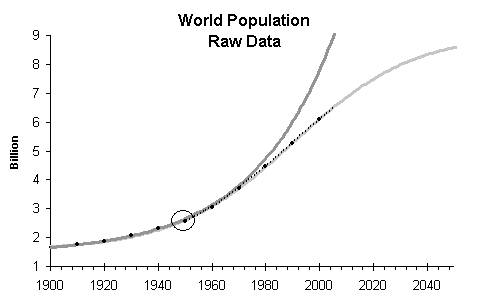
See, for example, Verhulst's mathematical description of population growth [0], written in response to Malthus. You can chart the data and see a very clear divergence from Malthus' expectations [1].

[0] http://en.wikipedia.org/wiki/Logistic_function#In_ecology:_m...

[1] for example, http://www.growth-dynamics.com/articles/Kurzweil_files/image... -- the higher curve is exponential, the lower curve is logistic

This is what I really want to believe - that technology will ride in and save the day. I even think it is likely that new tech will emerge that can do it, but (and maybe this is my cynicism showing through) I believe powerful interests that stand to be harmed by the "new tech" will make sure it never gets off the ground. I sure hope I am wrong though!
I was at Disney World last week, and they have this neat thing called the Carousel of Progress. It basically shows a household in the early 1900's through to present time. The interesting thing is how little has changed since then. There have been huge changes in communication, but other than that, the family of 100 years ago had an ice box, running water, etc. There were 130,000 cars in the country.

We marvel at our advances in medicine, but the biggest advances in life expectancy, from relatively simple techniques combatting child mortality, are long behind us. Life expectancy at age 65 has increased only 4 years (from 12 to 16) in the last 100 years.

In any given field, we see technology progress rapidly than plateau. Aerospace plateaued in the 1960's, for example. Even semiconductor technology, which has progressed at a breathtaking pace over the last half century, has improved markedly slower in this decade.

I think the faith in technology to save the day is misplaced. Improvements in energy technology peaked in the 1950's with the invention of nuclear power. Indeed, we still get most of our electricity from coal power plants that aren't dramatically different than they were 100 years ago (the city of Chicago just shut down two coal plants that are 100+ years old).

I have no doubt that technology will solve these problems, eventually. But the scenario in the article isn't something that might happen hundreds of years into the future. The projection is for 2050. I won't even have retired by then. We need a revolution to happen in the next 38 years, and I don't think one is forthcoming.

Life expectancy of a white male at 20 yrs was 62.1 in 1900 , 76.7 in 2004[1]. that's 14.5 years. And that's under somewhat harsher health conditions: more stress, bad diets, pollution and chemicals.

And don't forget what medicine for quality of life. for example the pill.

Other changes that happened in that time span: personal cars, affordable international travel, home air-conditioning, home cleaning automation, the microwave, pre cooked food,walmart prices.

[1]http://www.infoplease.com/ipa/A0005140.html

The reason I looked at life expectancy at 65 is that it tells you how far medicine has come at addressing the fundamental biological limits on life--the answer is not very far. The premise behind the "technology will solve our climate change problem" is exactly that sort of science that will let us overcome what we now perceive as fundamental limits. It's breaking the sound barrier, not moderate improvements in life expectancy through better treatment of contagious diseases.

The other examples you mentioned don't come anywhere near the sorts of technologies that are necessary, and also happened quite long ago. The personal car was well on its way by 1910--almost a million cars on the road by 1912. The first regular international airline service was in 1919. Buildings were air conditioned starting in the 1920's. Frozen food dates to 1929. There have been dramatic in making these advancements cheaper since then, but they were already quite prevalent more than 80 years ago.

The time scale of global warming projections are not hundreds of years from now. In that time scale I can imagine revolutions in energy technology. 2050 is only 38 years away. For reference, NTT rolled out the first cell network in Japan about 33 years ago. The Xerox Alto came out 39 years ago, with most of the basic elements of modern GUI's: http://upload.wikimedia.org/wikipedia/en/1/10/Alto_Neptune_F...

Are you seriously suggesting that health conditions are worse now than in 1900?
I meant that if we lived in the environment of 1900(most people living in villages in the u.s.?) and use current health and sanitation technologies , we would live even longer.
Malthus's prediction was also not based on science like contemporary predictions are.
Malthus may still some day be proven right. It's a common fallacy to think that because something hasn't happened yet is a reassurance that it will never happen.

Don't forget there are a lot of people that have little or no food at all (according to statistics about 1/7th of the world is malnourished). We're really, really spoiled in the West ("plenty of food").

Earth is already a scary place. And it will still be scary place in 2050. Even scarier for those at the bottom of the social order, and probably slightly happier for those at the top.

Nobody has a health problem because the celery farm was overproductive. It is the technological advances that have introduced the health problems, because it's hard to get a quick meal that doesn't involve hormone-injected beef and genetically-modified potatoes.
I actually think that food is the least of our problems.

Now growing animals for food is incredibly wasteful (in terms of water and other resources). Lab-grown meat isn't economically viable yet but by 2050 I imagine it may well be. Still, it'll be hard to argue with the economics of how cheap it is to grow a cow.

Fuels and metals are the big problem. The first is I believe a much bigger problem than the second. The reason is that there fuels are a means to an end: energy. When it comes to the electrical grid, you can supply that power with coal, oil, natural gas, nuclear power, wind power, solar power or nuclear power. It doesn't matter to the end user. It will be reflected in the price but the point is that you can make substitutions.

The bigger problem is metals as we're rapidly running out of those or, rather, the cost of extracting those will in the next century or two drastically increase. It is incredibly cheap to rip up iron out of the ground (~$10-15/tonne IIRC). Transportation and smelting to steel may increase the overall cost by an order of magnitude but that's still cheap.

Some look to space as a means to solving that problem but I have trouble fathoming a situation where extracting metals from the Moon or asteroids or whatever will be within even a few orders of magnitude of the cost of digging a big pit on Earth. Even if energy were free (in fuel terms), the cost of travelling far, retrieving the ore, refining it (probably in space) and getting it back to Earth are just fundamentally high (in comparison).

I honestly believe there needs to be at least one order of magnitude less of us than there is now and there will be one way or the other in coming centuries.

|Still, it'll be hard to argue with the economics of how cheap it is to grow a cow.

There's some interesting work being done on manufacturing food elements using synthetic biology[1]. they think it will cost one tenth of cheapest foods we have today, and will require little water. one of their food elements is a healthy substance with the taste of fat.

[1]http://www.wesolveforx.com/#t=t&n=ee7350c5

You should also consider that fertilizers and pesticides are derived from fossil fuels. Modern agriculture and oil go hand in glove and not just because equipment, processing, shipping and storage all rely on it to function.
Once we reach a stable population, can't most metals be recycled indefinitely?
Yeah, I tend to think it will be viable for say mining the moon for local structures long before it would be to cart them back to earth.