Hacker News new | ask | show | jobs
by thisiswater 999 days ago
We have known this is coming for decades, we have known it will be devastating to the sustainability of human civilization as it exists. Little to nothing has been done in a timely manner. And now it's here.

In my opinion there's a kind of Accelerationism going on here, where those who contribute the most to global warming also believe that they will be insulated from the effects, and therefore are the least inclined to address the issue. They're probably not wrong.

That is, those with wealth and power believe in climate change - they just don't care if monsoonal crops fail or northern India becomes uninhabitable. Denialism was always a strategy, not a serious strain of thought.

Eat the rich.

10 comments

> We have known this is coming for decades, we have known it will be devastating to the sustainability of human civilization as it exists. Little to nothing has been done in a timely manner.

You're right, we're growing exponentially in a finite environment.

https://futureearth.org/wp-content/uploads/2015/01/great_acc...

https://en.wikipedia.org/wiki/Great_Acceleration

I wonder how long it will take for the population to accept that the the need for growth is encoded in our system's very structure, in its financial system that prioritizes accumulation, exploitation, and pollution over sustainability and equality.

https://en.wikipedia.org/wiki/Ecological_overshoot

We're in overshoot. If we were sane, we would work on reducing our consumption, but instead, everybody's just trying to preserve the business-as-usual path for as long as possible, no matter how unsustainable it is.

Maybe we need to start thinking about new ways of managing things.

First, we created colonialism and robbed the Global South of their resources and their future. Then, we exported most of the pollution from our production to the Global South. Now, due to our lifestyle, we are making the Global South pay for climate change, as they are projected to be the most affected based on data. While doing this, we are trying to make ourselves independent from fossil fuels so that we are not dependent on the Middle East anymore. Once we achieve this, we can claim that the Global South is polluting the rest of the world while we are emission-free. We may then threaten sanctions or even invoke casus belli in some cases where our interests are at risk. But hey we are the good guys.
This kind of rhetoric doesn't change anything. Everybody needs to feel responsible. The richer countries need to help the poorer ones. Pointing fingers is fine for political activism but when it comes to real action, everybody needs to take it because everybody is affected.
> The richer countries need to help the poorer ones

Of course they need, but I'm not arguing they shouldn't, I'm arguing that we will again exploit them in the process as we always did in our entire history, the only thing that change is the form of exploitation but the exploitation never ended. You have a lot of examples here[1]. We will throw them a few billions to feel good about ourselves so we can look into mirror and say that we are the good guys because we are helping them.

1. https://en.wikipedia.org/wiki/Neocolonialism

Lots of ways to criticize cooperation between countries in economic areas, call it exploitation. But for a working person needing a job, it's an armchair distinction. Got a job? Feeding your family? Better than the alternative.

I'm just saying, mutual benefit does not equal exploitation.

I feel like there is a notion in your comment that I fit the stereotype of a radical left person, but I assure you I'm not. Of course, it's a good thing when people can find jobs instead of being unemployed.

> Lots of ways to criticize cooperation between countries in economic areas, call it exploitation

I'm referring to some of the examples on the Wiki page I linked. Many of them clearly involve one side exploiting the other.

> I'm just saying, mutual benefit does not equal exploitation.

Consider slavery. It may appear mutually beneficial on the surface, as one might argue that it's a choice between being a slave or starving or facing death. However, it's essential to acknowledge that such a relationship is deeply unjust and exploitative.

All true.

Still, after the US Civil War, people existed who were loath to leave the plantation, strike out on their own. They had been essentially institutionalized all their lives, didn't have skills to survive independently.

Where am I going with this? Well, just that changes are difficult and the law of unintentional consequences looms large.

When you say eat the rich, you’re surely referring to the western middle class (who are the global 1%) right?
Yes, that is a reasonable response. I will allow the reader to draw their own lines.
When you wrote this argument, you're surely referring to what they actually said right?
Yes, the global middle class is insulated from effects they are causing.
Accelerationism

Learned a new word today, thanks. Had to google that.

https://en.wikipedia.org/wiki/Accelerationism

Very depressing...

Acknowledge the sadness, but fight the depression. Act. We can only do our best.
Indeed.

I think I recently heard Cory Doctorow phrase it like this: Both pessimists and optimists are essentially fatalists. Ie.: at the core it's more important to believe you can make a change, than to "know" what "will" happen.

That's Doctorow's prescription of hope rather than "optimism" or "pessimism".

Hope reserves agency.

Optimism and pessimism both presume an outcome regardless of action, and absolve responsibility.

As a counterpoint, Derrick Jensen's “Beyond Hope”: https://orionmagazine.org/article/beyond-hope/
That reminds me of Ashleigh Brilliant's aphorism: "I feel much better now that I've given up hope".

<https://www.ashleighbrilliant.com/book4.html>

That's more about hope as expectation than hope as possibility, I think. And that's certainly Jensen's vibe.

Thanks for the reference.

After reading it it, sounds like old fashioned Terrorism, coated under rose sugar flavors of right-wing pseudo intellectualism...
Yep. For a bit more context, here’s the Wikipedia article on climate justice:

https://en.wikipedia.org/wiki/Climate_justice

The “Disproportionality between causality and burden” section makes me sad.

Who is going to tell people to have fewer children? or to "lower" their lifestyle? It is taboo.

Who is going to tell people that the concept of tourism does not scale? and the most resources you require, the most inefficient you are?

Not the political authorities, influencers or people admired due to their lifestyle (who happen to be the most influential).

The people compulsively consuming resources should be given some form of mental health support so they stop marsforming the planet.

> Who is going to tell people to have fewer children?

No need really, most (all?) western countries and large swathes of the rest of the world are already below replacement rate.

https://en.wikipedia.org/wiki/List_of_countries_by_total_fer...

It took all of human history up to 1800 AD to reach a population of 1 billion.

Now, in the next 30 years we will have grown by almost 2 billion.

Don't you see the problem?

It is venusforming.
We have known this is coming for decades, we have known it will be devastating to the sustainability of human civilization as it exists.

You are promising devastation to human civilization, but all we have is a hot summer. Even got an end to the drought in California!

If you want to fight climate change, you have to be real about it. Doomsday hyperbole backfires and gives ammunition to people who don't acknowledge that the climate has been warming.

Ocean Acidification:

https://ocean.si.edu/conservation/acidification/ocean-acidif...

Effects of Ocean Acidification on shell formation:

https://www.nature.com/articles/srep21076

https://www.epa.gov/ocean-acidification/effects-ocean-and-co...

This does not come with a silver lining. Imagine, by rough analogy, the effects on the ecosystem if every bug on the planet began struggling to form its exoskeleton.

I think their point applied to your reply is "ok so ocean acidification is happening. so what?". the flood of scientific papers and muddled messaging is what has led to the common populace now really understanding the implications. For better or worse, most people will not click into a nature.com or epa.gov article vs a quick TikTok
Why will it be devastating? More food? Longer growing season?

Put it this way, where is humanity suffering from the current hot temperature? Deaths are still far higher due to cold.

We are better off now at these CO2 levels than we were in the past century.

https://ourworldindata.org/crop-yields

The world's climate has been consistent for most of the history of modern humanity - certainly since the advent of farming - until the 20th century.

Where humans grow their food is where they've been growing the same food for THOUSANDS of years.

Industrialization has certainly improved yields and the scale but by and large the spaces we allocate for farming have been chosen because they are optimal for the specific plants we grow there.

Rapidly changing climate means many of these locations will no longer be efficient or effective.

The regions of the world that are becoming more comparably temperate and perhaps theoretically would be the new ideal do not have the nutrients in the soil to be effective.

And anyways as long as the climate continues to evolve rapidly, they will not stay stable for long.

This isn't as simple as "We'll just start growing our food 100 kilometers to the north" and nothing else changes.

> The world's climate has been consistent for most of the history of modern humanity

That really was not the case.

Most major civilizational collapses (Bronze age, Rome) can be linked to climate change (of course premodern societies were generally much more sensitive to even relatively slight changes).

Those civilisational collapses were in response to changes in climate far less than what we're now facing.

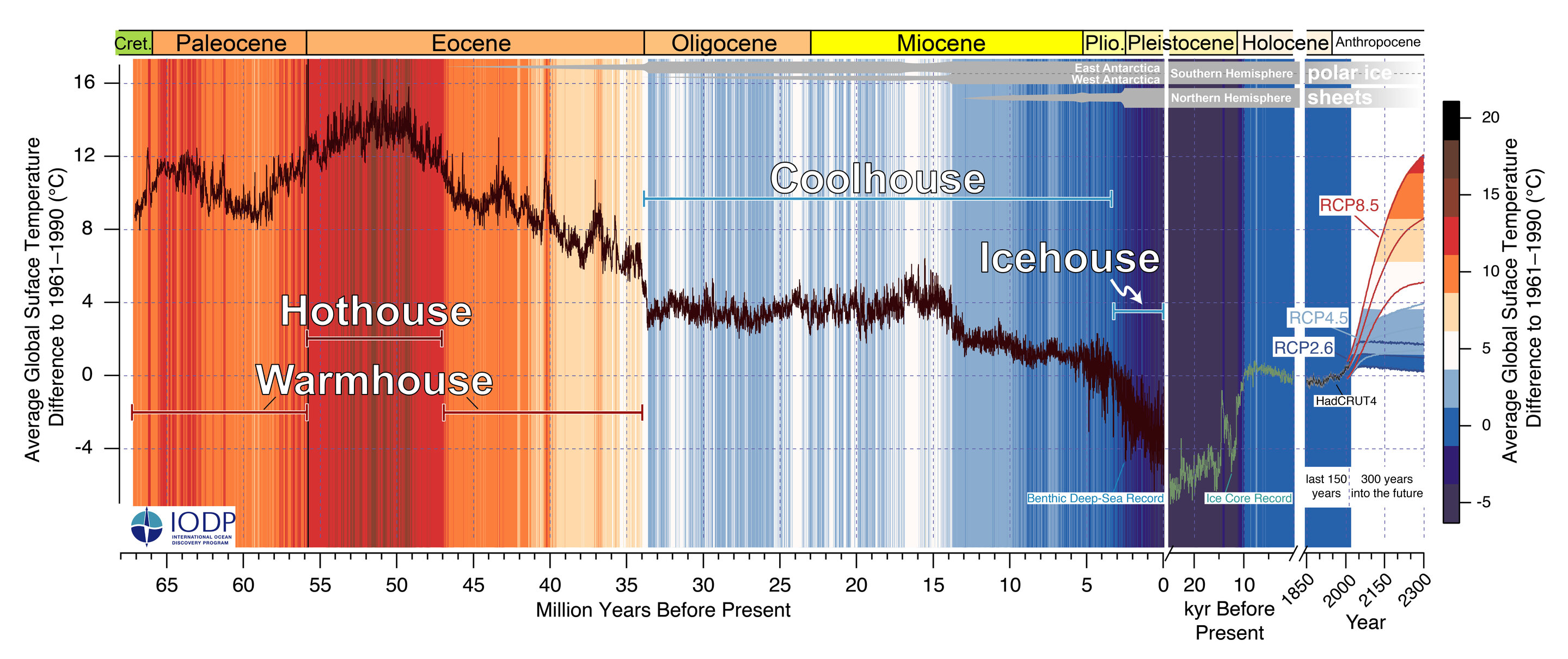
Graphical representation of global temperatures, where the relevant period for human civilisations is roughly the past 10,000 (10kyr):

<https://scx2.b-cdn.net/gfx/news/hires/2020/highfidelity.jpg>

Note too that the timescale is discontinous, with the scale expanding at 30,000 years ago and in 1850 (173 years ago). The span to the right of 1850 shows 350 years, the span to the left of 1850 shows ~30,000 years, before expanding again to show 65 million years of climate history, back to the extinction of the (non-avian) dinosaurs.

Chart is "Average Global Surface Temperature: Difference to 1961--1990 (°C)". Citation is IODP: International Ocean Discovery Program.

Appearing in context here:

"High-fidelity record of Earth's climate history puts current changes in context" by University of California - Santa Cruz. September 10, 2020.

<https://phys.org/news/2020-09-high-fidelity-earth-climate-hi...>

And yet we're all still here..
Except that all agricultural lands have increased production with increased CO2. There hasn't been any degrading of agriculture to date with the warming we've seen. And at 400ppm to 800ppm for CO2 you barely get any more greenhouse effect from this doubling, it's already nearly saturated. At most only .7C more increase which is easily manageable. Plug in 400 and 800 here, it barely changes the effect: https://climatemodels.uchicago.edu/modtran/
Yeah, but it's not just the CO2/temperatures alone.

Heatwaves, heavy rainfalls, droughts, hailstorms and other extreme weather events can devastate crops and disrupt agricultural systems.

Don't forget that overshoot is our problem, and climate change is just one of its symptoms. The loss of biodiversity, particularly pollinators like bees, can threaten crop yields. Increased pests and diseases. Soil erosion. Fires. Etc. etc.

https://skepticalscience.com/co2-plant-food-advanced.htm

A specific plant’s response to excess CO2 is sensitive to a variety of factors, including but not limited to: age, genetic variations, functional types, time of year, atmospheric composition, competing plants, disease and pest opportunities, moisture content, nutrient availability, temperature, and sunlight availability. The continued increase of CO2 will represent a powerful forcing agent for a wide variety of changes critical to the success of many plants, affecting natural ecosystems and with large implications for global food production. The global increase of CO2 is thus a grand biological experiment, with countless complications that make the net effect of this increase very difficult to predict with any appreciable level of detail.

And yet the cyclonic energy on earth seems to be slightly decreasing or in stasis over the last forty years: http://tropical.atmos.colostate.edu/Realtime/index.php?arch&...

Use the drop down and pick the last option.

Cyclonic energy may show a specific trend, but it's just one aspect of the broader climate system. While cyclones might not have intensified, the multifaceted impacts on agriculture, ecosystems, and weather patterns due to increasing CO2 are undeniable. The entire picture should be considered, not just isolated metrics.
> This isn't as simple as "We'll just start growing our food 100 kilometers to the north"

why not? doing that would ironically counter all your prior arguments. besides displacing the incumbents and needing adaptation, I do not see a reason why the poor need to be taxed 30% in energy costs in Seattle

Are people this dense?

Do you understand that last ~2C the permafrost melting accelerates climate change out of our control, and that the end result in a post-5C world is that the ozone layer goes to shit because of all that methane?

Do you understand food production shutdowns once we get beyond a certain carbon threshold?

It’s warmer now, but it won’t be very nice when you have to live in a cave because skin cancer will develop so quickly.

Source: https://en.m.wikipedia.org/wiki/Six_Degrees:_Our_Future_on_a...

Relax, it's ok and won't happen.
If you want a long answer, ask a farmer.

If you want a short answer 'Because even minor temperature variations play havoc with agricultural output. And 1.5 C isn't minor. Nor is it the limit for climate change - it's just the starting point.'

This is not a satisfying answer. Sure, temp variations affect current farms and what they currently grow, but if you assume adaptation, it’s not so straightforward.
"Adaptation" means: people moving from places that become uninhabitable (middle east, Africa, India, Latin America) to places that are inhabitable (Europe, USA, Russia, South America), while those people flee to places that become inhabitable (Alaska, Siberia). That's billions of people, trying to cross borders.

In the mean time there will be failed harvests and conflicts around the globe. Yes, we'll adapt, human kind in some form will survive, but it's pretty gloomy.

What if prevention is futile (human caused or not)? Wouldn't we be better off preparing (which seems practically possible) for the inevitable, rather than the futile exercise of burdening society with ESG, energy costs, etc
It probably is human caused and we're probably going over the falls because we're shit at long-term planning.

But prevention can still soften the blow. Just because you're about to have a hard landing doesn't mean you take your hands off the stick.

It's quite straightforward: The cost of 'adaptation' - moving global food production and populations - is astronomical; it's absurd. Just look at the impact of food logistics disruption in Ukraine.
> but if you assume adaptation

Adaptation will require moving tens and hundreds of millions of people, and we live in a world where people were screaming bloody murder over accepting 20,000 refugees that were fleeing a civil war that we have been pouring weapons and missiles into for the past 12 years.

We're not interested in adaptation.

Why? Which parts of earth need relocating?
That is the point: there are no satisfying answers and the future is increasingly uncertain and unstable.
Yeah, everything will be great, even 'Russians will spend less money on fur coats.' as that one guy said...
> those who contribute the most to global warming also believe that they will be insulated from the effects

I think they are just not facing reality, and that has been normalized by the very effective climate disinformation campaign (i.e., climate denial). People follow the herd, they do what's socially acceptable, and that campaign has made it acceptable enough (which is its goal).

The power lies in that campaign (by the same general grouping that uses disinformation for all sorts of other purposes too). That's what needs to be addressed. Fix that and we fix lots of things.

"... And now it's here." Well that's a relief. To hear some people talk, you'd think now we'd be living in devastation.
We are