Hacker News new | ask | show | jobs
by senttoschool 1003 days ago
You're kidding right?

Nvidia never went into cryptocurrency. Cryptocurrencies went into Nvidia. Nvidia actively tried to sell GPUs to gamers instead of crypto people because crypto people will flood the used GPU market when the bubble inevitably pops every single time.

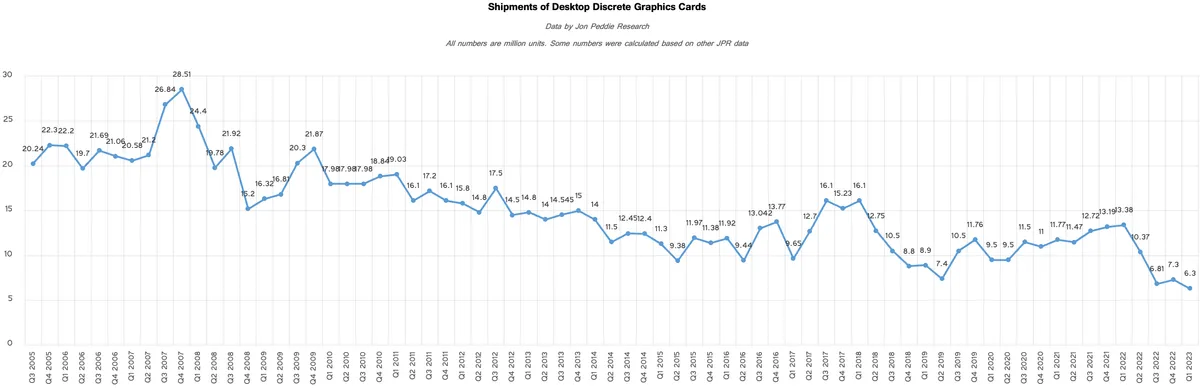
Nvidia isn't abandoning the consumer GPU market. They're still the leader by far. The consumer GPU market has actually been declining for nearly 20 years now.[0] They should not invest more into a declining market.

AI is the correct market to put their eggs in.

[0]https://cdn.mos.cms.futurecdn.net/osFsEsoUthvCrzKiF5aoLn-120...

1 comments

Nvidia sold dedicated crypto mining cards. It definitely did went into crypto.

They are charging non-competitive prices for their consumer GPU market. This is opening the door to more competition.

The desktop discrete video market is not the same thing as the consumer GPU market. You are ignoring a huge sector of integrated GPUs and mobile GPUs.

>Nvidia sold dedicated crypto mining cards. It definitely did went into crypto.

They crippled normal GPUs and sold them to miners. They did this because once the crypto bubble pops, the used GPU market won't be flooded.

>They are charging non-competitive prices for their consumer GPU market. This is opening the door to more competition.

Ok, so what? All companies do this when they're the leader.

>The desktop discrete video market is not the same thing as the consumer GPU market. You are ignoring a huge sector of integrated GPUs and mobile GPUs.

Nvidia does focus on laptop GPUs. It's much bigger than desktop discrete GPUs. Nvidia doesn't have a way to get into phone GPUs because they're tightly controlled by Apple, Qualcomm, and Mediatek. That's why they tried to buy ARM.

They usually sell crippled GPUs to the low end of the market. That's a segment of the market they no longer really serve. They also didn't do anything to hide the fact that their GPUs were really being sold to miners and not gamers, something they got fined doing.

Their leadership is going to be transitory since they are not being competitive. Intel would never had entered the discrete GPU market if nVidia keep prices low. Lack of mobile GPUs and integrated GPUs is a red flag that they're charging too much money. Discrete laptop GPUs is a niche of the market. It is not what most laptops use.

>They usually sell crippled GPUs to the low end of the market. That's a segment of the market they no longer really serve. They also didn't do anything to hide the fact that their GPUs were really being sold to miners and not gamers, something they got fined doing.

1. Low end GPUs have extremely small profit margins. It's smart business decision to not lower prices in a declining discrete GPU market. Business 101.

2. Nvidia did not sell GPUs directly to miners. They had no control/no way of verifying what the GPUs will be used for. And who cares if they sold to miners? It's just business at the end of the day - free market.

>Their leadership is going to be transitory since they are not being competitive. Intel would never had entered the discrete GPU market if nVidia keep prices low.

Their leadership is extremely competitive.

Nvidia prices GPUs at the price the market is willing to pay. It has nothing to do with "greed" that you seem to be suggesting. Business 101.

Intel needs to enter the GPU market because AI runs on GPUs as well. It's both gaming and AI. Intel needs to be in the AI market or they're toast.

>Lack of mobile GPUs and integrated GPUs is a red flag that they're charging too much money. Discrete laptop GPUs is a niche of the market. It is not what most laptops use.

No clue what you're talking about. Cite the source for lack of mobile GPUs? You mean laptop GPUs right? Nvidia doesn't make SoCs for phones or laptops.

Discrete laptop GPUs outsell discrete desktop GPUs. While it's not what most laptops use, it's still a much bigger than desktop GPUs.

1) That's the point. A cheap GPU for low-end gamers. Pursuing profits over expanding your business is a bad idea in the long-run.

2) They did, and more importantly did not try to stop it from happening. They could have banned bulk sales or whatever. Through inaction, they created huge shortages.

At the end of the day, their advantage is really via a few things: software support and somewhat more advanced technology. Few people really cares about the actual hardware behind their gaming rigs. In places like game consoles, nVidia already lost a lot of ground because they weren't willing to cut costs.

The vast majority of laptops have integrated GPUs. I don't have exact numbers for laptops, but for PCs in general, it is integrated graphics: https://www.pcgamer.com/intel-is-already-matching-amd-for-ga...