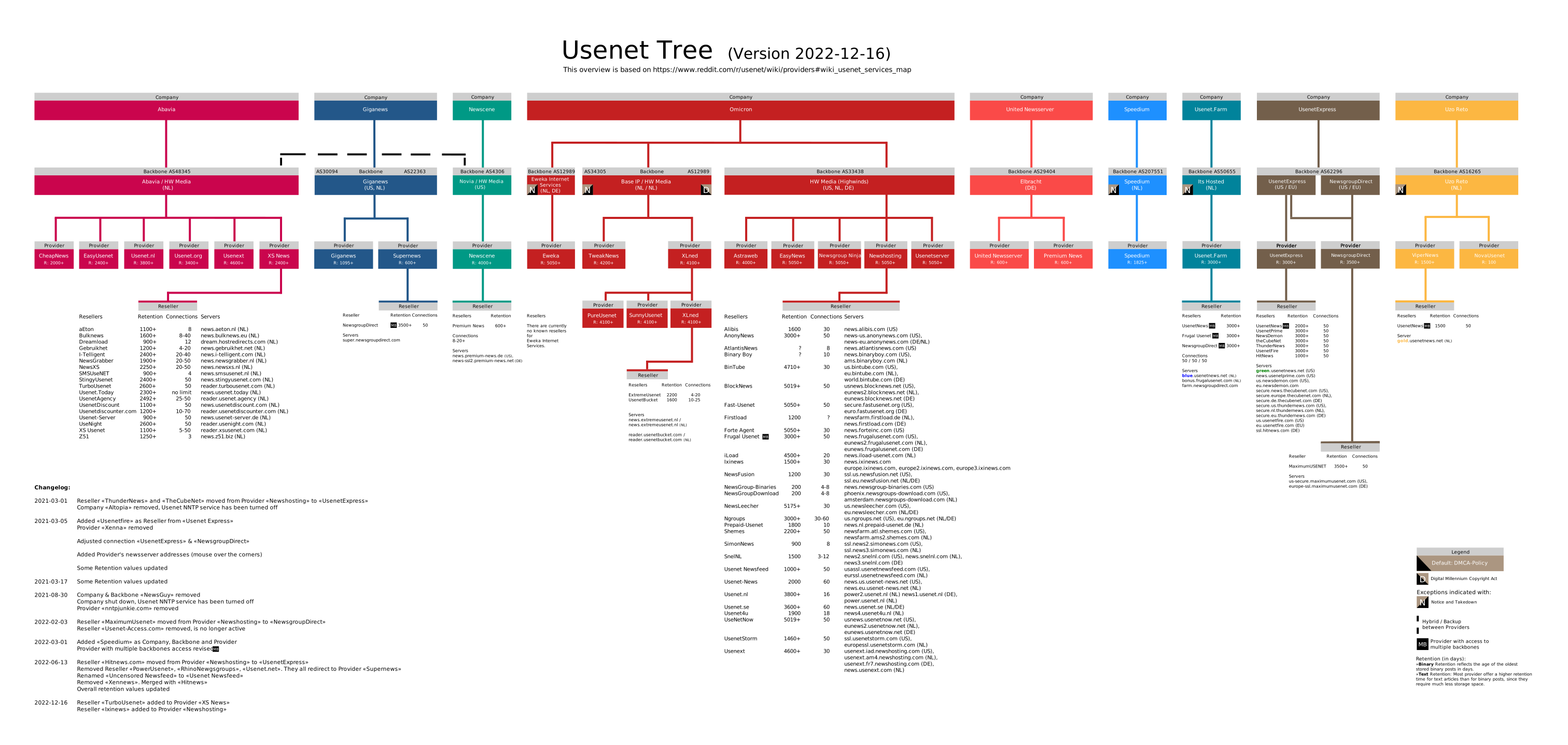
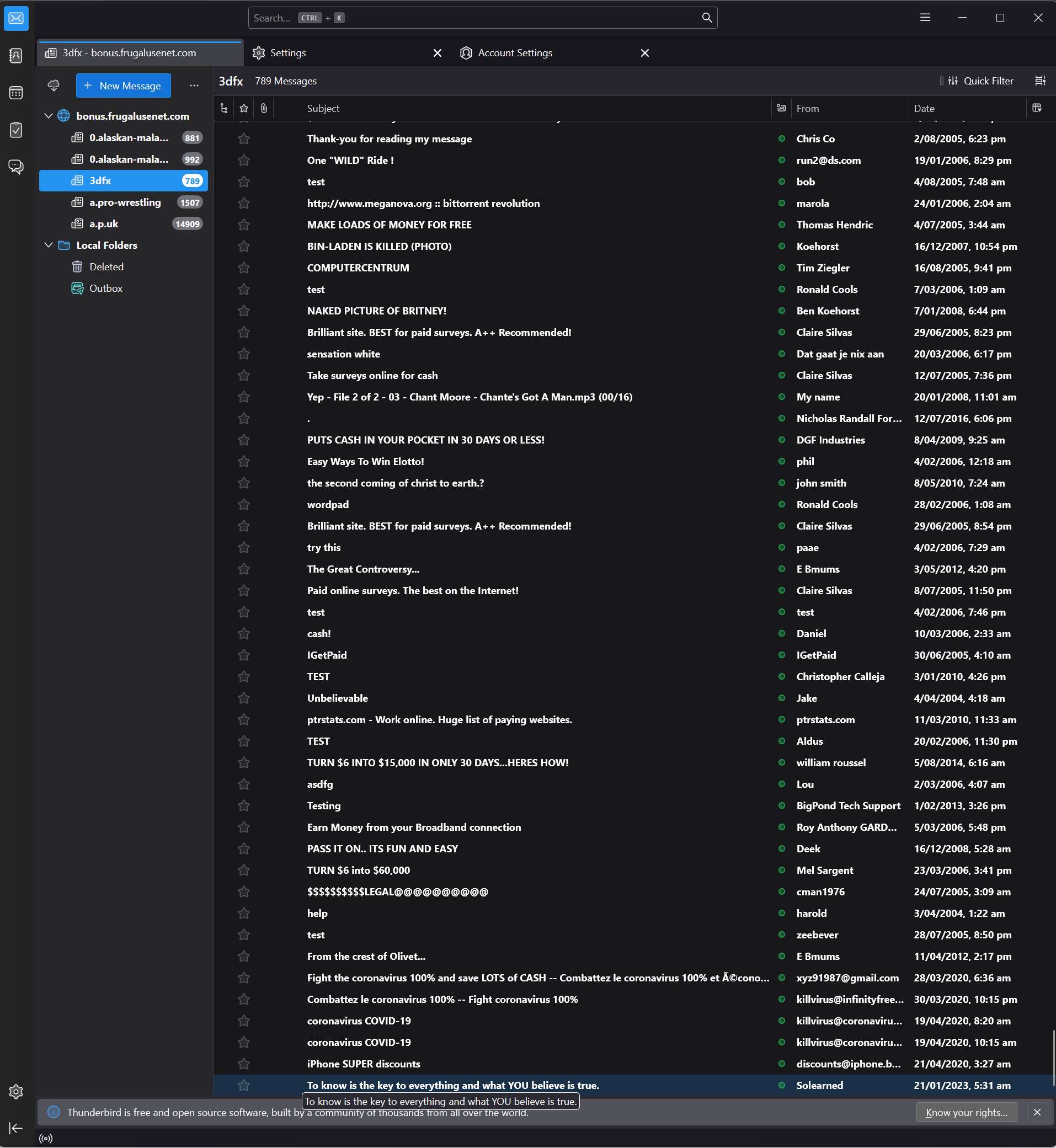
| Thank you very much for the thoughtful reply. RE the libraries, while it is true that I can't find anything made specifically for Usenet in Go, Usenet itself is just an extension of the Telnet protocol[0], and there are Telnet clients in Go[1] and Node[2]. It probably isn't simple, but I'm sure working with OrbitDB wasn't easy either! RE the resilience of content on Usenet, the vast majority of binaries are heavily encrypted, and doesn't make sense to anyone without the key, despite being conveyed en-masse between the world's 10-ish full-scale Usenet backbones [3]. I'm proposing that the backend of a service that makes use of Usenet could be similar, with a single 'background server' on one trusted machine enough to continuously push the history to Usenet. A regular user client could then search for the latest version of this history and quickly refresh their side from Usenet, regardless of the status of IPFS at the time. RE democratic access to technology, at least with Superhighway84 it was very expensive for me to actually run the software, as I have a small allocation of bandwidth from my ISP and not much I can do about that in my area, and I ultimately had to delete it due to ongoing transfers of 3GB/day running the IPFS node. Quiet itself notes a limit of 30-100 individuals with its application - I'm proposing that using the one remaining federated multicast technology with some modern encryption might help with issues around blasting data everywhere from a bandwidth-constrained environment. I know that definitely in Africa, there are ongoing issues with bandwidth and networks that we forget about in the West. Usenet, with extremely lean network overheads, could be part of the answer. I do agree with your vision of a future of truly peer-to-peer technologies, but for those of us who are bandwidth-constrained or otherwise limited in our access to those technologies, having a technology-agnostic application that just 'does magic' to do whatever it needs to do with your content is what's going to make a majority of users happy. [0] https://www.itprotoday.com/windows-78/how-can-i-use-telnet-a...
[1] https://github.com/reiver/go-telnet
[2] https://www.npmjs.com/package/telnet-client
[3] https://svgshare.com/i/oti.svg |
> Superhighway84 it was very expensive for me to actually run the software
I agree with you, in terms of efficiency IPFS is still miles away from where it should be. Hence my feedback on Quiet, as I do not perceive IPFS to radically improve within the next few months or even years. And as you correctly stated it looks like Quiet uses some workarounds to improve on the overall mediocre efficiency of IPFS, which however lead to shortcomings on other ends:
> Quiet itself notes a limit of 30-100 individuals with its application
However, this is not how P2P should be. I'd be truly curious to hear from someone at OpenSea, or Fleek, or any of the services that offer high volume IPFS hosting about their experience and gut feeling on its future. I personally gave up on hosting my website via IPFS myself -- which I did for a brief period of time -- mainly for these exact reasons.
> but for those of us who are bandwidth-constrained or otherwise limited in our access to those technologies
I believe that quite on the contrary, this might benefit these people the most. Imagine not having to do the roundtrip from your phone, to a server on the internet, back to your computer, just to have a synchronized state of your address book available.
Similarly, imagine writing with someone in your city -- let's say Melbourne, Australia -- without your messages first travelling to Utah, USA, and then back again. My gut feeling is that overall congestion on the internet could even be reduced, by allowing more applications to communicate directly within small meshes rather than travel all the way across the globe and back again. That is, as soon as there are more efficient ways to deal with the overhead that is currently breaking IPFS' neck.