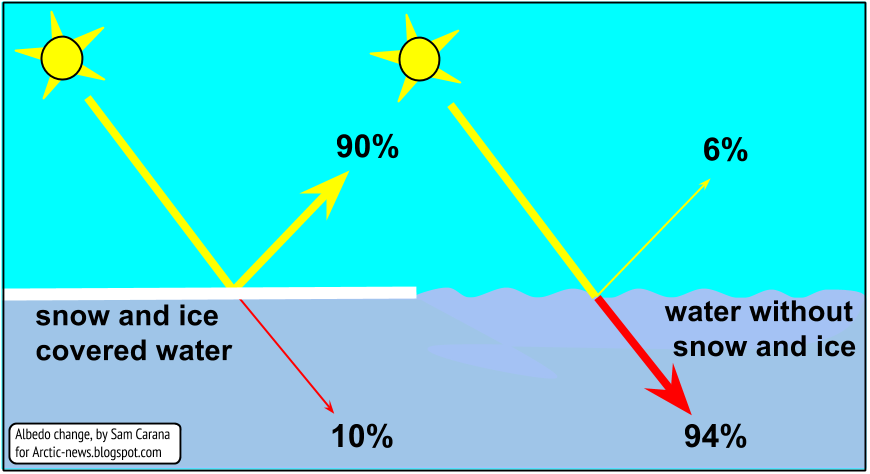
| Unless I'm mistaken, it has a lot to do with the albedo that in this case when the surface material's properties turns from reflection (glacier) to absorption (rock material). Wikipedia: https://en.wikipedia.org/wiki/Albedo So, fresh snow might have an albedo of up to at around 0.8 or more, where as darker surfaces like asphalt are at around 0.04 to 0.12, so, the less albedo, the more it'll absorb instead of reflect (esp. back out into space). The thing is that darker type rock materials also work as sort of heat capacitors in the sunlight, so basically, instead of reflecting that heat energy back into space, it'll stay around and warm up things. Not sure if this constitutes as an example of a climate feedback loop (or an accelerant to one), but at least the albedo loss is one of the main concerns among climate scientist when they talk about i.e. (northern) polar ice cap melt -- instead of reflecting the heat back into space via snow and ice sheets, the heat energy gets absorbed by the sea, and that causes all sort of additional wacky stuff. Arctic News often talks about it and even have this illustration on what happens if i.e. ocean ice is gone: https://3.bp.blogspot.com/-AHyeWIcSSVw/U70d6UBytbI/AAAAAAAAN... (although 0.9 albedo in that one is like at the higher end of expectancy for a fresh snow pack/ice sheet covered with white snow, the albedo drops rapidly with subsequent surface melt etc.) |