Hacker News new | ask | show | jobs
by aziaziazi 1026 days ago
> forward region, parallel to the beam line

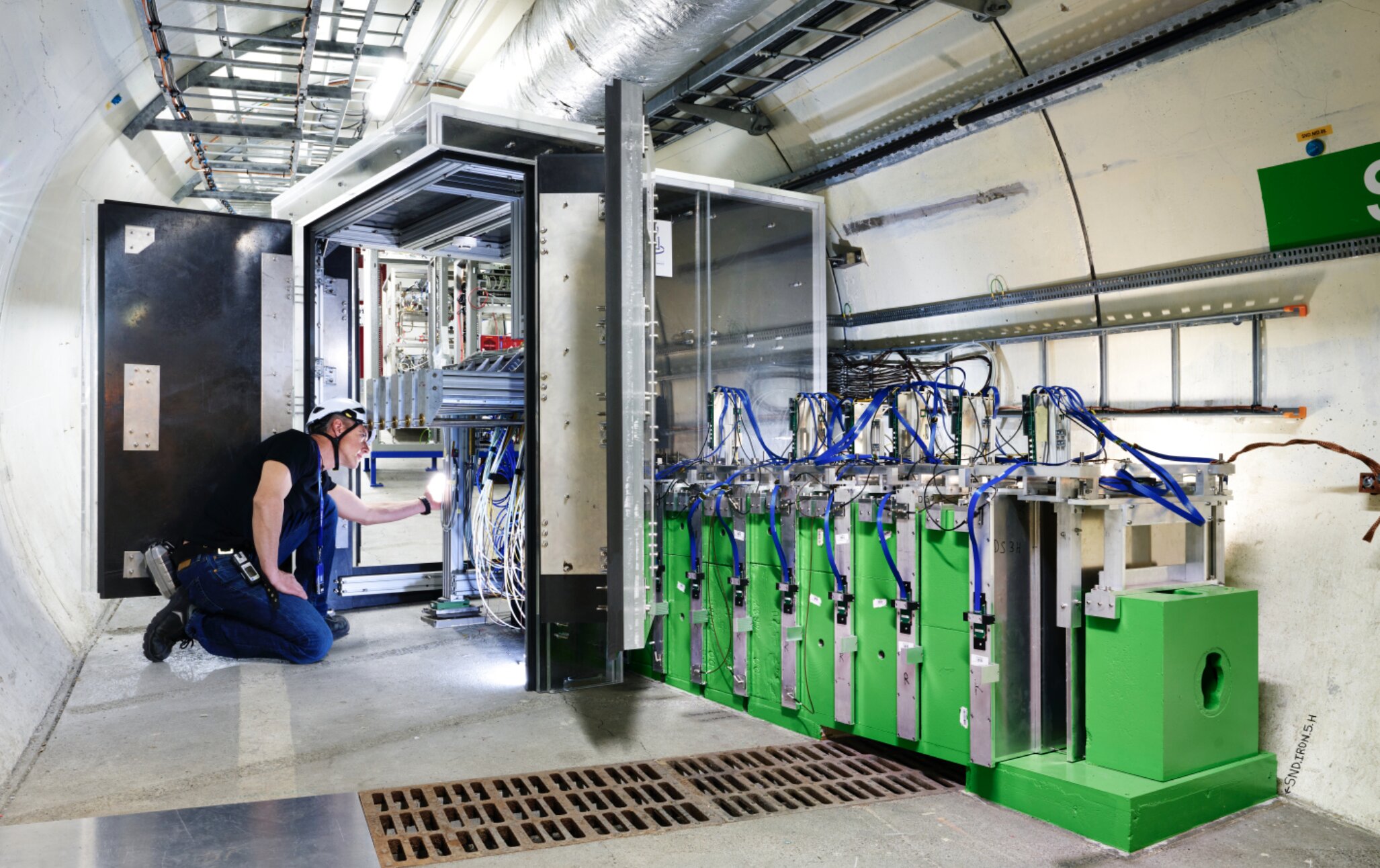
What collides here exactly? I always thought collider do throw a particule A in the direction of particule B while B travels in the direction of A, with measure instruments all around but not blocking one of the particule path. The photographie 0 make me wonder if they also crash particules directly into their instruments?

0 https://scx2.b-cdn.net/gfx/news/hires/2023/the-first-observa...

2 comments

Well, you sort of have to have the particle collide with something in order to detect it. When a photon collides with your retina, you see a flash of light (it causes a protein to twist, which generates an electrical signal, which is sent to your brain). The problem is the neutrinos tend to pass right through without getting absorbed by anything. No absorption, no change, no detection.

So the neutrino has to collide with something to get detected. Given that previous neutrino detections require a large vat of heavy water underground, while the current results are from a little box, the salient question is what did they do differently (and is it applicable elsewhere). The article completely ignores this.

The experiment is described in this[1] article. Relevant quote:

The detector is positioned on the beam collision axis line-of-sight (LOS) 480 m from the ATLAS collision point (interaction point 1, IP1) in an unused service tunnel, TI12. [...] A huge number of neutrinos are produced in LHC collisions via hadron decays, and their flux is collimated along the beam collision axis.

So what they did differently is to place the detector in a spot which has much higher neutrino flux than your average spot on earth. Thus the small detector volume is compensated for by having more neutrinos pass through it in a given time.

[1]: https://arxiv.org/abs/2207.11427

Neutrinos pass through the entire planet from space, so hopefully they will be able to see the background neutrinos as well as the neutrinos from their collisions.

If this was a brimstone and fire depiction for those with a religion vent, neutrinos would be likened to ash, the other particles would be various sizes of burning embers, some large but glowing gently (beta), others small and burning brightly (alpha).

Its all contained in a giant underground magnetic donut that would have Homer Simpson salivating which accelerates the particles, like a rail gun or steam catapult on an navy aircraft carrier or a catapult launcher for roller coasters, and it keeps accelerating these particles, like a child with ADHD on sodium benzoate can accelerate a fidget spinner, until the particles collide, like the crescendo of a fantastic firework display at a country's official New Years eve display watched through computer screens that's somewhat reminiscent of the 1979 Atari Inc Asteroids computer game when an asteroid explodes.

The electrical demand for the magnets is great but short term like the Death Star blowing up Alderaan, so whilst its CO2 footprint could be likened to a large Cruise Liner over the year, it generates this footprint over extremely small periods of time when running these experiments like something out of Weird Science when Kelly LeBrock comes to life!

So the electrical infrastructure is highly capable.

The electrical companies need advance knowledge to make sure they have ordered in enough coal and gas, and topped up the hydroelectric dams, when they run their experiments, otherwise the neighbourhood experiences something of blackout like in the movie Batteries Not Included.

https://en.wikipedia.org/wiki/Neutrino

SuperK (not the raving form of Ketamine being consumed down the Dog and Duck pub on weekdays) https://en.wikipedia.org/wiki/Super-Kamiokande#Description