Hacker News new | ask | show | jobs
by scotchmi_st 1037 days ago
The universe isn’t thought to be infinite in that sense- it’s finite but unbounded. There is a finite amount of space that did, we think, originate from an infinitesimal point.

Imagine getting in a spaceship and setting off in a direction, close to the speed of light- if you travelled for long enough you’d arrive back where you started. Like someone walking on the surface of the earth.

Any current cosmologists can correct me, but I believe the consensus is that the shape of the universe is a hyper-spheroid, I.e a 4D sphere.

3 comments

This is a very compelling theory - but it has no evidence for it. Searches for "repeats" in the CMB (where light traveled all the way around and repeated) have not found anything.
As cool as that would be, most experiments still believe the curvature of space to be flat, which means if you travel endlessly in one direction relative to a starting point, you will never return to that starting point.

https://en.m.wikipedia.org/wiki/Shape_of_the_universe

Not returning to your start means not connected, rather than not flat. Pac Man and Asteroids are flat but connected, a helix is curved everywhere but not connected.
That's true but when talking about space being flat vs having a curve, 2D and 3D visualizations are just to help explain the concept.

All current evidence points to the shape of space and the universe being relatively "boring" in that it behaves roughly like people would expect unless in the presence of a strong gravitational field.

From your own link:

> Although it is usually assumed in the literature that a flat or negatively curved universe is infinite, this need not be the case if the topology is not the trivial one. For example, a multiply connected space may be flat and finite, as illustrated by the three-torus.

Exactly. Which leads straight to the contradiction when saying that the universe was only 10cm in diameter at a certain early time. If there’s no end, how does it have a diameter?
The portion of the universe we can observe was 10cm in diameter. If there's more it's outside our light cone and we can never reach it or be affected by it, so it may as well not exist. The observable universe seems to be fininte, but seems to act like a finite portion of an infinite universe.
The apple explanation is wrong and needs to be qualified with "observable". Your understanding is correct.
Is there an experiment which leads us to believe that the universe wraps around? I’d be very interested in any details supporting this idea.
If there were certain patterns in two different (opposite?) parts of the CMB, that would suggest it wraps. None have been found, so if it does wrap it's bigger than that.
I mean, there’s plenty of evidence for the Big Bang, and if that’s the case then the most likely shape that falls out of the maths is a hypersphere, like inflating a balloon as others have said.
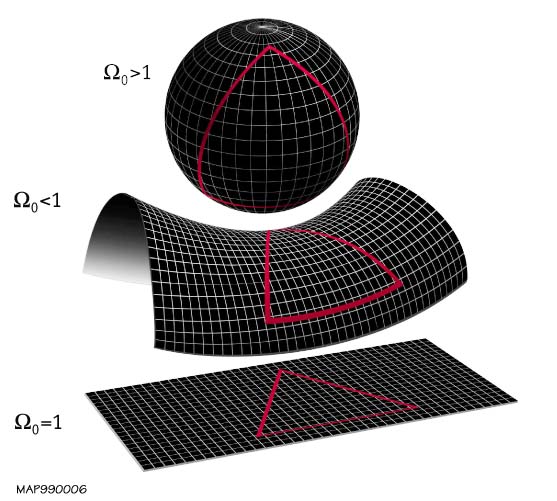
No, the big bang model allows for three topologies: flat, spherical or hyperbolical.

A picture like this is in every cosmology textbook: https://upload.wikimedia.org/wikipedia/commons/9/98/End_of_u...

Which one it is depends on the density. There is a critical density at which the universe is flat, and our current best measurements basically allow for all three possibilities. It's just hard to say if something is flat or actually spherical but really, really huge.