|
|
|
|
|
|
by asoneth
1045 days ago
|
|
|
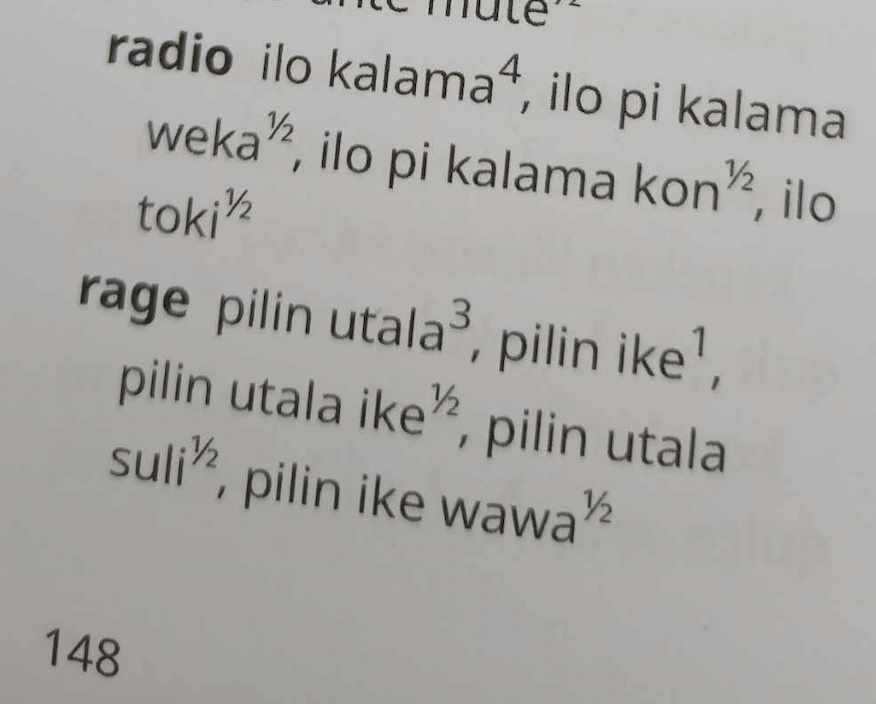
> aren’t you effectively expanding the size of the language, even if this is “implicit”? Yes, this is how Toki Pona dictionaries work. For example, there is a surprisingly thick two-way English - Toki Pona dictionary, "ku", which includes more than 11k entries such as "tomo tawa" for "car" or "ilo kalama" for a radio. See https://m.media-amazon.com/images/I/51n8JCdFlQL.jpg or other images from https://www.amazon.com/dp/0978292367/ Note that as it is descriptive rather than proscriptive, each translation has a superscript indicating what fraction of English-speaking Toki Pona speakers used that particular translation when the book was written. I don't have my copy on hand but I recall that there was a community survey and Sonia Lang used some kind of scale such as 4 for a universally accepted meaning down to 1 or 1/2 as a highly idiosyncratic/fanciful translation only used by a small number of people. I suspect if the language evolves some people may compress these further so that "tomo tawa" becomes "tomo-tawa" becomes "tomotawa" which may help with parsing written text. Perhaps fluent speakers do not have this problem, but I typically have to read a sentence more than once to parse it correctly. |
|
|