|
|
|
|
|
|
by PaulHoule
1045 days ago
|
|
|
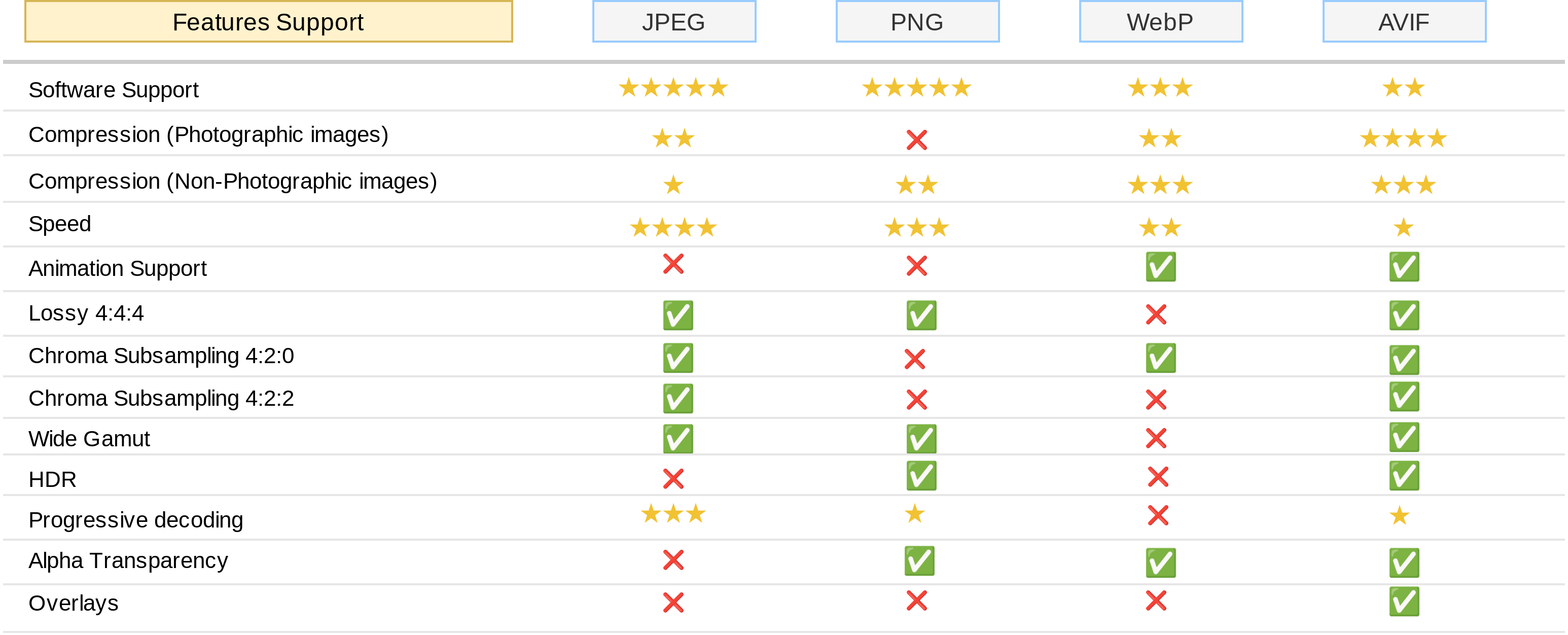
I switched to WebP about a year and a half ago. I’d been watching for a long time and it had finally reached the point where support was universal enough that I could not publish a JPEG. WebP has the big advantage that the quality setting is meaningful, you can set it at a certain level and then encode thousands of images and know the quality is about the same. This is by no means true about JPEG, if you are trying to balance quality and size you find you have to manually set the compression level on each image. Years back I was concerned about the size of a large JPEG collection and recompressed them which was a big mistake because many of the images were compressed too hard. In 2023 I think you can just use WebP and it will work well, my experience looking at images is that AVIF does better for moderate to low quality images but for high quality images it doesn’t really beat WebP. |
|
|
Distortion metrics[0] such as MS-SSIM, MS-SSIM*, SIMM, MSE, and PSNR can be used to define a cut-off or threshold for deciding the point at which the image is "compressed enough" by using one or more of those algorithms and predefining the amount of acceptable/tolerable distortion or quality loss. Each of those algorithms has some trade-offs in terms of accuracy and processing time, but it can definitely work for a large set if you find the right settings for your use-case. It is certainly more productive than manually settings the Q-level per image.
Some SaaS such as https://kraken.io do this on JPG images.
[0] https://sourceforge.net/projects/iqa/