Hacker News new | ask | show | jobs
by brigadier132 1056 days ago
> This was before doctors became incurably greedy

Doctors are not the reason healthcare is expensive.

3 comments

Any chance the US has of achieving the cost savings of other industrialized nations depends crucially on doctors making a lot less.

https://www.beckersasc.com/benchmarking/how-physician-pay-in...

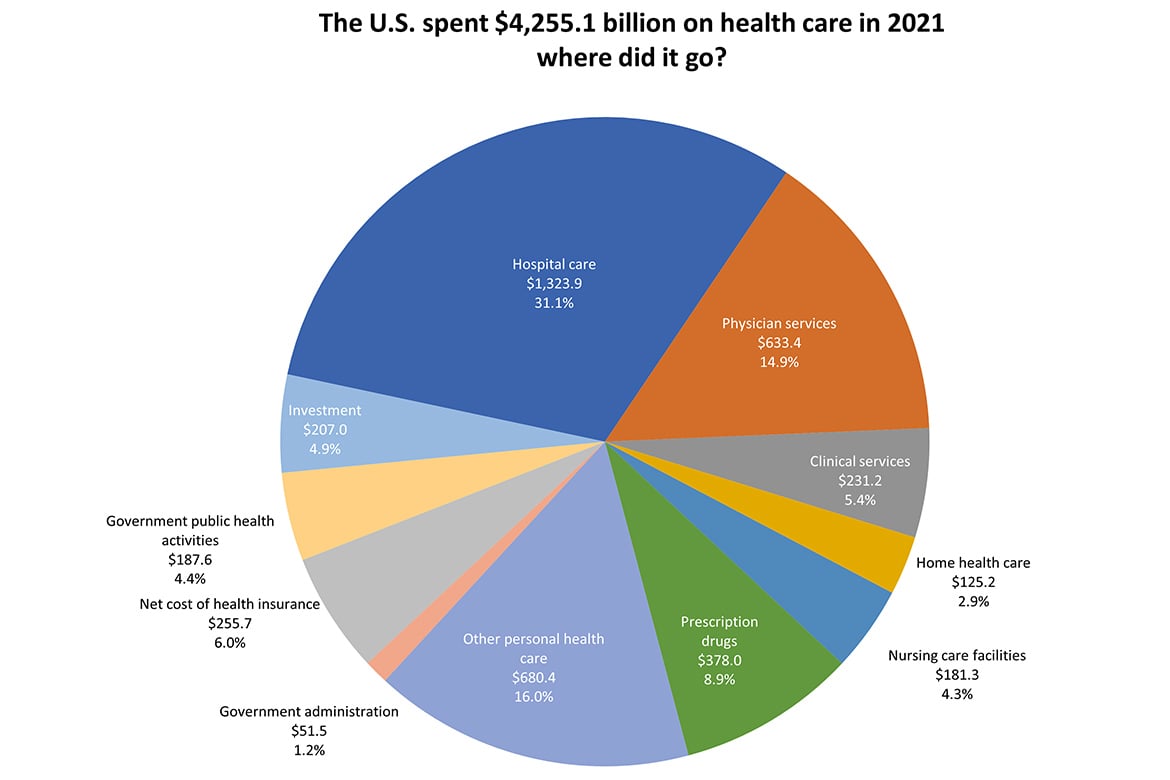
IIRC about 40 percent of all medical expenses are administrative costs and about 20 percent is drug costs. Improving those could drop healthcare costs by nearly half, without lowering healthcare salaries.

To lower medical salaries, we need to address (a) the AMA acting as a cartel, (b) residency slots being paid for by Medicare and being limited, and (c) crippling student debt problems. As an example, nurse practitioner salaries have dropped as supply has increased.

> Improving those could drop healthcare costs by nearly half

Wouldn't you have to decrease spending on admin and drugs up to 10x which would likely bring US well below the costs in most/all other rich c

I'm not sure how feasible it would be to reduce admin and drug costs by almost 10x?

Edit: to be fair 10x might not that far-fetched as I might have thought, admin costs are massively higher than anywhere else:

https://www.statista.com/statistics/1264127/per-capita-healt...

I'd assume the way they measure it might differ significantly between some countries. Also ~1000 is just 10% of per capita spending in the US.

If we look at drugs:

https://www.statista.com/statistics/266141/pharmaceutical-sp...

The gap is quite a bit smaller. Also in total drugs+admin seem to be about 25% or so?

Total per capita healthcare spend in the US is something like $13k, so yeah, much closer to 25% than 60%.

Also, you have to be careful about how you account for “administrative costs”. Medicare has low “administrative costs” but correspondingly high rates of fraud vs. a typical private insurer who has the incentive to spend more looking for it—administrative costs.

Huh, the numbers I’ve seen are much higher than that. 18% for prescription drugs [1], ~6% for retail drugs [1], and 34% for admin costs depending on how it’s accounted for [2]. A lot of places don’t seem to account for insurance related costs (billing/coding/etc.) in administrative costs, which may be the source of the difference.

[1] https://aspe.hhs.gov/sites/default/files/documents/88c547c97...

[2] https://time.com/5759972/health-care-administrative-costs/?a...

Well, the AMA does constrain the number of doctors in the US so that supply and demand part is on them.
Talk to any doctor about the priorities of the MBA-holding decision-makers at their hospitals.
When each one accuses someone else of gouging us, assume that they're all gouging us.
Doctors are paid the same as software engineers for a job that is like 10x as hard.

MBA hospital administrators have greed as their official main job responsibility.

Research shows that nurses have outcomes comparable to do those of doctors. It's not 10x as hard as SWE, don't buy into that. Plus, thats irrelevant, doctors supply is limited artificially and for no good reasons. The main culprit of high costs are is the insurance companies greed, but doctors are far from being blameless.
On average they seem seem to be paid quite a bit more (at least by 2x?).
> Doctors are paid the same as software engineers

The average physician salary in 2023 is $352K. I wouldn't say that.

Are salaries the only source of income that they derive from the medical industry? My doctor is a part owner of his provider network which also is the insurer.
Go and talk to a doctor about the upcoming reimbursement cuts by Medicare - 3.36% this upcoming fiscal year.

Then compare how much Medicare compensates doctors compared to compensation in other countries.

Doctors don't work for hospitals.
Quite many countries limit the supply of doctors with less expensive health schemes.
In the UK the government both limits the supply of doctors and manages a fairly cheap National Health Service. How? It is rationed by queuing and achieves poor medical outcomes.
I don't think any country has a healthcare system privatized to a higher degree than Switzerland? Yet they still manage to spend quite a bit less per capita than the US.
That doesn't prove your point.