We have also pumped a very large amount of long-lived fluorine compounds into the air, that will last for centuries. They have from 2500x to 25000x times the "greenhouse gas warming potential", kg for kg. They are mostly refrigerants (CFCs, HFCs, and soon their successors) and transformer insulation gas (SF6). Volcanoes do emit some amount of fluorine compounds, too.
We also have a great deal of methane leakage, which is usually cited as 25-100x, and we may soon have a lot of hydrogen leakage, at >100x. Rocket launches are installing water vapor, another one, into the stratosphere like never before.
So even if we got CO2 down to a pre-industrial level, we would still have heat forcing from the fluorine- and other compounds.
Capturing CO2 is kind of pointless until we get emissions under control. I.e., a dollar spent preventing emissions buys much more than a dollar spent capturing. Solar panels and wind turbines directly displace mass emitters of CO2.
I don't know about all compounds but CFCs stay in atmosphere for about a century only and we've already banned them, and methane has a very short lifetime of about 12 years. So we 'only' need to control emissions of those to solve the problem.
On the other hand, as said, CO2 stays for centuries if not 1,000+ years so at this point net zero is only half the job though probably the hardest part.
Yes and: I understand that we want to prevent the non-human emissions from becoming a positive feedback loop. Meaning that at some tipping point, the thawing tundra, burning forests, and acidic oceans will continue to get worse, even if/when human emissions completely stop.
Pre-industrial CO2 concentration is synonymous with the "natural concentration", at least in the recent past. We made a very large change that has thrown Earth's systems out of equilibrium. Returning to pre-industrial CO2 levels would undo that change and bring things back towards equilibrium.
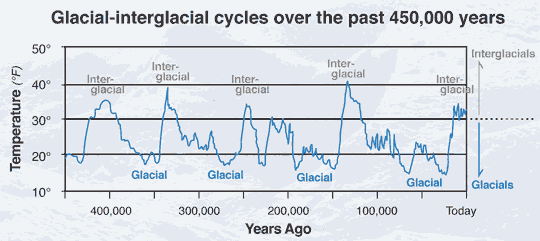
“Natural concentration” is not the right way to look at it because there are higher concentrations that predate the industrial revolution and humans. The all time high (that we know of) is from about 350,000 years ago. This was by all means natural and pre industrial revolution.
"The only known natural concentration empirically compatible with long-term human civilisation".
"The planet did exist/will exist just fine without us" is a pretty worn truism. You might as well wryly note that water isn't natural because everything was hydrogen once.
> empirically compatible with long-term human civilisation
Empirically observed, atmospheric CO2 went from ~320ppm to ~410ppm from 1970 to 2020[0], during which period the human population more than doubled from ~3.7B to ~7.8B and yet deaths caused by climate dropped threefold[1] (not 1/3 the rate; 1/3 in absolute number).
On the scale of human civilisation, 50 years is hardly "long term".
Polonium by that ultra-short-relative-term reckoning is not only harmless as it you still feel fine 10 minutes later, but actually healthsome as you rather feel refreshed by the delicious green tea you just drank in that 5-star hotel bar.
They are dynamical systems, there is no equilibrium. See also: climate charts for the last few ice age cycles.[1] In the bigger picture we want to modify Earth's climate and definitely do not want to end the current interglacial period, to be fair we've already done that, but returning to a "natural" pre-human climate cycle on the 10,000 year scale is not desirable.
Dynamical systems can have equilibrium points —- e.g. an inverted pendulum is stable when hanging straight down. If you deviate too far from an equilibrium point, the system may find another equilibrium that is less desirable for the user. I’m not an expert in climate change, but those things certainly happen for engines, robots, and other systems.
I like to think of it as scrappy terraforming because we aren't even sure we could handle any of the naturally occurring variation.
Scrappy because, well the planet doesn't quite become uninhabitable and we're starting from the end-game. Science fiction also had me expecting some very cool terraforming infrastructure, not psy-ops to get the serfs to eat bugs.
The point is that net zero is most likely not going to stop warming with 400+ppm CO2 in the atmosphere. CO2 concentration most likely has to drop but naturally it does so very slowly. Arguably at this point we already need cooling because 40+C every summer in half of Europe (for instance) is getting annoying...
Yeah it would be pretty silly for humanity to invest so much time and effort into lowering CO2 levels only for a Yellowstone or equivalent to erupt and send temperatures plummeting into a new ice age levels. When if humanity did nothing the eruption would only have taken us back to pre-industrial age temperatures.
That is the point where we started adding greenhouse gases that lock in energy from the sun, we need to at least get back to those levels to start releasing some of the heat. Otherwise we're containing to add insulation to an oven that already overheating - you'd ideally want to take off all the insulation and the metal casing since you can't turn off the heat, but the casing isn't an option so we need to remove the insulation and hope it hasn't gotten too bad yet
We also have a great deal of methane leakage, which is usually cited as 25-100x, and we may soon have a lot of hydrogen leakage, at >100x. Rocket launches are installing water vapor, another one, into the stratosphere like never before.
So even if we got CO2 down to a pre-industrial level, we would still have heat forcing from the fluorine- and other compounds.
Capturing CO2 is kind of pointless until we get emissions under control. I.e., a dollar spent preventing emissions buys much more than a dollar spent capturing. Solar panels and wind turbines directly displace mass emitters of CO2.