Hacker News new | ask | show | jobs
by blasterford 5212 days ago
Manufacturing actually died in the UK because of the unions. Workers became greedy, and unproductive. They were unable to compete with other countries, and instead staged big endless strikes demanding ever rising salaries, better working conditions etc - which made them even more uncompetitive with emerging countries.

You can either have great working conditions and pay, or a good manufacturing industry. Can't have both. Some other poorer country will just treat their workers worse, and so be more productive.

(I'm reading "Thatcher - the downing street years" at the moment - a great read).

6 comments

"You can either have great working conditions and pay, or a good manufacturing industry."

Someone needs to explain this to the Germans then.

The German pay for factory workers isn't so great, by the way. Income structure is more flat in Scandinavia, for instance; compared to Sweden and Finland, Germany has cheap factory labor cost.

However, the main problem with British industries and collapse of some of them in 1970's was unionisation and political fighting. This included even outright sabotage, and of course abysmal build quality. My uncle had a Morris Marina, my father a Sunbeam Avenger. Never again a British car. British workers are OK as long as their overlords are Japanese or German.

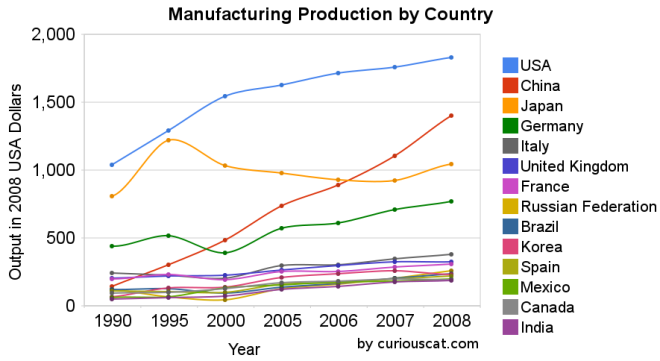
UK manufacturing value as such is not so bad, after all. The curve looks very much like any other Western country. See http://management.curiouscatblog.net/images/curiouscat_top_m...

The only major country that took a significant dip recently is Japan.

Compared to Sweden and Finland, EVERYWHERE is cheap!
This is a valid point but at the same time - can every country make a lot of money selling extremely high end luxury goods? It seems to me (but I'm very open to information that would change this view) that Germany occupies a rather special position that doesn't scale out world-wide.
> can every country make a lot of money selling extremely high end luxury goods?

It seems to be working well for Apple...

In any case, the biggest car company in Germany is VW, and I wouldn't consider them a "luxury" car manufacturer. And most of the Mittelstand in Germany are companies that are not household names, but are very successful in their particular industrial niches.

Is there such a thing as a "position" that scales out world-wide?

Just as every individual is unique in its skills, experience, available resources and location, so is each country. Surely China's cheap workforce cannot be replicated in Europe or the U.S. and China's biggest problem will be their own middle-class which gets richer, so you can clearly see that a cheap workforce is not sustainable in a growing economy.

Can the world replicate Silicon Valley or Hollywood? Maybe, maybe not, but surely a lot of effort is required and there are also cultural issues that makes this hard. Failure is accepted as a sign of progress in Silicon Valley, but in Japan it's unacceptable.

The way to grow is to rely on your core strengths and make your weaknesses obsolete. So for example if companies move to China for cheap labor, then pay engineers to build better robots, a strategy which in the long run can yield better and more efficient factories.

I personally don't associated Germany with luxury goods (not in the same way as Italy or Switzerland) but I do associated it with very high quality engineering.
Koreans as well
The manufacturing problem in any first world country has the same problem, if anything USA has been the last to have the problem because they kept cheap workers cheaper for longer.

Look at Germany, they have both but that's partly the vertical companies being ethical and patriotic.

In the case of Germany, they did the smart thing of promoting their products as "High Quality". Even today, German manufactured goods command a premium in the market (automobiles, power-tools etc). The British had an excellent legacy of quality engineering, I guess they have squandered it. (Although not related to manufacturing, I am reminded of a quote about British Civil Engineering I had read that said that "Americans build for 50-100 years, but the British build forever". This is quite true in India; a lot of the infrastructure laid down by the British is still in use)

EDIT: In responses asking for examples, see http://en.wikipedia.org/wiki/History_of_Mumbai#City_developm... . The British were responsible for merging the many Islands of Mumbai to get what it is today. Also, the pipelines supplying fresh water to Mumbai were built by the British and are being augmented only in the last decade or so.

> This is quite true in India; a lot of the infrastructure laid down by the British is still in use

I think that says more about India than it does about British engineering.

I think you'd have to demonstrate commensurate projects taking place after the Brits have left to make your point

(fyi I'm neither :)

Indian railways is one of the third largest employers in the world (the Chinese Army and the UK National Health Service are the other two) and yet they are well known for being bloody awful.

EDIT: Forgot to add:

The engineering might be good, but the middle management was often really poor and the build quality of mass-produced items was usually sub-optimal.

Combined with post-war poverty here and post-war subsidies there (Japan) the UK had a weird combination of factors.

This is quite true in India; a lot of the infrastructure laid down by the British is still in use

How much of the continued re-use is due to it being so superior, or the government being so cash poor that they can't pay for any replacements?

They can pay for nuclear weapons, aircraft carriers and a space programme; India is not a poor country.
There are loads of countries that squander money on military and things like that, while people starve, or the infastructure falls apart.
Possibly the Indian government doesn't consider railways to be as sexy as those things.
Why does the UK give India £295m a year in aid?

http://www.bbc.co.uk/news/magazine-12607537

I like the way you state this as incontrovertible proof + openly admit you are reading an overtly right-wing book. I wonder whether this is a troll...

All I shall say is a. I think you'll find it's more complicated than that, and b. look at the data.

"openly admit you are reading an overtly right-wing book."

It's called an autobiography.

I've heard the left wing excuses and arguments and find them thoroughly unconvincing.

> b. look at the data.

I have.

I have a policy of not arguing online any more as it tends to lead nowhere, so this will be my last response on this (I don't mean to be patronising here, just stating my position).

It's a autobiography by a right-wing leader, so if you talk about subject X then reference said book, it's likely that opinion will be right-wing, which was my point.

Anyway, I didn't mean any offence, and I don't want to get embroiled in a political argument, rather wanted to highlight that.

I agree @ arguing online.

For what it's worth, the book isn't really filled with opinions, more than it's filled with facts from the time.

eg "We were spending X on British Steel, and the Unions wanted us to spend Y, wanted pay raises of Z, despite falling productivity" etc.

It was a mistake for me to include the book I was currently reading as it instantly isolates half the political spectrum unfortunately.

UK Manufacturing died because of the decision by the Thatcher government to privatize previously nationalized industries and abandoning the policy of full employment, happily accepting 2-3 million unemployed if it meant cheaper goods and services in the short term.

The unions certainly didn't help their cause, but it took two to tango to create the mess that is the UK economy.

Read the book (Or some other facts from the time).

She had to privatise industries because they became ridiculously uncompetitive and expensive to run.

During the previous socialist government the number of public sector workers increased drastically.

British steel was haemorrhaging money. And the unions response? Demand pay increases and strike. Same with the coal industry.

Would you rather she kept us paying billions in ever increasing public sector wage demands?

"Full employment" should not be a policy. You don't spend public money employing unproductive workers in useless public sector jobs just for the hell of it.

Full employment is something that happens naturally when individuals take responsibility for themselves.

The UK economy is a mess because of drastic overspending by socialist governments. Something we're having to put right (again). Shame the lessons of the 70s/80s weren't learnt.

FYI I actually lived through the Thatcher years so witnessed first hand the effects of her policies. I lived in one of the communities that she destroyed through her policies of privatization (enriching her supporters in the process) leaving thousands of workers with no future employment prospects and very little hope as the private sector having made its money promptly left town and did not deliver any of the promised new jobs.

(I agree that the actions of the unions in 70s are also to the blame, but a better approach would have been to engage the unions and slowly transition to better balance of public and private sector industries rather than the union busting and throwing the baby out with the bathwater that MacGregor and Thatcher did)

In answer to your question would I rather pay billions in the cost of benefits to support people being unemployed or billions keeping people working in nationalized industries or the public sector ? At least with the latter you are getting something back for your money rather than people sitting on their arse all day watching daytime TV.

I lived through it too.

I fundamentally believe that it is NOT and should not be the task of the government to "create" jobs.

We should toughen up benefits, which the current government is already doing, to ensure people out of work don't just sit on their arses all day.

You cannot do what the past socialist governments have done - create tons of unnecessary public sector jobs paid for by debt. That is unfair to everyone and just has to be paid for later.

I hope you realise that regurgitating from what's obviously going to be a right-wing book is only half the story.

For example there was a discussion that I half caught on Radio 4 this very morning that claimed the death of manufacturing in the UK is mainly due to the government totally failing to invest in R&D for the last 15 years or so.

I think the truth is probably somewhat more complex and a combination of a lot of factors.

Also find people who were around in the Thatcher days, you'll find a lot of people who either despise her or love her, the book will be biased.

"the death of manufacturing in the UK is mainly due to the government totally failing to invest in R&D for the last 15 years or so."

Interesting. Why is it the government's obligation to invest in R&D (of manufacturing?), surely that's the responsibility of the manufacturers themselves?

They problem is that they don't, they'll take the low-risk route every time.

The debate included anecdotes saying that China, Germany and America have been pumping %-wise much higher amounts into R&D (or schemes to 'encourage' it) through their governments compared to the UK.

To a socialist it's the governments obligation to do everything.
It's an autobiography. It's biased.

This doesn't make the facts she cites, or arguments she presents any less compelling.

It's not really that far fetched to say that "most of our stuff is made in countries with abundant cheap labour".

Investing in R&D would not have solved the fundamental issue - workers in the UK are expensive. Workers in poor countries are cheap.

That's not a fundamental issue unless you've redefined fundamental, you need to learn more about Economics and Manufacturing.
Yes it was a combination of factors, but most of them were class-based.