In comically French fashion, their complaints also include the same message in French just in case someone in Mountain View is more fluent in French than in English. I wonder if this is just a bunch of amateurs hired by the French label or if they actually pay legal professionals to spam these.
> Dear ssyoutube.com User: As you may have heard, our industry has been under strenuous attacks by certain GB copyright holders. Because of these attacks, it has become financially impractical for ssyoutube.com to continue to provide services in the Great Britain. Accordingly, ssyoutube.com will be terminating its services in the Great Britain as of November 3, 2022. We thank you for your past loyalty and patronage and wish you health and safety during the present health crisis and beyond. Very truly yours, ssyoutube.com
Next step would be for the copyright-enforcement industry to sue VPN providers, claiming that they are making excessive profits by letting users sidestep the geofences, and so they must share some of the profits.
Geofences are a great way to start copyright reform. Bobby from Zambezia downloaded your new X-heroes movie, and you're complaining about piracy losses? How can you claim losses, if you're geofencing your content and don't want Bobby's money?!
I think having exclusive distribution rights within geographies is one such usecase for geofencing. This is why Netflix et al may have content available in some zones but not others.
There are all kinds of different legal rights owing to differences in copyright law, contract law, court cases, the medium in question, etc. such that even if one rights holder gave out worldwide distribution rights, inevitably some local difference will require geofencing.
Example: a famous {musician, artist, author, etc.} dies. His heirs dispute who owns the rights to his work.
Courts in Country A give Heir A exclusive rights, but Country B gives Heir B those same rights. Other countries give both of them part ownership.
Worse, a backup drummer / ghostwriter / etc. gets some rights by law in Country C due to a quirk in their local laws.
Now a hypothetical Netflix has to negotiate with different parties in different countries.
This is a mess all on its own.
Add on decades of trading around rights on a per-country basis (or even per time period, per medium, etc.) as part of deals, and it's intractable.
At one point I worked on software to record this kind of thing. It certainly was eye opening, to say the least. Needing to capture legal disputes was an important feature...
The Internet is too global/ubiquitous (except in evil shitty countries like North Korea, China) to make dividing content availability by region realistic in the long run.
Well, Bobby should have thought of that before he so nastily stole from a massive corporation! Why would it be their fault, they didn't want Bobby to watch the movie, because let's face it, Bobby's a bit of an ass.
Just like the fact that Hollywood got its start because the film studios moved out west to get out of the reach of Edison's lawyers when it came to his patents on film technology.
> someone in Mountain View is more fluent in French than in English
No, I think this is for a case of any dispute of terms and particular formulations. The French version, I suppose, is the authoritative original, and a judge or an arbitrator might call for a certified translator to make exact sense of the letter's demands.
The only countries where American law is irrelevant are Russia, China, North Korea, and Iran.
Go anywhere else, and on closer examination you'll find that American law is in fact very relevant, with local governments often bending over backwards to accommodate US legal provisions. Copyright, financial regulation, and international travel are some of the areas where this is usually apparent, but far from the only ones.
This is the problem with the so-called "multipolar world". There aren't any other democratic poles. So - if you're a dissident or a whistleblower and you're too high-profile - you have nowhwere to go.
Snowden has to live in Russia, because pretty much all Western countries would put him on the first plane to the USA if he ever tried to enter.
My country extradites even our own citizens to the USA.
Pretty much yeah. The US is quite strong at throwing its weight around its areas of influence to enforce laws favorable to their corporations, otherwise they put you on the naughty list (US Special 301 report) and you could start seeing trade restrictions come your way. It's how they managed to get RARBG taken down all they way in Bulgaria.
Is that actually why RARBG was taken down? Because their notice did not mention that. The only reasons I’ve heard have been deaths, health issues/Covid, and the war in Ukraine
Folks.... It's literally called a Reciprocity Agreement.... Most developed nations have them with each other... It's how we can make sure murderers and other criminals can't just run across borders to escape justice....
Biggest army in the world, also the only reason most of europe has freedom today and not a german dictatorship is the US in WW2. This is something europeans forget when complaining about "outsized" US influence but then also don't invest in defense and keep being safe just by the grace of the US. This comes with a price.
> the only reason most of europe has freedom today and not a german dictatorship is the US in WW2
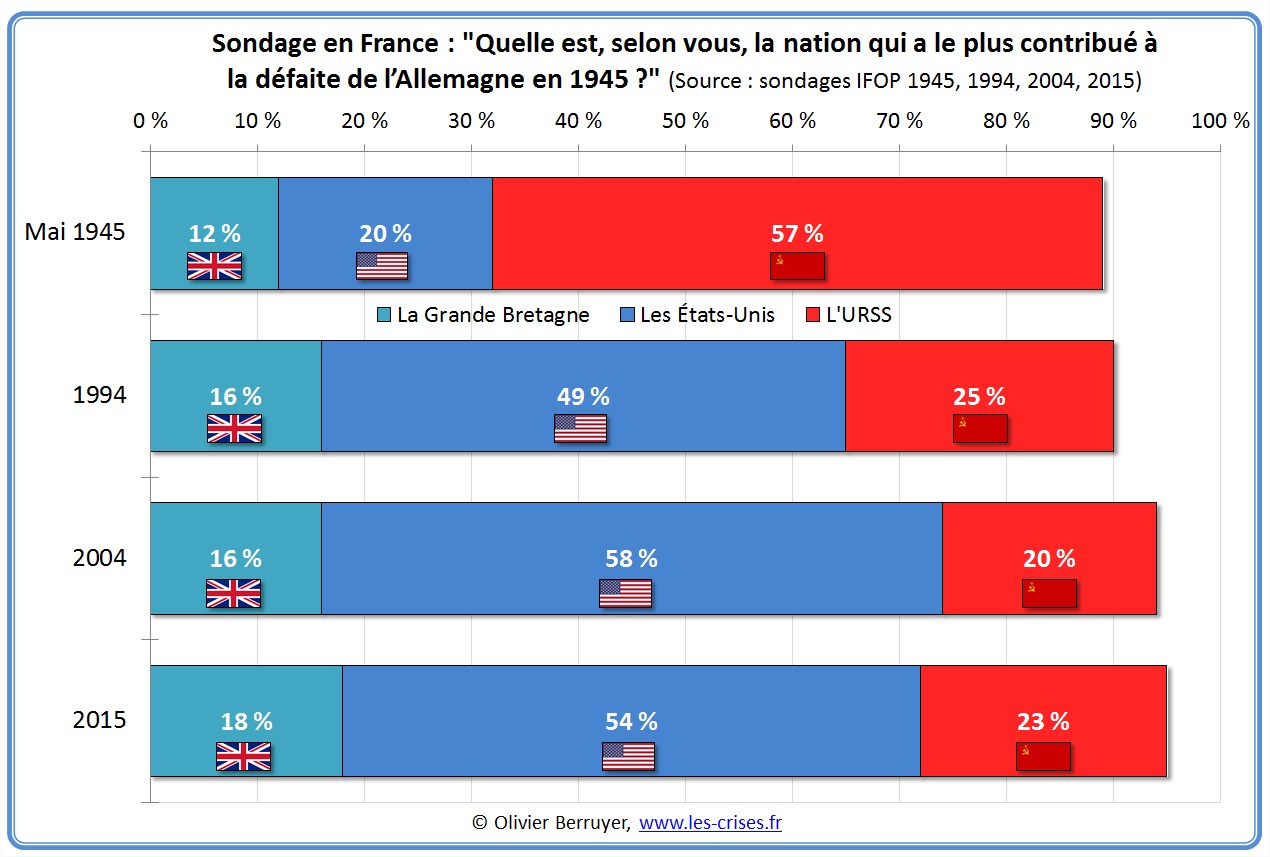
That thought is the result of decades of successful US propaganda. The people who actually lived through WW2 in Europe thought different. This poll [1] asked: "In your opinion, which nation contributed the most to Hitler's defeat?"
Germany would have lost to Russia, they were already being beaten back when D-day happened. Europe would have become a communist dictatorship, not a german one.
Kind of assuming the lawyer or whoever formulated the complaint spoke english... would make sense if there was a translation of a legal request, that the original and the translation be included. In case of errors if nothing else.
The French invented the word chauvinism :) They take their language very seriously likewise. I work for a French company and even though the official language is English you're kind of a second rate citizen if you don't speak it. Or write last names in all caps or quotation marks like <<>> :) They just are that way :P
And if you ever work in any other countries, you would see the same in different language. Work in a Swiss company? Hope you enjoy German.
At one stage, French people has to stop this self deprecating and think elsewhere is much better and only French does this or that. It is not.
Not my experience in Swedish company. n=1. It's not just business. Initially I felt awkward in shops, asking directions, etc using English. People just drop into English seamlessly.
We're a Swiss company and we speak everything! English is the main language, but the engineers are mostly Eastern European but French-educated so they speak French. Some of the team is German/Czech/Polish, so they speak some German.
The common policy though is that if someone does not speak the language of the ongoing conversation in the room, everyone switches to English. A policy that I picked up from my Japanese internship days.
All caps started becoming more popular in English because a lot of people now have names where the first and last names are interchangeable and it was causing uncertainty.
I'm pretty skeptical of stuff like that. To me, it looks like they proxy the download for you, but that doesn't make sense because there's no way they have the revenue to support that, right?
You take youtube-dl/yt-dlp, make a frontend for submitting URLs to it, and stick it in on a page absolutely teeming with ads. With enough ads and enough random people searching for "youtube MP3 downloader" you can cover the server expenses and probably make a few bucks per month in the process.
I have a set of test questions I use to gauge how badly a LLM model has been lobotomized whenever a new one is released. This post made me finally realize that google search is really going away (compromise core mission due to invalid DMCA request? really??) and that I will have to start looking for new search engines.
This of course means that I need a way to gauge prospective search engines. My first attempt:
- Search for software like newpipe and dolphine emulator
- Search for content that very strong people fought hard to bury
- Search for public library sites like libgen, zstd, and scihub.
- Search for popular torrent sites
- Search for far-right content if search engine is US-based (suggestions please)
- Search for far-left content if search engine is US-based (suggestions please)
What else have I missed?
Sidenote: It's been clear for a while now that unbiased google-grade search engines are going away. Each search engine has at least one topic where it would deliberately return garbage results. We need a meta search engine that automatically routes a search query to the least damaged search engine.
> Search for far-right content if search engine is US-based (suggestions please)
I use a similar litmus test. I search for the website for the Proud Boys. Google doesn't just censor it. They place obviously hand-curated results critical of the movement on the first page. Bing is the same. DuckDuckGo also fails the test. Kagi and Yandex both pass this test.
Just because Yandex passes the test, doesn't mean the can be relied upon.
Remember, because they are Russian, it is in their interest to show you content that US corporations censor, but they may be censoring the content that Russia wants to be censored or manipulate it for the benefit of Russian propaganda.
What I am trying to say is that it is probably better to get information from many sources as every can be biased one way or another.
edit:
Just query yandex about WWII, you'll see links to conspiracy sites and sources whitewashing Soviet Union involvement in starting it.
> Powered by Metasearch technology, Dogpile returns all the best results from leading search engines including Google and Yahoo!, so you find what you’re looking for faster.
According to their 'About' Page, they still do it right?
Maybe the solution is something like a search engine aggregator? A website that sends your search to both DDG and Yandex and shows you the top 5 links from both, removing duplicates. That way if something is censored on Yandex or DDG but not both, you'll still see it. Something like that would be non-trivial to implement, but a lot easier than writing a new search engine.
You are absolutely right. I’m certainly not claiming Yandex passes these tests either. They’re clearly guilty of censoring content critical of Russia. So far only Kagi has passed all my tests.
Good question. I just tested them. The results share about a 70% overlap with Google, with similar ranks, so I'm assuming they basically just use Google's results with a filter and privacy layer. There's no sign of the actual website, so Brave fails the same way Google does on this test.
While websites such as Wikipedia, Britannica, and history.com are trusted sources of information, they may not always provide a fully balanced perspective on historical events such as World War II. These sources, largely based in the West, can sometimes underrepresent or insufficiently emphasize the role of the Soviet Union's aggressive actions and atrocities in the lead-up to and during the war. Which is probably why they are so high on the list of results.
Wow, I didn't realize even DDG was censoring this hard. I tried what you suggested and the results between DDG and Yandex aren't even close. This comment convinced me to switch to Yandex.
Please educate me: what makes the results “obviously hand-curated”?
When I search on DuckDuckGo I get a list of Wikipedia entries for its prominent members, and a few recent articles involving its members. In this case it’s their convictions related to Jan 6, but it seems like the articles showed up because they are recent in time, not because of some sinister plot.
Edit: To be clear I am not trying to discount your experience, I fully accept that the results you are served for the same term could be completely different than mine.
Forgive my poor syntax. I didn't mean to imply that DDG provides hand curated content on this search. I accused only Google of that. Google provides obscure university links which are critical of the movement in the top few places, above news stories (which are also, incidentally, negative). The links are very different in nature to all the other engines I tested. DDG only censors the links, from what I can tell.
- Search for specific git hashes, model numbers, and other forms of UIDs
- Search for known phone numbers
- Search for Tiananmen Square and Winnie the Pooh
- Search for the Armenian genocide
- Search for Mein kampf, Der Judenstaat, and other symbols used by extremists
Unfortunately, I have a fairly western-centric view of the world. I need the perspectives of others with different views to cover my blind spots. I don't care what values you hold, I just want a reliable search engine tool that doesn't hide information from me.
>I just want a reliable search engine tool that doesn't hide information from me
I don't think this is something that a ranked search algorithm can do while keeping everybody happy.
As an example, let's search for "vaccines cause autism". If you put "vaccines cause autism" content on top, some people are going to get very angry and think you're "hiding information" -- you haven't shown all the content debunking the claim. But, if you put "vaccines don't cause autism" first, some people are going to get very angry and think you're "hiding information", because you're not listing the original sources of the claim.
There are a million such examples with varying degree of controversy; you've listed some of them already, but others could be "penis enlargement pills", "best truck to buy 2023", "dakota access pipeline", "thai king opression".
You can't make an algorithm to distinguish fact from fiction, what counts as "information" and what doesn't. You can, at most, rank by consensus or popularity, but what's "popular" (or "allowed by the government") isn't necessarily true (or false). And you must rank your results somehow, there's just too much content.
Most search results on google give fake clones. The current urls in wikipedia seem to be accurate. Also, use the Tor version because it has far more books.
DMCA anti-circumvention provisions are regarding tools that circumvent effective access controls.
I realize that broken encryption is considered an effective access control in this context despite it being broken, but apps like Newpipe aren't even breaking encryption, right?
What aspect of the YouTube servers' behavior can be construed as an effective access control? Is there even a rudimentary secret, that never gets served to clients typically but that apps like Newpipe figured out?
Unofficial cable TV descramblers are illegal despite simply reconstructing the missing sync signal, but that's because they facilitate theft of services that are normally paid. YouTube is free.
Access to YouTube videos is only "authorized" through YouTube's site and official apps (or yada yada), and YouTube videos are copyrighted material. YouTube has technological measures to ensure that you only watch YouTube videos that way. If you circumvent those technology measures, that's prima facie a DMCA violation, no?
The definition of circumvention of a technology measure is extremely broad including "to avoid, bypass, remove, deactivate, or impair a technological measure".
I'm pretty much of the opinion that the DMCA is a piece of crap as a law, but it doesn't lack for breadth and generality in those definitions.
DMCA 1201 isn't just a crap law. It's completely unworkable, as has been known since before it was passed.
Suppose Bob is in the business of duplicating public domain US government works. He downloads videos from the NASA website, presses them onto DVDs and sells them on eBay. He can do this without anybody's permission because DVDs are from the mid-90s and the patents are expired. He uses the same DVD format as Hollywood so people can watch them on their existing DVD players, but he also makes a free DVD player app for Linux so people can watch his DVDs or rip them or do whatever they want because they're in the public domain. It can also do the same with any other DVDs, because it's the exact same format. Is Bob breaking the law?
Now suppose Bob is a jerk who is doing this with public domain works without providing anyone a way to exercise their right to copy them, or doing it to enforce contractually unlawful license terms or something like that. Is someone who makes a tool to thwart Bob breaking the law? If so the law could have (more) First Amendment problems, to say nothing of the obvious unreasonableness. But if not then it's a worthless law because anyone could use that as a justification to break anything. Which it is regardless because it has never been effective at suppressing the availability circumvention tools, only at should-be-impermissible abuses like prohibiting interoperability to prop up existing monopolies.
It's also notable that NASA publishes many videos on YouTube. As in, only on YouTube.
DVD supports both encrypted and unencrypted video, so Bob is only breaking the law if he's releasing a decryption tool. The entire DeCSS case hinged on video decryption specifically, everything else was already implemented by other parties.
Now, if Bob decides to encrypt those DVDs, then you have an interesting legal area where half the law applies and the other half doesn't. DMCA 1201 only applies to things that protect copyrighted works[0], not just any kind of access control measure. And it comes in two parts: one that makes it illegal to break encryption, and another that makes it illegal to provide tools to break encryption. So if you put uncopyrightables behind DVD CSS's encryption algorithm, you can't sue someone for decrypting that particular DVD. But if you distribute a DVD decryption tool, then you're harming the protection of copyrighted DVDs, so you can't distribute a decryption tool even though some jackass might try to functionally recopyright public domain material with DVD CSS.
More interesting than the NASA case would be Kevin MacLeod. He releases Creative Commons music under a CC-BY license, and that license has a clause specifically prohibiting the distribution of Creative commons material with DRM on it. A lot of YouTubers use his music, probably didn't know about this clause, and definitely didn't know that the music industry would rugpull everyone by claiming that dynamic download URLs are a DMCA 1201 technical protection. So if these music industry cases succeed, it also means that a lot of YouTubers are open to some copyleft trolling on Kevin's part. I doubt he'd actually do that, but it's still shitty that this is possible.
> But if you distribute a DVD decryption tool, then you're harming the protection of copyrighted DVDs, so you can't distribute a decryption tool even though some jackass might try to functionally recopyright public domain material with DVD CSS.
I don't think you're appreciating how crazy that is.
Suppose some implements a DRM system that works like this. They have a server that speaks ordinary HTTPS and has a standard HTML page that serves content to anyone, but their proprietary client will filter the page on the client side and only show content after a user signs in and buys a license. The content is encrypted with ordinary TLS. If you visit the page using a standard browser instead of the vendor's proprietary client, it doesn't know anything about the filtering system but does implement the "encryption" (i.e. TLS/HTTPS) so it will "bypass" the DRM. Are web browsers now illegal?
Suppose someone implements a DRM system that works like this. The content comes unencrypted on a hard drive inside a computer that asks for a login. The computer is screwed shut with pentalobe screws. Are pentalobe screwdrivers now illegal? What if they sealed the computer with phillips screws?
Suppose I got saddled with a contract with someone saying I would encrypt their content, but I'm lazy so instead of designing a DRM system I just copy the on-disk format of Bitlocker and use a key of all zeros for everything. Anyone with a copy of Windows can decrypt all the content. Do I get to sue Microsoft?
Suppose a ransomware organization uses the same DRM system as a copyright holder. Illegal to provide anyone with tools to break the encryption?
DMCA 1201 has a knowledge requirement, so in the first example, someone just viewing the website normally has no knowledge of the DRM and thus isn't circumventing anything. However, if they had known of the proprietary client beforehand and used a regular web browser to circumvent the DRM, then that would violate DMCA 1201's anti-circumvention provisions. However, keep in mind that anti-circumvention is the sane half of the law where all the actual exceptions for fair use and all that live. And also the half of the law that's significantly harder to enforce.
The second half of the law is the anti-trafficking provision. This is a lot stricter because it has no fair use exception. However, the actual requirement for violating this law is that the tool has to either...
- Be only capable of violating the DRM scheme
- Have limited commercial purpose other than violating the DRM scheme
- Be advertised as being capable of violating the DRM scheme
Just selling a pentalobe screwdriver is not enough to trip the anti-trafficking part of DMCA 1201. Either your DRM system has to have special screws that only that particular device uses[0], or you have to specifically sell it as a way to steal music. Pentalobe screwdrivers have all sorts of significant commercial uses other than just breaking this hypothetical DRM scheme.
For the same reason, you misusing Bitlocker does not make Microsoft liable for violating DMCA 1201, because Bitlocker has a very wide commercial purpose outside of circumvention. However, if someone says "hey the key is all zeroes", they are liable for trafficking in circumvention tools. Generally speaking, DRM needs to be narrowly tailored to avoid overlap with commonly-available and thus legal circumvention tools. If you abuse existing functionality to make DRM in a way that is trivially circumvented then you gain very little from anti-circumvention. For the same reason, those little right-click blockers people used to put on their website don't mean that Chrome DevTools is illegal[1].
Your ransomware-by-FairPlay example is actually legally interesting. I could see it going all the way to SCOTUS. If I were a cybercriminal, I would absolutely do this just to see people hold off on releasing unlock tools. That being said, I don't think a judge would actually find a security vendor liable here. There's a very basic principle in law that illegal activity is afforded no protection by the law[2]. So I can't sue a drug dealer because he spiked my heroin with fentanyl, or sue a game developer for using my unauthorized fanart of their characters without permission[3]. The criminals who released the ransomware cannot sue the security vendor, the DRM system vendor would have to be baited into doing so. Furthermore, "decrypting shit that was encrypted without my knowledge or permission" would be a perfectly valid commercial purpose. So as long as the security vendor does not say "this tool decrypts DRM" it's probably fine for them to release this.
[0] For various economic reasons in screw manufacturing, this is highly unlikely to ever exist.
[1] I'm pretty sure just mentioning this is committing one of my three felonies for the day.
[2] This does not mean that criminals have no protection under the law at all, of course. Someone who burgles your house and gets injured can still sue for damages, because it's illegal to set up traps to kill people.
[3] Under US law, if an artistic work is a derivative of another artistic work, the derivative is afforded copyright protection if and only if it is licensed. If it is unlicensed you own nothing.
Sure, but I'm trying to grok the essence of the technological measure being used by YouTube.
I have to imagine that merely offering terms of service doesn't constitute a technological measure, and nor would merely slicing up the response in a DASH-like manner [0].
Well... here's the dumb thing. The DASH-like manner (or, "rolling cipher" as they like to call it) has currently held up as being an effective protection measure. It comes up all the time when RIAA in particular sues YouTube stream-rippers.
Very interesting. I feel like any type of digital storage or transmission format (PCM audio formats like CD Audio, packet switched networks like Internet Protocol, etc.) could also be described thusly, given that a typical human can't readily consume it. We use a tool that parses it using some algorithm, not a tool that avoids/breaks the algorithm. The error correction of a CD or the sequence number of a packet surely rolls way more rapidly than those DASH slices, too. Are those more common formats also considered effective access controls, since humans have severe difficulty interacting with them without the help of a tool?
Granted, I suppose the difference there is that the creators of those formats/protocols did publish the spec, whereas YouTube didn't. Or did they, though? The JavaScript that YouTube serves is the instruction for parsing the DASH response, available publicly, hardly different from publications like IEC 60908 ("Red Book" CD-DA spec) or an RFC 791 (IP spec) -- a different language, is all.
YouTube implemented the rolling cypher to satisfy music industry demands that the files were not permanently downloadable (and it appears they were able to provide abundant evidence that Google has communicated that to them in court, I don't think this is a controversial point).
> I realize that broken encryption is considered an effective access control in this context despite it being broken, but apps like Newpipe aren't even breaking encryption, right?
Encryption isn't the only access control. "Access control" is a pretty loose term. I think of it as being similar to what (in the US) counts as "breaking" in a breaking-and-entering charge: you've "broken into" a place if you had to move anything in order to enter. Even a door that is partially ajar and you had to slightly move it to slip by.
I don't know in this particular piece of software. I'm just saying that an "effective access control" can be something very trivial. It doesn't have to be anything as sophisticated as encryption.
Just to speculate, it could be something like using the user's login credentials.
>What aspect of the YouTube servers' behavior can be construed as an effective access control? Is there even a rudimentary secret
My understanding is that YouTube does implement a trivial sort of DRM/encoding with a rolling cypher to the actual location of video file. This is what tools like youtube-dl implement, and what get their DCMA from the RIAA. It's supposedly very light weight in terms of DRM, and notably I don't think Google has ever attempted to change it to break downloaders.
> YouTube does implement a trivial sort of DRM/encoding
Nope. Youtube break their streams up into a number of tiny pieces so they can adjust bandwidth dynamically extremely easily.
It's just the RIAA and friends looking for an excuse, so they've attempted (and likely will continue attempting) to make people believe that's "sort form of DRM".
Since an effective access control would by definition not be subject to circumvention, there is no conceivable situation where someone might be guilty of circumventing an effective access control.
Well, the thing YouTube does (whether you call it an access control or not) does actually have a measurable "effect" on people. It makes those people seek out third-party tools when they don't perceive any other reasonable way of downloading the work. So by that logic, it's pretty effective.
Nothing is ever 100% effective -- even the best encryption is technically a compromise -- other than OTP. YouTube just happens to be on the low end of effectiveness; the third-party tools likely wouldn't exist if it were on the high end. But I guess even slight effectiveness is enough for DMCA purposes.
As I understand the 'cipher' is in how you find the next tiny piece of stream. I haven't grasped fully how that works for Youtube but it is certainly more than 'increment a counter'. I believe it is something like 'read a variable in the previous packet and decode it'.
If they wanted any semblance of an argument, decoding that variable should require a session key that is set on log-in or after a captcha. But I doubt they do that, it would be a horrible hassle to handle the session dependant encoding.
Interesting. So instead of authorizing the fetching of pieces by way of authentication, they're just saying "you can have another piece if we've been talking since the very first piece". I guess that's a bit of a control, just not secret whatsoever.
I feel conditioned to equate the two, but they're distinct concepts I suppose. A CAPTCHA is an access control, and one that doesn't rely on secrets.
Doesn't it more boil down to "if the available bit rate is above ABC then grab the next piece $foo, else if the available bit rate is above DEF then grab the next piece $bar, else if the available bit rate ..." (etc)?
Not really sure where you're getting "authentication" from for this?
I'd argue that even YouTube users who aren't paying for premium are paying too, just with their personal data instead of state currency. But it's still an exchange of value. Which IIRC, is the whole reason Newpipe exists, to circumvent that exchange of value.
It's not just data. Watching ads is paying, because it increases the viewers' cumulative likeliness to spend money with the brands whose ads they see.
The way money leaves your wallet is through probability, spread out in time and with the viral ability to spread to others. Compared to a fixed subscription or one-time payment, this is a lot harder to notice or control, but it's money leaving your wallet nonetheless.
Why should I be forced to use (a recent, and thus increasingly more user-hostile version of) Big Browser in order to visit a site? There's a huge difference between "not supported" meaning "you're on your own" and "illegal".
Call it what it really is: user-agent discrimination. Don't let them dictate the software (and hardware) that we can use.
Google accepted a DMCA request for the homepage of the Android streaming app NewPipe. Its homepage newpipe.net has been removed from Google search results if one searches for "newpipe". NewPipe is an alternative privacy focused YouTube frontend, but also supports other services like PeerTube, SoundCloud and Bandcamp.
> Google has to accept the notice, unless NewPipe submits a counter notice,
They don’t have to accept it-they can choose to ignore or reject it. However, if they choose to ignore/reject it, and the notifier then sues them, they may lose one of their legal defences.
Obviously they decide that most of the time complying is the legally less risky path, so most of the time they comply. However, if they get a DMCA request for a famous website like nytimes.com, they probably won’t action it.
> I don't think counter notices apply to circumvention devices.
Right, because the DMCA takedown notice procedure as a whole doesn't apply to circumvention devices, only to content that is itself copyright infringement.
Why isn't this higher up? This seems like the actual meat of the discussion: Google is erroneously interpreting this takedown request as something it's supposed to comply with, when in fact it's not. Furthermore by misinterpreting requirements here Google is harming the public and newpipe. I wonder what newpipe's appeal (to Google) process looks like...
If it's wrong you just counter-notice and it's put back again, does take two weeks though. If the initial person is not the copyright holder they've committed perjury.
Which is an undue burden on legit publishers who get effectively DDosed by big publishers with money. If the big publishers have no consequences, then they have no incentive to stop.
If they got ever increasing fines for false claims, then they would have an incentive to actually only make legit claims.
Set up and automatic counter-notice bot to start with, thus annoying them back.
However:
Any person who knowingly materially misrepresents under this section—
(1) that material or activity is infringing, or
(2) that material or activity was removed or disabled by mistake or misidentification, shall be liable for any damages, including costs and attorneys’ fees, incurred by the alleged infringer, by any copyright owner or copyright owner’s authorized licensee, or by a service provider, who is injured by such misrepresentation, as the result of the service provider relying upon such misrepresentation in removing or disabling access to the material or activity claimed to be infringing, or in replacing the removed material or ceasing to disable access to it.
I block ads not because I'm completely anti-advert. I'm anti being-stalked-through-my-entire-life-and-having-my-details-sold-like-I'm-a-cheap-peice-of-meat, and unfortunately ATM blocking that also means blocking most online adverts.
So I draw the line before sponsorblock. At least the content creators get a better cut of that than they get from YouTube monetisation & youtube can't take it away from them as easily at a whim, and those segments don't track me, and there is an increased chance that the sponsor is relevant to what I'm looking at (not what I clicked on days ago). One or two channels even manage to make the sponsor segments fractionally entertaining.
I'm also anti irritating adverts of course, which does include manually skipping some sponsor segments or avoiding channels that can be relied upon to be irritating in that way.
I'm curious why you aren't anti-ad. Ads are psychological manipulation. Why would you want to subject yourself to that?
I was recently visiting some family, and saw the garbage my 7-year-old nephew sits through to get to the YouTube video he wants to see[0]. I can only assume we're just training a new generation of kids to believe that ads are a normal, inevitable part of every kind of media consumption.
I agree that creators need to be compensated somehow. And I'd be fine throwing a couple tens of cents per view of a video rather than either watch ads or block them and freeload. But micropayments will never take off (for understandable reasons), so that's pretty much never an option. For creators I watch frequently, I contribute to their Patreon if they have one, at least. But if someone links me a one-off video from someone I've never heard of, and will probably never watch a video from again, I'm not going to do that, and I'm certainly not going to let them pollute my brain with whatever advertising they've decided to push.
But I loathe every form of advertising and will block it any chance I get. If I could wear AR glasses that blocked out things like billboards, I would.
[0] (If my stupid grandfathered free GSuite account allowed it, I'd gift them a family YouTube Premium membership, but of course GSuite breaks random features everywhere.)
> I can only assume we're just training a new generation of kids to believe that ads are a normal, inevitable part of every kind of media consumption.
Maybe? I distinctly remember doing my utmost best to ignore TV ads between my cartoons as a kid. Especially <10yo I'd be basically chanting "boring boring boring" to myself until it was over, or just stay focused on toys.
Then again, today's children have access to Youtube far earlier and with more control over what they watch, so you may have a point in that they're starting earlier and thus it gets normalised instead of "this is a sucky thing I'm going to try to ignore".
The cartoons when I was a kid were advertisements themselves with breaks for further advertising: He-Man, GI Joe, Jem, My Little Pony (the old series), Teenage Mutant Ninja Turtles, Transformers, etc.
Mainly because to an extent they are a necessary evil, or at least we'll never convince enough of the right people that they aren't necessary.
> Ads are psychological manipulation.
They are currently, which is why they get blocked by my anti-stalking-and-other-dickishness kick, but they don't have to be. A simple advert (image and a little text, not directly obscuring what I'm trying to read or bouncing around to break my attention from elsewhere artificially) for a product that might be relevant to what I'm looking at, doesn't seem evil to me. Unfortunately advertises are not satisfied with that and want full-page adverts with forced interaction and full user background tracking.
>I was recently visiting some family, and saw the garbage my 7-year-old nephew sits through to get to the YouTube video he wants to see. I can only assume we're just training a new generation of kids to believe that ads are a normal, inevitable part of every kind of media consumption.
Just like parents have a responsibility to teach their kids about safe sex, I think parents have a responsibility to teach their kids about ad-blockers.
I'm completely anti advert. They declared war on civilization 20 years ago and don't deserve to be treated as anything but a parasitic cultural disease. It didn't have to be this way, but that's where they took us.
20 years ago? Advertising has corrupted every public medium since the dawn of print media, arguably even before that.
In the 19th century, it was quackery and false advertising in newspapers, making snake oil salesmen rich.
In the first half of the 20th century, advertising started using propaganda tactics to psychologically manipulate consumers, as pioneered by Edward Bernays[1], making tobacco companies rich.
Radio and television amplified their reach and power, fueling modern consumerism. People were hooked on tobacco, corn products, sugar, fast food, and a million other mass produced products. Whether the products were harmful to society was irrelevant. The spice must flow.
The internet was another major frontier, where ads could precisely target specific consumer profiles. Adtech was born to give this power to advertisers by facilitating data collection and creating the multi-billion dollar dark data broker market.
Adtech was then (ab?)used by local and foreign agents to spread propaganda, disinformation, and conduct psyops at an unprecedented scale, disrupting democratic processes, toppling governments, causing social unrest, and boosting intolerance, xenophobia and racism on a global scale to levels unseen since WWII.
And we haven't seen the worst of it yet. Once everyone has their own personal AI that is trained on the most intimate details of each personality, ads will become even more personal and manipulative. Advertisers are salivating at this opportunity, and adtech is surely experimenting with this right now.
So, no, I refuse to participate in this perverse system, and subject myself to being psychologically manipulated. Companies and creators who depend on advertising don't deserve my business, attention or respect.
[1] This man was evil beyond words. See Adam Curtis' The Century of the Self.
> advertising started using propaganda tactics to psychologically manipulate consumers
Advertising and propaganda have always been the exact same thing, and in at least some latin languages it is plainly called propaganda in all occasions. As in people will say that they work in propaganda and universities offer degrees in propaganda.
Advertising is inherently immoral and it's our moral obligation to drive advertisers into bankruptcy.
All advertisers are liars. Even when they're not directly saying untrue things, they're presenting a one-sided view of the truth, to the extent of being intentionally misleading.
The harm done by these lies is incalculable. The distraction. The loss of self-esteem caused by ads always telling us we aren't enough, don't have enough. The fear caused by ads telling us we'll lose what we have. The loss of financial stability on things we don't need or want.
And that's just what ads are. That's not even talking about how advertising is done, with a million dishonest tricks to jam themselves in front of you or gather your data to lie to you more interestingly and convincingly.
The only good ad is a blocked ad that cost the advertisers money.
sponsorblock doesn't just have sponsor segments. There are segments for intro, outros, filler content, non music section for music videos, etc. Depending on the type of content you watch, skipping these segments are great. Sponsorblock has a config option so you can toggle on/off which type of segments you want to skip.
The creator gets zero dollars from you watching sponsored segments, unless you actually go and buy the product using their promo code. So you are not helping them, only wasting your time.
A better option is YouTube Premium + Sponsorblock. Then your time spent watching a video translates to payment to the video creator - at a higher rate than for users watching with ads. And you save your time by skipping sponsored segments.
> The creator gets zero dollars from you watching sponsored segments, unless you actually go and buy the product using their promo code. So you are not helping them, only wasting your time.
That feels like a deliberate misrepresentation of how sponsorship works.
The sponsors are not paying directly for viewings or sales (though number of eyeballs is one consideration in negotiating the worth for a sponsored block) but for the potential opportunity for sales offered by increases market awareness. It is far more subtle than paying for impressions/clicks like other advertising models.
If no one watched them, the creator would get zero dollars full stop because the sponsorship simply wouldn't happen.
> A better option is YouTube Premium + Sponsorblock.
I'll stop using youtube completely long before I pay them to stalk me (you may not get the ads on premium, but you are still being tracked to the fullest extent possible).
> The sponsors are not paying directly for viewings
And in that case you are not contributing by watching the ads. There's also a ton of sponsorship where the creator has a referral code that the viewer uses to purchase a product. In these cases they make money if you buy the product.
If you're not going to buy anything, you are not helping the creator at all by watching any ads. Your are better off just blocking the ads to not waste your time.
It makes no direct difference, they don't get paid directly per view like with monetising via youtube ads and such, but if no one ever sees the sponsor segments the sponsorship will dry up and the content will need to be paid for by other means (the creators just loving it enough to make it for free, some of the audience paying by some means, etc.) which usually isn't a long-term viable position.
Here's a thought experiment, though: if you manually skip sponsor segments every single time you watch a video by dragging the scrubber, is that any different from having a piece of software do as much for you, in an automated fashion?
If it is the same advert I've seen many times for one of those casual games that all look the same (battle of the tanks, tank war, waring tanks, battling tanks, fantasy tanks, tank fantasy, …) then that isn't even relevant to what I'm watching (I wonder how much they pay for a spot on an LTT vid or similar?) it'll get skipped every time. If it is something that might be relevant but I'm already aware (either I already was, or I've already seen the ad four times this week) again it'll get skipped.
The Running Is BS podcast is sponsored by a tea company: irrelevant to me as I don't drink tea at all (there is some relevance to the people making the cast, which is how the segment came about initially), hitting skip-forward-30s a couple of times each fortnight is no hardship to me. I listen enough that I perhaps should consider doing the Patreon thing, the fact that I and no doubt many others in a similar position don't do the Patreon thing is why the sponsor segment is useful to the creators.
> is that any different from having a piece of software do as much for you
The difference is that something new and potentially useful doesn't get skipped and it would automatically with sponsorblock. Hitting the right arrow key a couple of times is hardly a hardship. Before the sponsor segments on a video channel or podcast get to the point of irritation where I'd use something like sposorblock, I'll probably just start avoiding looking at that channel at all.
It’s not that it’s a hardship to press right a few times, it’s more that I’m trying to understand, academically, how to make a “respectful” skipping tool. Because I believe both that in-content ads are the most user respecting ads and deserve better engagement/treatment than “universally skip”, but also that users are not morally obligated to consume ads even for ad-sponsored content (is’t the advertiser’s, and only the advertiser’s, problem if users aren’t interested).
Sounds like the requirements would be: 1) it plays every new sponsorship pitch once, which you can still manually skip, and 2) it maybe asks you whether you want to skip on a per-instance level?
If you're looking for a Bromite successor, right now best way is to download the uazo builds direct from GitHub: https://github.com/uazo/bromite-buildtools There are some third party tools that will download the releases for you, but I'm fine to just manually pop by the repo whenever ungoogled-chromium[0] updates on my desktop.
So far the uazo builds have only run up to a couple weeks behind Chromium mainline, unlike Bromite which could fall months behind. I'm not sure if there is a better privacy-oriented browser for Android right now if you want just want a stripped back Chromium. The other privacy-oriented browsers all seem to add a bunch of extra stuff.
I need to actually try Fennec one of these days instead letting it sit on my phone.
I still don't exactly trust these builds since they are small fries and I imagine not a ton of people are combing the code to make sure data isnt getting logged somewhere. They are great for browsing the internet, but I typically don't put passwords in them.
Oh man, I'd never heard of NewPipe until now. I've literally had it installed for three minutes, and I am amazed. I was able to dial up a music video that I frequently listen to without ads, I could immediately background the app, and even turn off my screen while still listening.
> I could immediately background the app, and even turn off my screen while still listening.
Ads are a major nuisance but those features are also really important because YouTube deliberately crippled their free-as-in-beer mobile app, to push folks toward a paid app.
I also just installed the app yesterday. I like it too but this "turn off the screen" thing happens when I watch videos in full screen too to me. I happily watch a video and suddenly the screen turns off while the audio is still on. Didn't find a way to solve that yet.
To be specific: In full screen mode it turns off the screen after a while and so far I could not find any setting that disables this behavior. The things I found on the internet where about dimming the screen and the suggested solutions against it did not work for me. It seems that is goes into "audiobook" / "listening" mode for some reason.
When I press the power button of my smartphone again the video player is a floating mini player.
NewPipe is excellent. I was disappointed that it was not available for desktop until I discovered tartube which will download video files from almost any website easily
JDownloader, youtube-dl, yt-dlp and many others can also download YouTube videos (and hundreds of other sites). Yes, the last two are command line tools, but if you put them on your desktop you can just drag&drop any YouTube-link on them and it will download it for you
I also recommend FreeTube, which sounds like a porn site but actually it's another open source desktop YouTube player: https://github.com/FreeTubeApp/FreeTube
The Lumen Database page lists only domain names of the URLs in the complaint unless you solve a captcha and enter an email address. The full complaint lists https://newpipe.net/ itself, while the chrome.google.com (and addons.mozilla.org, and store.microsoft.com...) URLs are to browser extension pages, and the Facebook URL is the URL of a post that has a link to a Youtube downloader.
The list generally seems to be a collection of things that range from the websites of Youtube downloaders and interfaces to simply mentions of them, including a Wikipedia page about Youtube downloaders and a Trustpilot page of reviews about a website for one.
Item 9, meanwhile, appears to be a completely unrelated Soundcloud track that isn't even connected to the complaint description, but appears to have the URL of a Youtube downloader in the title.
incredibly useful product. pretty sure 'background play' is a paid feature on default droid youtube[1]. newpipe does it out of the box. I don't object to paying for youtube but I do object to them linking my watch activity to my account. guessing youtube is constantly trying to kill this, just like ytdl, but for now amazing work keeping it up
> As a result, websites for fake clones of NewPipe that mimic our homepage will tend to rank higher in the results. This could ultimately cause users to fall for such scams.
Sounds like a good idea in theory, but when i do imagine it, it seems like it might be a dystopian nightmare of the worst parts of our nature.
I think a better idea would be a regulatory environment for tech that - squeezed monopolies and oligopolies, mandated transparency, and mandated a minimal system of human-tended justice and appeals.
Presumably, any search engine that works passably well will not show you snuff films if you type in a search for something entirely different. The only people who see snuff films will be the ones looking for them.
Child porn shouldn't be on the internet because it is illegal, and if it's not on the internet, it won't come up in search. If it does come up in search, that makes it all the easier to report to the police.
Freedom comes at a price and I believe, while I'd never support such results, the scenario that includes unwanted/illegal results is still better for the pursuit of taking power and control of freedom of speech from big corps and governments in the long run.
Any good equivalent to Newpipe for iOS? I'm using Video Lite so I only get one ad when opening the app.
I'd like to have SponsorBlock like some Newpipe versions have and no ads at all.
Vinegar is the best. It replaces hostile video players like the one on YouTube with native HTML5 <video> elements so everything works as expected (like picture-in-picture).
For what it's worth, Google results continue to show the F-droid, GitHub and all other links for NewPipe for me. May be, because I'm accessing it from outside USA
> DMCA Title II, the Online Copyright Infringement Liability Limitation Act ("OCILLA"), creates a safe harbor for online service providers (OSPs, including ISPs) against copyright infringement liability, provided they meet specific requirements.
The notice [0] says "Kind of Work: Unspecified" and "Original URLs: No copyrighted URLs were submitted" so the safe harbor provisions pertaining to copyright infringement aren't really applicable here.
Safe harbor has nothing to do with net neutrality. Not complying with DMCA takedown notices would leave them open to legal liability, which I think is fair for them not to want to do.
It doesn't index more stuff overall, but marginalia.nu has a pretty great system for identifying non-commercial sites, which tend to be higher quality since they're not trying to sell crap.
The creator recently started working on it full-time.
Precisely what I wanted to ask as well. I only of yandex which gives really good results like old google, but I'd rather have alternatives in case when yandex fails.
The general search engines that I know of are (ordered from best to worst):
- yandex
- ddg
- google
Literally any search engine, regardless of affiliation, is welcome as long as it returns google-grade results (old google ofc) for more than half its searches.
Brave search works. Google is no longer a very reliable search engine, between the terrible spam, the insane censorship, the political biases and "regulations" such as this one.
I fail to understand why people think that YouTube is a charity service. They are a business and act like one, you'd do the same if someone threatens your business.
The problem is that YouTube/google want "le beurre, l’argent du beurre, et le sourire de la crémière".
They want to (and are managing) to distort the openness of the web: they provide free access to a service, the way the web intended to be; but don't want people to use the tools in the way they are meant to be used.
If they want to charge for the service, fine, it's their prerogative but don't blame the users for using the tools as they are meant to be used.
Why don't they stop free aceess? They can, no one is stopping them from doing business that way.
Because they want everything, that's why. When will their "business" stop? What's the end goal?
Not the first time they've spammed DMCA takedowns either: https://lumendatabase.org/faceted_search?sender_name=Because...
In comically French fashion, their complaints also include the same message in French just in case someone in Mountain View is more fluent in French than in English. I wonder if this is just a bunch of amateurs hired by the French label or if they actually pay legal professionals to spam these.