Hacker News new | ask | show | jobs
by jseliger 1085 days ago
I think this is just complacency and a bias towards how things are; imagine a world in which biking is safe, pedestrians are safe, and huge amounts of the city don't have to be devoted to parking. That's what 24/7 driverless cars can enable.
4 comments

Why will self driving cars enable this though? It seems to me that an equally plausible outcome is that we move even further towards cities built solely around the car.
I have never owned a car. As a result, I look at each trip and think about the best way to accomplish it. Usually the optimum in terms of cost is by bicycle, or by bringing my bike with me on a transit connection.

If I'm short on time, going to the airport, or my eyes are dilated from going to the optometrist or something, I'll use Lyft or Uber. This is like a once a month or less occurrence, (as you might guess since dilated eyes are one of my main reasons for using a car... I don't go to the optometrist that often.)

So I'm a world where few people own care, you might expect something like this. The car costs are up front per trip, not sunk as they are when you own the car, so you should see people thinking more rationally about their trip planning.

Driverless cars won't ever road rage / deliberately drive close to bikers to freak them out at least.
Driverless cars can come pick you up, which means you don't care if they park further away from your house, because you don't have to walk that distance.

Also, every parked car is one that isn't being used. So if there is lots of parked cars, that means you would need a lot fewer driverless cabs to replace them.

It would be easier to make a street car free. As driverless cabs dont need parking and can use daily updated maps. There would be very little resistance if a street gets converted to a small park. People would have to walk 5 min further to pick up a cab.
Unless you take all human driven cars off the road, you’re not going to get nearly the efficiency and safety you describe.

I, for one, don’t want to live in a world where my ability to go anywhere is decided by Google and Uber.

Big Tech has way, way too much power already. Please don’t give them any more of it.

> I, for one, don’t want to live in a world where my ability to go anywhere is decided by Google and Uber.

Seems like a red herring. I think it’s safe to assume that you will be able to own your own SDC, and the faster Google gets this tech scaled, the sooner you can affordably purchase one.

Will the SDC not get any updates over the internet? What Google decides to lock me out? Or show me unskippable ads before starting the car?

I don’t think the self driving car cheerleaders have thought this out.

If there's no law to prevent it, "traditional" cars will also soon come with unskippable ads. At least, that's the way how "traditional" TV manufacturers went. And if there is a law against it, Google or VW isn't a meaningful distinction anymore.
Nothing will stop someone from building a SDC that doesn't have the ability to be locked out like that.

The tech to do this is getting easier each year.

We’re down to a duopoly in the smartphone market. For most of us without a desktop/laptop (the bulk of global internet users), our digital lives are essentially controlled by Apple and Google.

Why would this be any different with SDCs? The tech might be getting easier, but current market forces make it far easier for the big players to monopolize the market.

There are a lot of competing car makers. In theory, they should select from multiple competing offerings.

Then again, they haven't always done well with that in supplier selection. You might be right, they might end up largely tying themselves to a few suppliers.

OTOH, the network effects shouldn't be as strong. It isn't hard to imagine FOSS options like OpenPilot continuing to exist.

Selling self-driving cars at cost is not the profit-maximizing strategy here.

With Google (and big tech) squeezing more and more for profits, some here even proclaiming it the new IBM, I don't see this ending with consumers winning.

I think you’re assuming (incorrectly) that Google will have a monopoly on SDC technology. There are already many big players in the space, so the profit maximizing strategy is probably much closer to what the consumer actually wants.

It doesn’t seem to me like there’s a big competitive moat other than $xxb in R&D costs, so if there is unmet consumer demand for self-owned SDC, it’s probably safe to assume someone will cough up the R&D costs.

Would I be purchasing it from Google ? Android Car (tm)?
Google or someone they partner with will likely be an option. Another will be Cruise or whoever they partner with. Or, Tesla.
Not sure that really makes much difference, it will be like buying an android phone. Full of tracking and spyware.
That is what government regulations are for. No one freaks about about Amtrak suddenly deciding who can and can't ride their trains.
MasterCard can and does decide who can or cannot take payments and nobody gives a damn either
Lots of people give a damn, laws surrounding that exacts issue have changed in the past and obviously they can be changed again in the future.
True, but the self-driving cars argument has always been that if all cars on the road are replaced by self-driving cars, you will have no road deaths.

Which pretty much means that in this future, you will have no choice but to use a self-driving car. Which gives disproportionate power to automobile/SDC companies.

If the only motorized way to move from point A to B was Amtrak, I would be worried about the power Amtrak has over my physical movement too.

If you rely on human-operated cars for transport, your ability to go anywhere is already controlled by large institutions.

- You require a car manufacturer like Ford or Toyota to manufacture and sell you a vehicle.

- You require an insurance company to cover your liability.

- The government must issue you a license, which it may take away at any time for not abiding by its traffic laws.

Well, you atleast have some control over the government and can theoretically vote out any policies that would deny you the license to drive a vehicle.

Google is not beholden to any democratic process and can summarily deny my request to go somewhere.

TBH, that's a fallacy. You don't have to get rid of literally every human driver to get vastly better safety for VRUs.

Just reducing it to only the people who choose to drive will make a big difference.

> I, for one, don’t want to live in a world where my ability to go anywhere is decided by Google and Uber.

Great news! If you join the tens of thousands of people who die from driving related deaths every year in the US, you won’t have to.

As a society, you have to make a decision between perfect freedom and perfect tyranny. Its never a clear cut choice and the reality is always somewhere in between.

But surely I can’t be the only one concerned about companies that already own my digital lives now also encroaching upon my physical life?

In this world, we'll still have giant hunks of steel zooming around our cities, creating noise, taking up space and wasting energy to move themselves around (the payload to weight ratio of cars is abysmal).

We need to get rid of cars altogether, with exceptions for emergency services etc.

I'm fiercely anti-car, but I also live in reality. If you find a few tens of trillions of dollars to rebuild every American city to be car free, let us know. I'll buy some books to occupy me during the 2-3 decades on non-stop construction.
What do you suggest people do when the weather isn’t quite as nice?

Where I live, it gets so brutally hot and humid in the summer that people literally collapse and die if they do anything much outdoors.

You're inverting cause and effect.

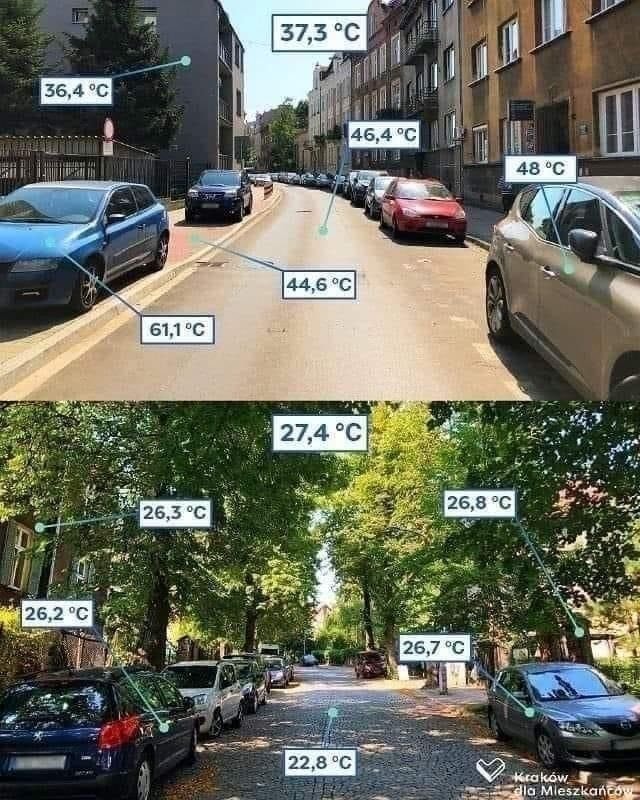
The reason it gets so hot in cities is because it's a concrete wasteland that traps heat because of, guess what, cars.

Here's an experiment to show said effect - same city, same day, very different street layouts: https://doemee.leiden.nl/uploads/55aa69e8-fb15-4ccc-8335-9b6...

San Francisco is not like that though. that's the whole point of the article. They could also take transit.
SF despite being dense and having high transit ridership for a US city is still fairly car oriented. If the endpoints of your trip are not near Muni/BART station it's going to take twice as long on transit. And the hills can make the walking part difficult for people who are elderly, disabled, or need to transport items.
That sounds like a place not suitable for human life.
Well, hundreds of millions of people already live here.
Not for much longer. In the 20 - 30 years, those areas will become uninhabitable.
These self-driving taxis are basically just buses you can call to pick you up on demand. In areas where there's sufficient density, the most cost efficient option would probably be a self driving on demand bus. In principle, I think they can be part of the solution.

The main difficulty is making sure the self driving transit vehicles are safe enough that people feel comfortable taking them instead of individual cars. Even though you are statistically speaking less likely to get shot on Philly public transit than you are to die in a car crash on a Philly highway, many people still choose to drive because there's a shooting on transit every few months or so and other less serious disorder on a more regular basis. I assume the same is also true in other cities like San Francisco or New York.

I'm strongly in favor of walkable cities and public transit but most people are going to choose cars and suburban sprawl if it means not having to deal with rampant crime. So anybody who wants to get rid of cars and car dependent suburbs needs to be in favor of both locking up the criminals (in a manner that respects their rights to due process of course) and addressing the root causes of crime (i.e. poverty, bad schools, drugs, etc.) so we don't end up with another generation of hardened criminals.

Transitioning to bike-centric urban transit takes decades. The best cities in the world have roughly equal bike and car traffic (and a big chunk of transit), but it's taken decades to get there.

Cars moving over the next 15 years to be much safer for pedestrians/cyclists could be a big shortcut on this path.

Seemingly Paris has done a great job over the past 2-3 years.
Paris has done great in climbing up to a bit more than 15% of daily trips by bike.

My point is: even the bicycle capitals of the world (Amsterdam, etc) have equal car and bike trips per day, and it's taken a long time to get there.

IMHO, San Francisco's Telegraph Hill neighborhood with it's 31.5% grade will take longer than Paris to become bike friendly.
There is 36C outside with ca 50% humidity

Do you suggest biking?

That's what 24/7 driverless cars can enable

If the prospect of this happening was somehow grounded in reality, that is.