Hacker News new | ask | show | jobs
by camel_gopher 1092 days ago
The core problem is assholes on the trains. People stopped riding because there’s either someone dangerous, someone crazy, or someone tweaked out. Literally on every Bart car, probably 2/3 of the time I ride. I end up using the Bart watch app to report this stuff every other time I ride.

One guy tried to light a seat in fire. Another tailgated me through the gates and proceeded to push past me. Another was slumped over in a wheelchair (someone called 911 in that case).

To their credit, the cops on the other end of the Bart watch app respond to almost everything submitted. They don’t have enough officers though to cover the whole system.

How do you fix it? Add more cops. No ticket, no ride. Two cops on every train. One at every other station. Arrest anyone who is there without a ticket more than once. Arrest anyone jumping the gates. Enough with the nonsense.

7 comments

I agree, it goes beyond danger which I see some people debating elsewhere in the thread. A tweaker might not be dangerous to me but I still won't enjoy being stuck in a tin can with him. Societies generally try to police antisocial behavior for a reason, but I guess some people think anything short of actually violent behavior should be tolerated. And "it's a city" shouldn't be an excuse.
Cops are expensive. You can run a bus line all day for the cost of 3 officers. If you want cops everywhere, aside from the fact that the HN demographic is much more open to this than lower income folks, you're gonna have to deal with a much more expensive transit system which will cost taxpayers more.

The disconnect is frustrating though. Middle and low income people do not trust the police. Don't believe me? Just listen in on any public meeting. Multiple community members and community groups call in to talk about how much they hate the police. Nobody calls in about how much they were helped by the police, unless they live in a wealthy district.

So what. The Bay Area is one of the most economically productive places on the planet. Tax payers are more than capable of handling it.

The public transit system is frankly an embarrassment across the country. If Morocco can have bullet trains, the Bay Area can have a safe, smooth intercity transit system.

A lot more of the lower income segment is more pro-cop than higher income segments. Those individuals may not trust the police, but they still typically prefer their presence to a lack of it.
That's not what comes out in public meetings, and local government makes decisions based on who speaks up at public meetings or who takes the time to contact their local representatives. I was listening in on the Oakland Budget negotiations that happened the other day and multiple speakers talked about how they mistrust the police and do not want to offer them additional funding. The pro-police crowd almost always come from the wealthier district, and in Oakland it's fairly obvious because a couple districts are much wealthier than the others.
Your comment is really misguided. Anyone in lower income does not have time to attend meetings or pay attention to local politics. Think about it this way, crime does not happen in affluent areas because they will more often generate much more attention to police their neighborhood for safety. Lower income areas are ALWAYS where the crime is because the population there does not have the time or resources to form a safe community, nor do they even believe they will be listened to because they are always neglected by government action.

A few years back the city of San Francisco was trying to buy a local hotel in Japantown to use as a lower income housing / shelter. They tried to sneak fast track the process but were still required to have community meetings. I was in these meetings as its my neighborhood and ALL the people who were PRO on this project were OLDER people who were retired or in good places in their lives and wanted to interject their good feelings on a neighborhood they DONT EVEN LIVE IN. All the people against the project were all people who LIVE in or work in the area. It was just incredibly infuriating hearing these people who had no business being there but wanted to give their woke justice opinion.

> Your comment is really misguided.

I think you're reading something into my comment that isn't there, probably because the nature of this site lends itself to reply opposition. I'm not against police enforcement. I'm trying to say, this desire you speak of isn't visible.

While what you say is true about lower income residents, plenty of community groups who perform outreach to lower income communities show up and comment against the police. Pro-bono law forms, homeless volunteers, soup kitchen folks, they all claim that low-income people dislike the police.

All I'm saying is that this disconnect is frustrating. Fundamentally low-income people are just being spoken for. On this site it's high-income people who claim to know what low-income people think, and in public meetings it's community groups who claim to know what low-income people think. I myself grew up low-income but am high-income now and I'm wary (my skin color is dark) of but overall positive (I mean what's the alternative? Lawlessness?) toward the police, but again I'm a high-income earner in a high-income district.

All I can say with certainty is that cops are expensive and that nobody seems to be excited enough to secure the tax revenue needed to fund them. If the only point of contention here was policing attitudes that would be one thing, but transit agencies don't even have enough money to maintain service let alone hire officers.

> Fundamentally low-income people are just being spoken for. On this site it's high-income people who claim to know what low-income people think

That line is spot on. Your comment on the data in the original comment felt like it was trying to paint that low income people don't want police. I think if we take a step back, we both agree that the data itself might not be an actual representation of how people in their area/district/transportation system actually feel.

I do think Bart, San Francisco, and of the like are going to now need to think of how to make people want to use and be active in the systems they created. They use to have the privledge of people being forced to use what was provided and didn't care about the quality or level of service it needed to have. But now people have a choice. AThey don't need to ride bart to go to work and feel uneasy around unsafe people. They don't need to go shopping in downtown SF because they can just amazon everything they need and don't need to interact with shady people outside the west field mall. People are speaking with their actions and hopefully governence are paying attention to why.

Think about who has time to go to public meetings.
Roads are similarly unpoliced -- but the lack of enforcement mostly harms vulnerable road users like pedestrians and cyclists rather than the people driving. This creates a cycle where driving is increasingly the only safe option.
I can corroborate this experience. Last time I rode BART, someone lit up a joint while we were in the airtight car under the waters of the San Francisco Bay. The time before that, I had a crazy guy screaming the whole ride.
five middle school kids, one of them with a baseball bat, stalking fast through the train.. mid-day, weekday, at the SF tube
The San Diego Trolley used (haven’t been there in 20 years) to be crawling with cops; you’d be hard pressed to do a longish ride without seeing at least one.and they responded fast.

The latter being important; if you see a situation, report it, and see it handled it fades away as a memory; if each time you see it it never gets resolved and you just leave, it stays as a bad memory.

> No ticket, no ride.

I've ridden BART sometimes recently, and they are much more aggressive about requiring tickets and making freeloaders exit now. Feels like they're cracking down.

I haven't had an unsafe experience yet, while I have been attempted carjacking. Granted that was at midnight, a time I wouldn't try to ride BART. And I would probably avoid most stations at night, especially Civic Center anytime.

> Two cops on every train. One at every other station.

that will never ever happen.

I remember 15 years ago reading about how much BART police get paid, was supposed to be way up there to the point people got upset about it

Face forward, no eye contact. Rookie.
The first rule of self defense is to not go places you need to defend yourself.

See a crazy person? Cross the street. Notice every ride on BART is dangerous? Don’t use BART.

Simple pattern matching can save your life.

Exactly: notice that there's constant danger and violence in America? Don't travel to or live in America.
This is a misperception. There are a few hotspots that make the news regularly, but most people in America don’t face “constant danger and violence”.
There's mass shootings almost every day in America now, and they can be anywhere: shopping malls, schools, workplaces, Walmart, wherever. Yes, most people in America really do face constant danger and violence. People in civilized countries don't have these problems on such a huge scale.
But again, crime is not uniformly distributed across the geography or population of the US. Most people simply do not “face constant danger and violence”. I don’t know where you got that impression, but it is wrong.

Here, just look at this table of crime counts and rates per 100,000 people in various states and regions of the United States: <https://ucr.fbi.gov/crime-in-the-u.s/2019/crime-in-the-u.s.-...>.

You can see that in 2019 the murder and non–negligent homicide rate varied from 23.4 per 100,000 people in the capital city of Washington DC down to just 1.5 per 100,000 in the state of Maine. Note well that DC has just over half the total population of the entire state of Maine, and had 166 murders where Maine had 20. That’s an 800% difference! DC is a little weird though, because it’s a city rather than a state. Suffice it to say that within each state there is a wide variation between different areas of the state.

“Mass shootings” were only 11% percent of homicides in 2019: <https://ucr.fbi.gov/crime-in-the-u.s/2019/crime-in-the-u.s.-...>. Note however that not every “mass shooting” is some dramatic spree killing in a public place. This count also includes crimes where one member of a family kills several others in a private place, shootouts between gangs where both sides were armed, etc, etc. All very tragic of course, but not something that you’re likely to be a part of.

Overall, Americans are more likely to be killed by a family member or acquaintance than by a stranger, and we’re more likely to be killed in a non–felony situation than as a part of a felony. We’re mostly likely to be killed in an argument with a family member, but arguments with acquaintances are a very close second. See <https://ucr.fbi.gov/crime-in-the-u.s/2019/crime-in-the-u.s.-...>. But I suppose that if you are a European who has recently moved to the US and has no family here, then you are rather unlikely be murdered by a family member after all. You’d better keep an eye on all those acquaintances instead. :)

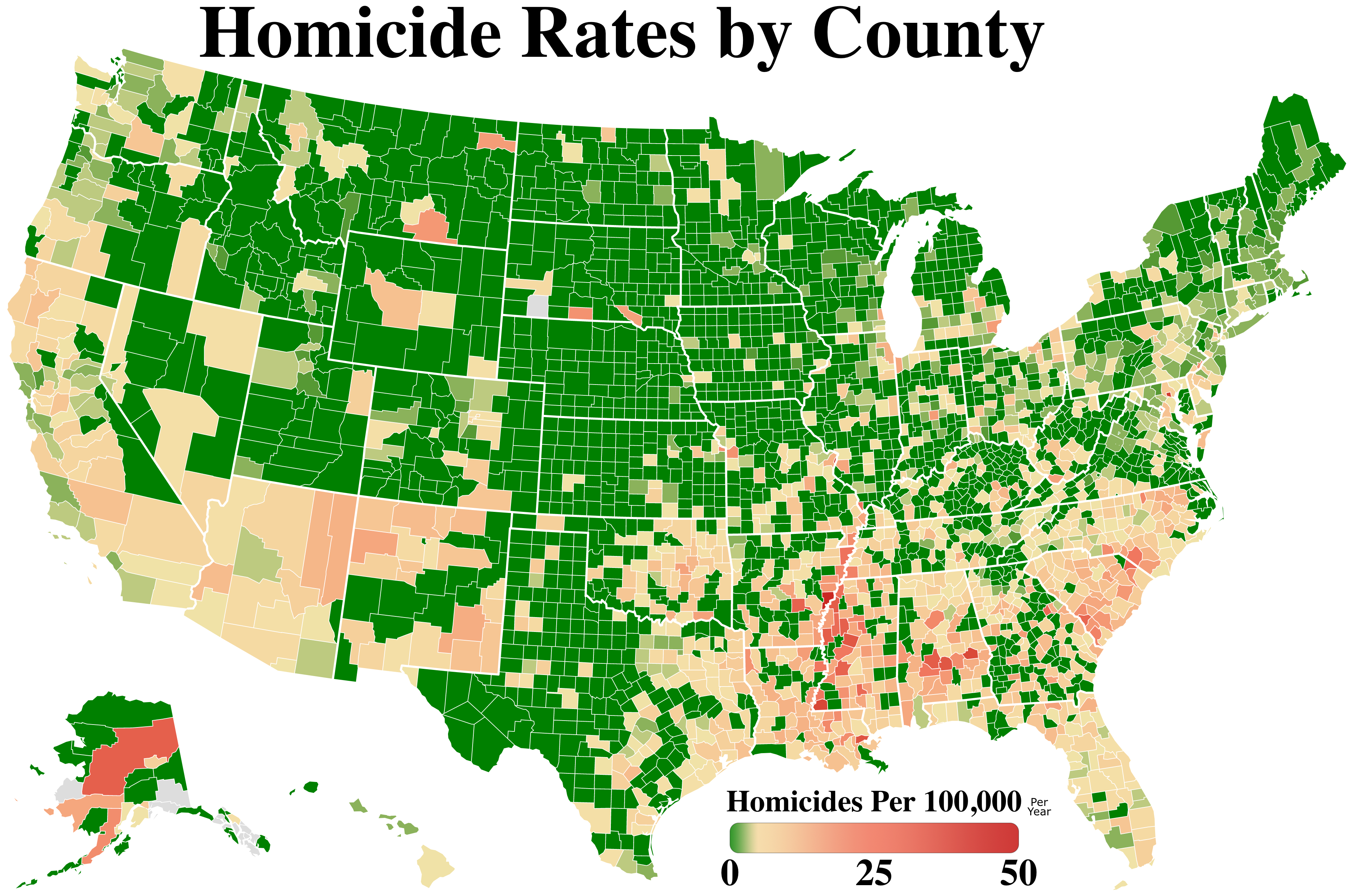
I’ll grant you that the average of 5 homicides per 100,000 is higher than the average for most European countries (which run around 1 or 2 per 100,000, iirc), which is a point in favor of Europe. But recall again that not all parts of America are the same. I said before that crime and violence are concentrated in hot spots, and I stand by that: <https://upload.wikimedia.org/wikipedia/commons/2/27/Homicide...>. There are definitely parts of America that you would not be advised to move to, but most places are fine. Look closely; all of New York City, the largest city in the US, is green or the lightest tan. LA and Houston, #2 and #4 respectively, are light tan and perfectly fine places to live. Chicago (#2) and Philadelphia (#6) are worryingly pinkish. Maybe move somewhere else. San Antonio (#5), is spread across three counties that range from light green to very slightly pink; a mixed bag but overall pretty nice. San Jose (#10) and the actual location of Silicon Valley is light green.

You could live a lifetime in one of those green counties and never encounter a violent crime, let alone be victim of one. Even most of the light tan places are great places to live, with homicide rare enough that you’ll probably never be personally affected. It’s just the red ones that you have to avoid.

Are you sure you're not shell shocked? It shouldn't have to be like this.