|
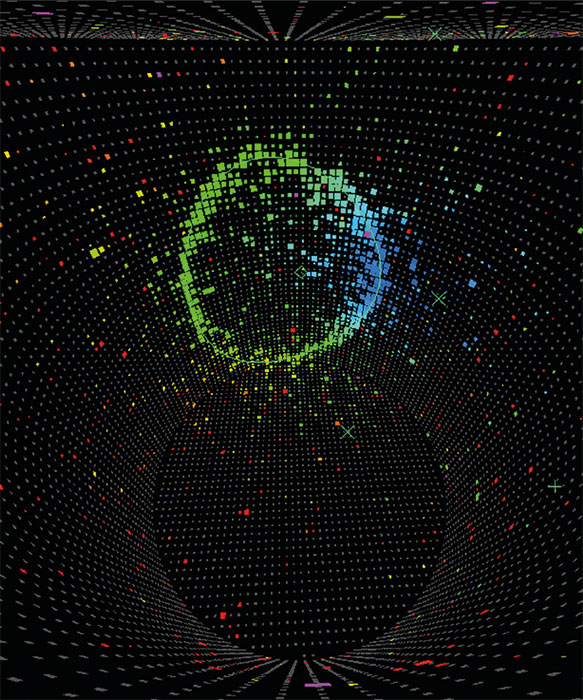
The only neutrino detector placed in a salt mine was the IMB detector. That detector was ~10kt of water observed by ~2 thousand photo-detectors, it was located ~600meters underground. The only neutrino detector that's a mile underground was the SNO detector, which was ~1kt of water, observed by ~10 thousand photo-detectors. The SNO detector is still running today as the rechristened SNO+ experiment. Both the IMB and SNO detectors used electron scattering to observe neutrinos, a neutrino comes in and bumps into an electron orbiting an atom, the electron & neutrino both then go flying off. The electron will usually go off in the same approximate direction that the neutrino was traveling, conservation of energy and momentum requires that. The electron, if energetic enough, emits Cherenkov radiation as it goes. Cherenkov radiation is just the light equivalent to a sonic-boom, it is emitted in a cone centered around the electrons direction of travel. The light from that cone is detected by the photo-detectors. Crucially, both the interaction process (electron-scattering) and the detection process (Cherenkov radiation) will preserve the directionality from the original neutrino (for the most part). The pattern of photo-detectors that gets hit by the Cerenkov light can be analyzed to reconstruct the Cerenkov cone and estimate the original neutrinos direction. Here's an example of an observed Cerenkov ring at the Super Kamiokande detector, although this example is very clear, the Cerenkov rings aren't always so obvious.
https://cerncourier.com/wp-content/uploads/2016/07/CCthe1_06... Also the Super Kamiokande experiment used this sort of analysis to produce a "neutrino picture of the sun", which is kind of a predecessor to the OP image.
https://www-sk.icrr.u-tokyo.ac.jp/en/sk/about/research/ The IceCube detector is somewhat different. Their photo-detectors are buried in the Antarctic ice at various depths from ~1-2km and spread out over a roughly 1-cubic km volume, which is ~1Gt of water. I'm not exactly sure how many PMTs in total they have, I reckon its probably around 5-10 thousand. Since their PMT array is so much less dense than the previously mentioned experiments, they can only observe very high energy, very bright, light flashes. So neutrino sources that are low energy, like the Sun, are invisible to them. But, they can see sources that are very high energy, and Ice Cube's extraordinary size lets them observe interactions that are rare/infrequent, such as those from very far away galaxies. High energy neutrinos will almost always interact via "Deep Inelastic Scattering" (DIS), which is basically the neutrino hitting the protons & neutrons within an atomic nucleus. Since DIS is a scattering process, conservation of energy/momentum requires the scattered particles will preferentially travel in the same direction that the incoming neutrino was traveling in. After that Cerenkov radiation is produced from the scattered protons & neutrons, and that Cerenkov radiation still is emitted in a cone pointing in the direction of travel. So once again, the interaction (DIS) and detection (Cerenkov radiation) preserves directional information. So the pattern of which photo-detectors observe the light can be used to reconstruct that direction, and point back to the neutrinos source (approximately). |