Hacker News new | ask | show | jobs
by EscapeFromNY 1106 days ago
> Yes, being able to read smart contracts and audit transactions on the blockchain is how everyone knew FTX stealing customer funds from years ago.

Yes in fact! Anyone who looked into it knew. Maybe Wall Street and VCs were duped, but the crypto industry itself saw the train wreck coming from a mile away and distanced themselves from the start. That's why when the inevitable happened, the mainstream were pumping out articles about FTX disproportionately to its importance -- they were the ones that got played.

https://bitcoinmagazine.com/business/the-collapse-of-ftx-was...

https://twitter.com/BitcoinIsSaving/status/15396053464692531...

> There are a huge number of ways crypto exchanges pull of scams

There are a huge number of ways Google pulls off scams too. That's what this entire thread is about and the reason for the European Commission's complaint. Hence the comparison.

2 comments

That's a load of revisionist history.

FTX's schemes were only exposed AFTER they couldn't handle withdrawals.

Anyone who follows crypto closely knows that every crypto exchange is crooked. Even crypto bros will tell you that. I can say that Binance is shady and likely stealing from their customers and I'll more likely to be correct than not. Saying FTX was shady before they were exposed was not a bold statement.

Not revisionist, you can literally just search reddit for posts from before the collapse to confirm.

https://old.reddit.com/r/BitcoinMarkets/comments/cj5ovr/ftx_... (2019)

https://old.reddit.com/r/CryptoCurrency/comments/m6b53a/sbf_... (2021)

You're right about Binance, but the same wouldn't be true about Fidelity, Coinbase, Kraken, etc. People with an axe to grind about crypto like to pretend the industry is homogeneous and always complain about the likes of FTX and Binance (who are in the news a lot for reasons you'd expect), but conveniently never have anything to say about the exchanges with a good track record that people actually use and trust.

Of course FTX was doing shady stuff. Every crypto exchange does it. You can find examples of crypto exchanges doing shady stuff everywhere.

But no one figured out that FTX was 100% scam, moved billions from their customers, commingled funds with Alameda until after the collapse. This is despite being on the blockchain.

My point is that the transparency of blockchains does not matter for crypto exchanges. They have a million ways to scam their customers without being noticed on chain.

Yes, that's where the saying "not your keys, not your coin" comes from. But that's another deep rabbit hole.

Since this thread is about Google (don't forget), what's the equivalent of "not your keys" for Google ads? That's why it's an apt comparison, and the subject of the EU's complaint.

>> Yes, being able to read smart contracts and audit transactions on the blockchain is how everyone knew FTX stealing customer funds from years ago.

> Yes in fact!

Your first link is someone saying "I told you so", but there's no mention of reading smart contracts or auditing blockchain transactions. Instead it's something like, SBF seemed very fishy to him. Ex, "if you actually listened to him speak, it was obvious that he was a bumbling idiot who didn’t really grasp the industry he was supposed to be a domain expert in." Your second link is an example of someone doing something similar, again without using anything on-chain.

> the crypto industry itself saw the train wreck coming from a mile away and distanced themselves from the start

This is a pretty hard claim to support, and two people who said "this looks suspicious" isn't much evidence in that direction. When I talked to crypto people pre-2022-11 they were generally positive on FTX (but crypto is large and diverse and this is also saying very little).

Those are fair points.

Here is someone using blockchain analysis in 2021 https://old.reddit.com/r/solana/comments/qs3hb5/alameda_buyi...

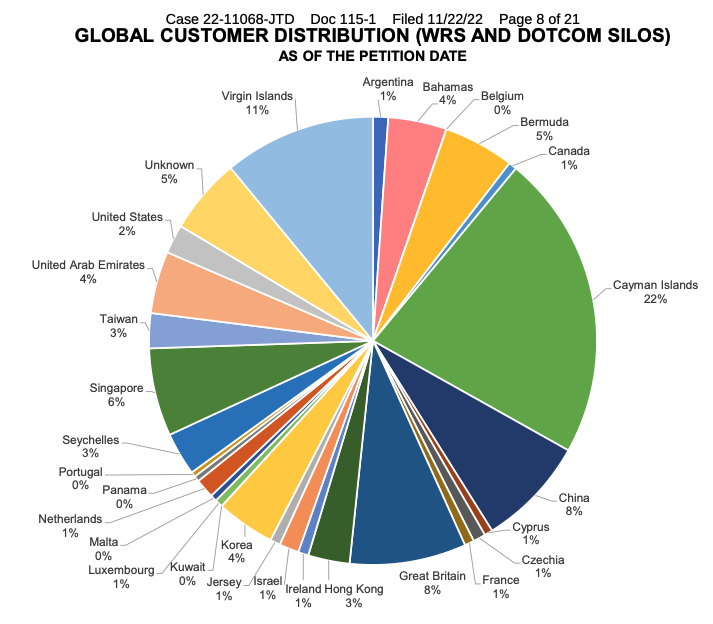
My memory of general sentiment is different, but again you can't prove something like that. As far as hard data, all I can think to offer is this breakdown of FTX's creditors by country, compiled from the bankruptcy filing.

https://nitter.net/pic/orig/media%2FFiMwSncXEIMlb70.png

The creditors are 2% USA customers, 93% offshore customers, 5% unknown. The USA did not trust FTX at all.

The Reddit link is analysis of public information, but the gist of that comment thread seems to be "Alameda is buying, I'm going to buy too" and not "evidence of improper FTX/Alameda separation".

With the customer distribution, how much of this is downstream from the crypto industry avoiding high-regulation countries? The biggest two are the Caymans (22%) and the Virgin Islands (11%) -- how many of those people are really Americans?

1. You're right, that link isn't relevant on second look. I do remember a specific thread but I could be misremembering and my google skills are failing me (or maybe the subreddit has gone private?) I'll concede the point.

2. They could be, but if an American retail trader sets up an offshore company to do their trading with to avoid regulation, you're not a regular joe anymore, you should know what you're getting yourself into and I don't have a lot of sympathy.