Hacker News new | ask | show | jobs
by oAlbe 1106 days ago
At risk of sounding stupid in public, what does that epilogue mean? I've read it several times now, and aside from being surprised at how fluid it still reads despite the parsimonious use of punctuation, I really can't figure out what it's talking about.
10 comments

It's often interpreted as a critique of manifest destiny, the idea that settlers were destined to expand across North America. He's describing that westward expansion in abstract terms.

The man digging holes is a pioneer. McCarthy isn't really clear on what he does; intentionally so. He might be digging fence holes, making campfires, building railroad tracks – it doesn't really matter.

The wanderers are the settlers following the pioneer westward. They appear to be coordinated by some force, like the pieces of a clock. This is arguably the "go west" attitude of manifest destiny.

"...they appear restrained by a prudence or reflectiveness which has no inner reality" is McCarthy's true criticism of manifest destiny. Retrospectively, we glorify settlement of the west and slot it into a clean narrative or progress. But in its time, the expansion was chaotic, violent and devoid of morals. People were just walking hole-to-hole for the sake of finding the next hole.

Some wanderers collect bones and some don't. Perhaps McCarthy means that some wanderers kill, but we don't know. From McCarthy's nihilistic viewpoint it doesn't matter because the westward expansion is moral-less so killing someone isn't different from collecting bones on the ground.

This contrasts with the moral good vs. evil narrative usually applied to the old west (see anything written on cowboys vs. indians, sheriff vs. bandits, etc.) McCarthy portrays the old west outside of a moral framework. Horrific violence happens and there's no explanation or justification.

I'll just add: in my own opinion this epilogue is a bit of literary trickery. Like the past, it's difficult to parse. As the epilogue, it naturally occupies a place of significance. This must be the key to understanding Blood Meridian!

But after wracking your brain trying to decrypt the message, you realize that it just says there is no greater meaning to the violence of the book. It is just people doing things on a vast plain.

It's almost as though McCarthy is saying to us, "See? You're still looking for a deeper meaning that does not exist."

I’m about halfway through this book and I’d say this is a very apt explanation, but a bit handwavey.

McCarthy seemed to deal _absurdly well_ in the banality of the pitches of life, both high and low. One always leads to another. It’s a sort of nihilism but with a karmic baseline. Reading his prose I got the sense I shouldn't make much out of anything, but all the same, it still happened and is worth talking about.

Yes, I think the detail and lyricism of the prose intentionally causes us to look for a moral framework for the story.

Many readers feel cognitive dissonance from this book: there’s so much detail, it must add up to some moral lesson. You’ll hear people say, “Blood Meridian is an amazing book, but I don’t understand it.”

They’re still trying to apply a moral label to the story and can’t find one. To quote The Judge, “Your heart’s desire is to be told some mystery. The mystery is that there is no mystery.”

McCarthy’s message in Blood Meridian may be that we see a higher fidelity picture of the old west if we don’t attempt to fit events into a moral arc. Still worth discussing, but we must abandon good vs. evil as a framework if we want a glimpse at the truth of what happened.

I'd like to say that this is one of the best explanations of the epilogue I've ever read. Thank you.
When I read it without any context I could see the dawn of human civilization (and progress) in it as well (you can think that the man is trying to make fire, for example). I guess the vagueness allows for many interpretations and the parallelism between these interpretations gives a sense of profoundness. I wonder if the ancient texts, like Torah or Daode Jing, were written with the same intent :?
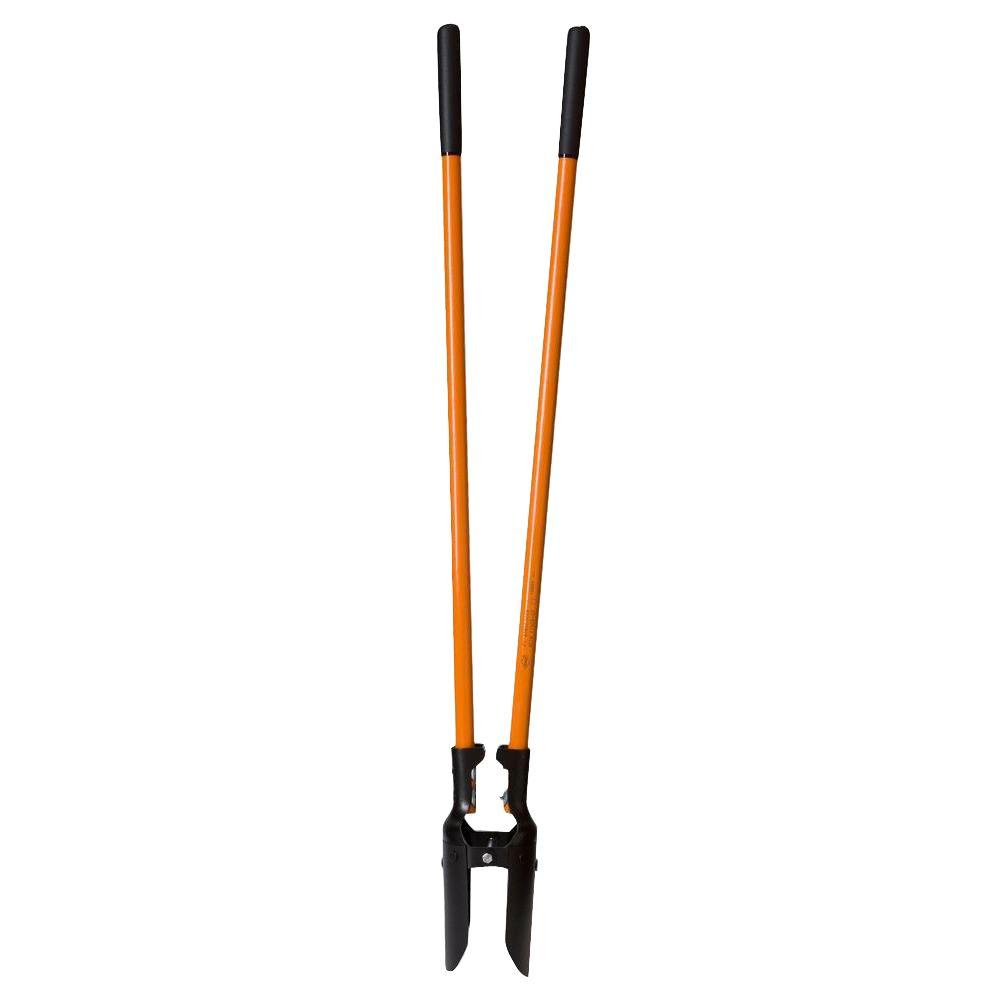
he is describing a man using a posthole digger, and hence the enclosure of the west
I’ve always interpreted it as post holes as they fence in and close the Wild West.

He uses an implement with two handles and he chucks it into the hole and he enkindles the stone in the hole with his steel hole by hole striking the fire out of the rock which God has put there

A post hole digger has two handles. When you’re using it in rocky ground you hit rocks and make sparks.

Picture:

https://images.homedepot-static.com/productImages/ed49f7f1-a...

Yeah, the interpretation of that scene as an elegy of the end of the “wild West” through fencing, feels obvious if the reader has read what McCarthy wrote next after Blood Meridian: the Border Trilogy, where some 20th-century Texas romantics are already dealing with that fencing-off.
I'm quite sure he means a post-hole digger. I can practically smell the odor of digging in rocky soil with those, coming off the page, almost feel the cracked dust-sweat-caked knuckles of setting posts on a hot, dry day.

[EDIT] As for the rest, putting aside metaphorical readings, the clockwork-like progression and repeated crossing of the line of holes calls to mind the stop-and-start movement of running barbed wire and working a ratcheting tensioner tool behind the one digging the holes, and in the right country, the curious among those workers may pause to reflect on the remains of long-dead things (fossils, "bones"—fish, horse, bison, mammoth, spine-like crinoid stems, shells and coral from an eons-dead sea, even dinosaurs—the ranches and farms of the West largely sit atop the shallow graves of life's history on Earth) sitting flat in the dirt or exposed by the digging, while others may pay them no mind. There's definitely a defensible reading of this as on the surface a plain, if oblique, description of a work crew running a fence line—not just the one digging the holes, but the whole set of folks described. I'd wager that's what's intended (though not the only thing intended), in fact.

It is also related to the judge's quest to name all things. The relationship is measurement, a fundamentally human activity... or perhaps fundamental to the way our civilization is doing human.
Not stupid at all! There's a long tradition of figuring out what it means (just google "Blood Meridian epilogue"), but the short answer is that McCarthy was probably playing around with ideas, having a bit of fun, waxing poetic. But there's some elements in the passage about determinism, causality, exploitation, the man with the instrument being a "pioneer" of the American West, the holes being railroad tracks, or fence posts, or mine stake poles (referencing the imminent gold rush), etc.

Like like with all poetry, it's a joy to think about and dissect.

I'm not a strong reader and Blood Meridian took me a few times to read and appreciate. I just remember thinking how crazy it was that almost the entire page was a single run-on sentence. I really liked the book but it was difficult for me to read and understand.
Some say it's more like approaching poetry than prose with his work. There is certainly causality and narrative development in his writing, but he often uses his magisterial command of language to impart a cosmic dimension to the simplest of instances or utterances.
It’s not all like that. Just the things that can’t suitably be explained as events. The native assault on the brigade comes to mind. How could you adequately describe such an event with words. It’s a horror poem in the way he writes it and if you haven’t read it, it is as chilling as it sounds.
It's a great book, but it was depressing enough the first time I read it. I can't imagine reading it several times :(
My reaction to McCarthy has been similar. After trying a couple of his works, my reaction was that he was primarily focussed on the nasty side of humanity. We people can be nasty, but - like much of today's news - he fails to balance that with our positives. There are a lot of grays between black and white. Great authors manage to show them all.
I am actually not sure. I used to agree, but I've found that the best stories I've read use the good and beautiful moments primarily to make the bad moments hit that much harder. That doesn't mean there aren't good stories focussing on balance, but I'd be surprised if there is as much to explore there as there is in the depths of both good and bad.

My foremost example here would be Berserk.

Suttree is your best bet if that's what you're after.
bizarrely reductive take. You think every piece of art should try to represent the entire spectrum of human emotion?
If you like that kind of writing, you would enjoy “Autumn of the Patriarch”. Probably Marquez’s best prose work.
Samuel Delany also has that fever dream wandering style of prose for me.
Or Wyndham Lewis’s ‘The Childermass’, which is 300 pages odd without chapters, just one continuous chunk of prose.
Stephen had a great quote - which I cannot find tonight - that Cormac McCarthy was like some pop music. It was ok to like it even if you couldn’t make out every lyric.
I'm right there with you. It was definitely a difficult read and I often found myself going back a few pages and re-reading sections. Many times.
There a couple themes in this particular passage that really come through to me: steel/fire/stone, the holes in the earth being a “path”, the wanderers following a command they can’t comprehend. To me it evokes it’s a commentary on the weary fatalism of westward expansion, the grim meaninglessness/banality of evil of the nascent industrial revolution. I really love the idea of those exploring the west as a gang of bone-collectors, which tracks with BM’s ghastly but realistic scalp economy.
I get the sense that McCarthy didn’t just find banality in evil but also in beauty and good. Not that they were bad things (any more than “banal evil” is a good thing) but more that they just _are_. His storytelling always felt to me like an illustration of “how can you know what’s bad or good in the grand scheme?”
Haven't read McCarthy, however it sounds like a pretty bleak take on westward expansion of the United States across the North American continent / high plains. The hole, steel and fire metaphor brings to mind the process by which rail lines, telegraph runs and extractive industries are established. Those seeking bones brings to mind the search for grounds in which to establish extractive industries concerned with oil and some chemical precursors.

Then the rest follow blindly not truly knowing why and getting stuck with the destruction/dregs/etc.

If that is what is going on, I can't really argue about it however I'll take the more joyous propaganda tyvm.

I read on Twitter that it’s a reference to the introduction of barbed wire fencing that marked the end of the wild era that the book was set in. It makes sense but I never looked into it.
The man is digging post holes, which means he is putting up a fence.

By putting up a fence he alters so many things about the land, in a profound way, and the others who occupy that land have a relationship and reaction to this fence.

Edit: maybe it isn’t a fence. Could be set up for a railway? Or something else like early poles for wires for communication?

I’ve read a lot of McCarthy but not Blood Meridian

I'm sure it's something horrible and violent, like the rest of that book. I go back and read the ending (in addition to the epilogue) periodically trying to convince myself of one particular version of the ending and main character, or another.
Siblings talking about the closing of the American West are correct but that's not sufficient; you have to extrapolate it out to the existential scale that Blood Meridian grapples with. He's critiquing the notion of "progress" as a whole, favoring instead a view of humanity stumbling through history and all which that entails.
I'm glad you asked, the responses were really interesting. I wasn't sure what it meant either and now I can get even more out of reading it.