IMO this is getting a bit too ahead of ourselves. IIRC, Russia and Japan are the countries with the most population shrinkage, and they've just lost 5 million and 2.5 million people off their peak.
- 5 million / 148 million is 3% down from peak for Russia.
- 2.5 million / 128 million is 2% down from peak for Japan.
Most importantly, Russia's population decline (which started before Japan's) has leveled off. It hit a local minima in 2008. It has wobbled up and down, but stayed close to 143m for almost 20 years [1].
This is how populations usually work; they level off and oscillate around their carrying capacity. It's often studied in biology [2].
Shaving off 3% of the population of a country doesn't lead to deserted cities any more than other factors do. Natural resource depletion and economic factors are and will most definitely keep being bigger worries for cities (ie, droughts leading to water shortages, big employers moving out, etc).
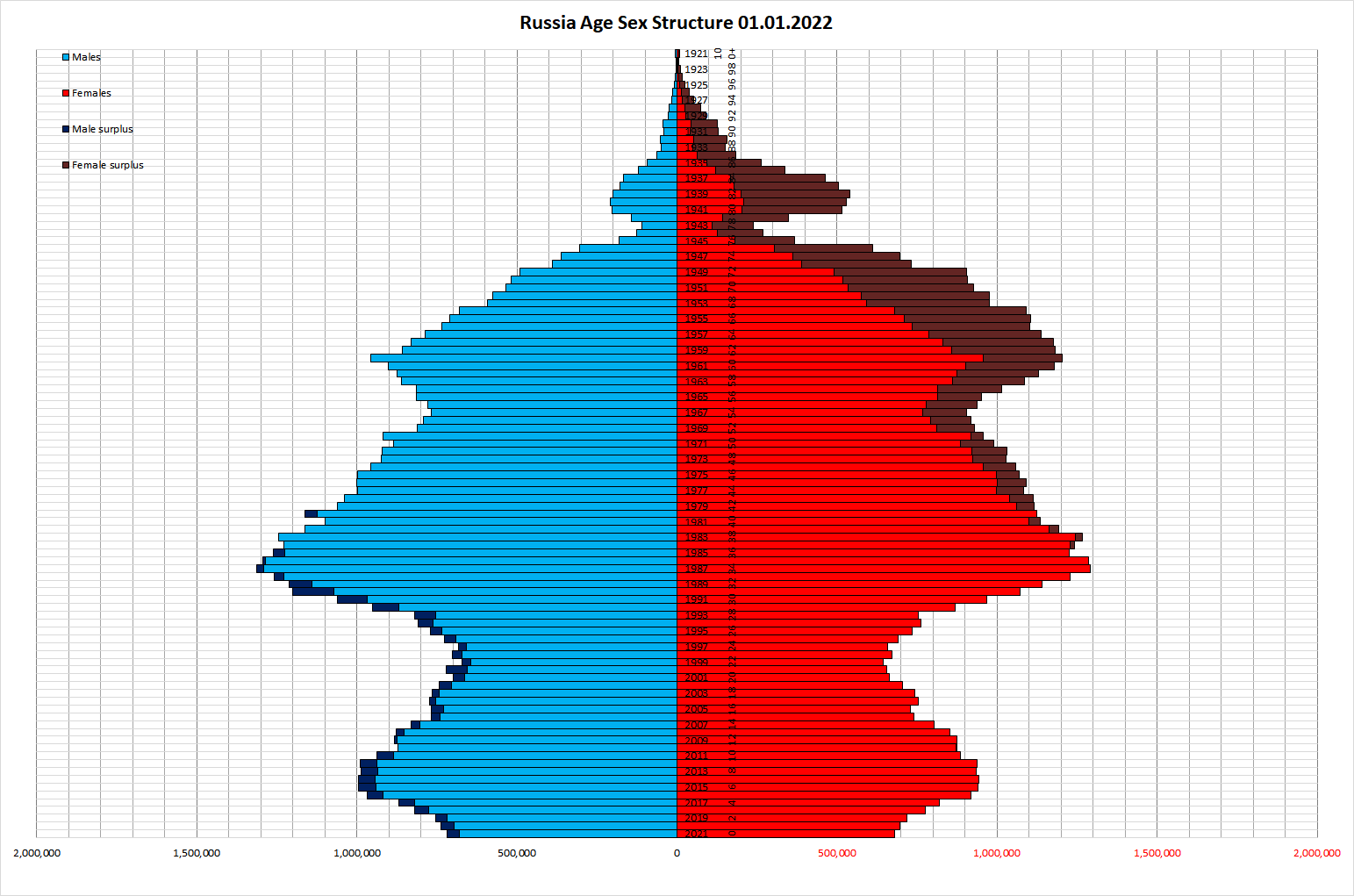
Russia: Eh, no. That's just a temporary blip caused by a lot of the people born before 1945 not having made it that far, so the population was unnaturally skewed young. Few elderly to be dying off at the time because a large portion of those people died off 50-60 years prior.
They're set for sharp decline going forward, and changes in geopolitics look likely to dry up or outright reverse their modest immigrant flows from former USSR countries.
You're right. Japan's population pyramid is inverted [1]. Personally, I wouldn't call the rate ever more rapid— it's seems quite linear given that fertility rate has been pretty steadily around 1.3 since the 90s [2], but it is definitely still shrinking.
Russia's population pyramid does seem to suggest a big dip once the generation born in the 80s passes away, but it doesn't look like a reversed pyramid just yet. The generation born in 2021 doesn't seem considerably smaller than the one born 20 years ago [3].
Russian population decline has been compensated for with a great number of immigrants from Central Asia (plus occupied Crimea; that's not recognized internationally but is obviously a factor for their economy). It'd probably be more like 138 million modulo those and their children, perhaps less.
That's an interesting point; Crimea has about 2 million people. This doesn't seem to show on the charts though, when in theory it should look like a spike around 2014, no?
Well Russian charts do show it, because since 2015 Russia includes Crimea in internal stats. As you can see it's also growing in 2022, despite there being consistently more deaths than births for years on end. I suppose we can infer what this means.
I've thought about this, and I'm no expert, but I've come to be convinced this is how reaching carrying capacity is meant to feel.
It's easy to imagine it as some sort of famine, where there isn't enough food to feed children, or overcrowding so extreme that everyone lives in slums and it's simply impossible to have kids. If it ever reached that point, a population graph would show a sharp fall, not a steady leveling-off.
When I think about previous generations in my country (Mexico) they seem more care-free. They loved someone, they had babies. One single head of household could afford to buy a house. It was a house too, not some tiny apartment!
I look at my life though and it just seems a little more stressful in a bunch of small ways. The squeeze is gentle, not abrupt, but it's there. Living spaces seem smaller, which adds a little stress. Comparing vs old photos, the city just looks more crowded, more full of traffic, which adds a little stress. In their 20s my parents weren't thinking about the environment, but I am, which adds a little stress. I think about the living standard I could give my kids more than my parents seemed to; I just can't shake the thought that my kids need to stand out from the huge crowds of people there's now, which adds a little stress. At the end of the day all these little bits of stress add up and lead to me not wanting kids any time soon.
Perhaps this is what approaching a population cap is meant to feel like. Just stress here and there, leading to less fertility, rather than some hard physical limit.
In other words, we are like a mouse population. If a cap is reached, fertility sinks (but for mice also mortality rises as well. We humans are lucky in a way compared to mice.)
Total population has oscillated for 20 years, but it would be mistaken to conclude that it's reached steady state because it's also been aging all the while. Meanwhile, TFR in Russia has been sub-replacement since at least 1990.
Unless Japan's birthrate picks up, its population is slated to fall by a lot more than 2% from its peak. Try 50% or more. A birthrate below 2.1 children per woman leads to extinction.
This is true, Japan's population pyramid [1] looks way more dire that Russia's [2]. Russia's does seem to suggest shrinkage after the big generation born in the 80's passes away, but oscillation afterwards. Japan's is an inverted pyramid.
More likely - dried out husks of small cities that shrivel up and die. Look to the US rust belt as a historical indicator.
For modern times, climate change has made it impossible to insure some areas of the US (Norther CA fire country, Florida hurricane corridor, etc). Insurers are going out of business or just not paying claims.
Small cities died because of increased crop farming efficiency, factory livestock farming and decreased heavy industry/manufacturing in the US.
I absolutely love the doomerism in your second paragraph. If you listen to those who buy into the whole climate armageddon thing, you would think that by 2030 large swaths of the US are going to be uninhabitable or under water.
No, the West isn’t going to burn away. We just need to resume good forestry practices and not build houses in precarious places.
Similarly in FL, this has little to do with “climate change” but rather an elimination of Government subsidized risk taking so the full insurance cost is bore by the property owners and not taxpayers.
Why? What if those left alone in rural areas end up moving to cities for the exact reasons they already do? At least that is what happens right now. Rural areas do nothing to make the young stay. If you don't own a car, you are lost. Most jobs are mechanical in nature, software almost nowhere to be found. And the cities are growing, slowly, but they are. What maes you think this effect would be changed just because overall, population goes down?
Haha, if we are talking about the final outcome of zero population, of course the cities are empty. But until then, there is still some way to go. And I am pretty convinced people will flock together in cities instead of withering away lonely in the countryside.

- 5 million / 148 million is 3% down from peak for Russia.
- 2.5 million / 128 million is 2% down from peak for Japan.
Most importantly, Russia's population decline (which started before Japan's) has leveled off. It hit a local minima in 2008. It has wobbled up and down, but stayed close to 143m for almost 20 years [1].
This is how populations usually work; they level off and oscillate around their carrying capacity. It's often studied in biology [2].
Shaving off 3% of the population of a country doesn't lead to deserted cities any more than other factors do. Natural resource depletion and economic factors are and will most definitely keep being bigger worries for cities (ie, droughts leading to water shortages, big employers moving out, etc).
[1]: https://data.worldbank.org/indicator/SP.POP.TOTL?locations=R...
[2]: https://www.khanacademy.org/science/hs-biology/x4c6733622308...