|
Well, obviously what I say must be wrong if you guessed that someone might say it. Indeed, someone might say "95%" because they want to make the same sort of impression as if they said "100%" but to be able to hide behind it if they're wrong. Or, y'know, they might say "95%" because they've thought about the strength of the evidence and expect to be right about such things about 95% of the time. (I'm not sure how relevant any of this is to "An Inconvenient Truth" since you say it makes its claims with 100% confidence. I haven't watched the movie. I don't know exactly what it claims how confidently. It's basically a work of propaganda and I would expect it to overstate its claims whether the underlying claim is largely right or total bullshit or somewhere in between.) Of course I don't think counting smart people is the only way to find out what's true. It couldn't be; you need some engagement with the actual world somewhere. Fortunately, there are plenty of people engaging with the actual world and reporting on what they find. It turns out that those people almost all seem to agree that climate change is real and a lot of it is caused by human activities. Of course they could be wrong. And you've looked at the evidence, so no doubt you know better than they do. But ... in that case, this is a field so confusing that most people who dedicate their whole careers to investigating it end up with badly wrong opinions. If so, then why should I trust that your looking at the evidence has led you to the right answer? For that matter, why should you trust that? Shouldn't you consider the possibility that you can go astray just as you reckon those "smart people" did? If I really wanted to be sure about this, then indeed I wouldn't go counting smart people. I would go into the field myself, study it at length, look at the underlying data for myself, and so forth. But that would mean abandoning the career I already have, and taking at least several years of full-time work before arriving at an opinion. So instead I look to see who seems to be (1) expert and (2) honest, and see what range of opinions those people have. I find that the great majority of experts think anthropogenic climate change is real and a big deal. They could be wrong or lying or something. Do they look less expert than the people saying the opposite? No, it mostly seems like the people with the best credentials are on the "orthodox" side. Do they look less honest? Hard to tell for sure, but there sure seem to be a lot of people on the "unorthodox" side who just happen to be funded by the fossil fuel industry, and I don't see any strong financial incentive in the opposite direction for the "orthodox" folks. What if I look at some of the particular claims they make? Some of them are really hard to evaluate without those several years of full-time work. But e.g. 10-15 years ago pretty much everyone on the "unorthodox" side was pushing the idea that warming had stopped, because if you look at the temperature graphs from 1998 onwards there was little or no upward trend. The people on the "orthodox" side replied that when you have signal plus lots of noise you will inevitably get periods that look that way. I did some simpleminded simulations and verified that the "orthodox" folks are right about the statistics. And there's a reason why this argument has disappeared into the memory hole: looking at the graph now no one would suggest that it's flat since 1998. My impression from the limited amount of "looking at the evidence" I've done myself is that, while the "orthodox" folks haven't been infallible, they've done better than the "unorthodox". For instance, since we're looking at things produced by political figures rather than scientists, here https://web.archive.org/web/20071015042343/http://www.suntim... is an article by James Taylor of the Heartland Institute criticizing "An Inconvenient Truth". Claim 1: Gore says glaciers are shrinking but an article in the Journal of Climate says Himalayan glaciers are growing. Truth: (1) Taylor's alleged quotation isn't from that article but from something else Taylor himself wrote; (2) what the article (https://journals.ametsoc.org/view/journals/clim/19/17/jcli38...) actually says is that in one particular region summer temperatures are falling while winter temperatures rise, and the result is "thickening and expansion of Karakoram glaciers, in contrast to widespread decay and retreat in the eastern Himalayas". So: no, Gore isn't wrong to say glaciers are shrinking, but in one very particular place things work out so that the reverse happens, which is odd enough that someone bothered writing a paper about it. Claim 2: Kilimanjaro. Truth: Yup, Gore got that one wrong. Claim 3: Gore says global warming causes more tornadoes, and the IPCC says there's no reason to think it does. Truth: I dunno, but if the IPCC says that then this is specifically an argument about Al Gore rather than about climate orthodoxy. Claim 4: similar, for hurricanes instead of tornadoes. Truth: again, this seems to be specifically about Al Gore rather than about climate orthodoxy. (Looking at e.g. https://www.gfdl.noaa.gov/global-warming-and-hurricanes/ it seems that the conventional wisdom today is that yes, hurricanes are getting worse and are expected to continue gettings worse, but we don't know with much confidence exactly what the causes are.) Claim 5: Gore says that African deserts are expanding because of global warming, but in 2002 someone found them shrinking. Truth: the Sahel region of the Sahara desert had an extra-severe drought in the 1980s, after which in the short term it improved; this is like the "global warming hiatus" post-1998. The Sahara seems to have increased in size by about 10% over the last century, partly but not wholly because of climate change (https://www.jstor.org/stable/26496100). Claim 6: Gore says Greenland's ice is melting, but actually it's thinning at the edges and growing in the middle and the overall effect is that it's gaining a bit of mass. Truth: take a look at the graph at https://climate.nasa.gov/vital-signs/ice-sheets/; it oscillates within each year but there is an extremely clear downward trend over the entire time NASA's satellites have been measuring. Claim 7: similarly for the Antarctic. Truth: Look at another graph on that same page. There's more random variation here, and circa 2006 you could claim that there isn't a decrease, but the trend is extremely clear. Gore doesn't come out of this looking anything like infallible, but he's done a lot better than Taylor. And, in general, this is the pattern I see: no one is perfect, especially people who aren't actually scientists, but the claims of the "orthodox" tend to hold up much better over time than those of the "unorthodox". |
1. Yes I believe independents are more reliable than full time researchers because the latter are deeply conflicted and independents aren't.
2. They don't work for the oil industry. I've checked. That's propaganda designed to stop people listening.
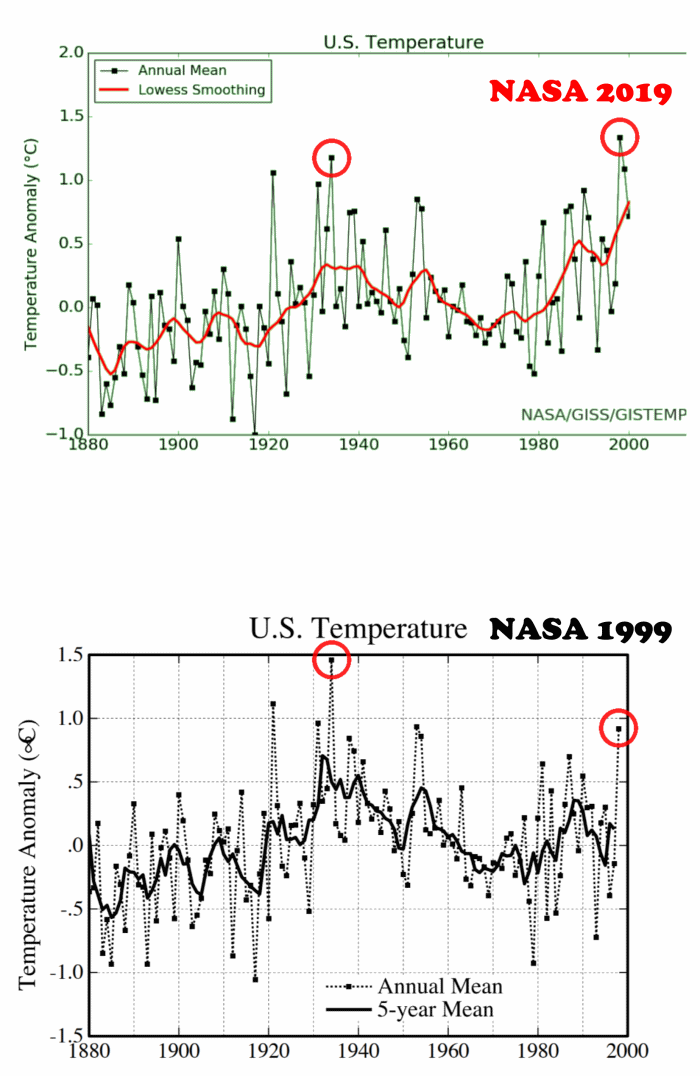
3. There was in fact a very real pause, not simply due to statistical chance. Climatologists didn't predict that and fixed the problem by altering the historical record to erase it. That's why you can't see a pause now - not because there wasn't one, but because any time temperature graphs don't go according to plan, they change the databases with the measurements so they do. Look into it. There's another pause going on right now! In fact temperatures seem to have been stable for about 20 years modulo an El Nino in ~2015, which is natural.
4. A big part of why they're unreliable is that these guys don't engage with the real world. A major embarrassment for them was when people started driving around and looking at the actual ground station weather stations and discovered what an unusable data trash fire the ground network was - this was something climatologists themselves hadn't bothered to ever look at! You'd expect these experts to know more about the quality of their data than random bloggers but it wasn't so.
5. Where do you think Al Gore got his original claims? He didn't invent them out of whole cloth. They came from climatologists, of course.
You can go back and forth on climate related claims all day and get nowhere because the field is so corrupt that half the data is truncated, manipulated, tipped upside down, cherry picked, or wholesale replaced with the output of models whilst being presented as observation. It should go without saying but if the people who control the data also make the predictions, then they will never be wrong regardless of what happens in reality!