Hacker News new | ask | show | jobs
by tptacek 1123 days ago
If your browser ignored all certificate errors, you'd have a real security problem. That's not at all the case for DNSSEC: it's possible that all of the DNSSEC root keys could hit Pastebin and nobody would really need to be paged.
1 comments

Browsers did ignore most certificate errors back in the early 2000s. HTTPS sites were fairly rare and most people did not care about it or even considered https to be a negative. Many administrators considered it as bad technology that only increased instability with no obvious benefit. "Who cares about what people post to a forum?" was something I personally heard when I added https to one site. It was only really banks with plain passwords that needed https, and then external hardware devices really made https obsolete for that problem.

For more fun diving into this topic, I can recommend a famous old presentation called the "Everything you Never Wanted to Know about PKI but were Forced to find out", and godzilla crypto tutorial written by the same author (Peter gutmann). The certificates in browsers has had a long history of problems and ill designs. People did not like them, and they definitively did not like them when they caused major issues.

> Browsers did ignore most certificate errors back in the early 2000s. HTTPS sites were fairly rare and most people did not care about it or even considered https to be a negative. Many administrators considered it as bad technology that only increased instability with no obvious benefit.

I’m not sure what you’re basing that on but every claim is the opposite of my experience back then. Even in the 90s it was expected that you used HTTPS for any site selling things, for example, as the credit card companies would block a business who let numbers go over the network in plaintext.

Early on there were concerns about performance but that was mostly over by the turn of the century for all but large file transfers. The primary drawback was the cost of a certificate back then.

I recall well those discussions. Web stores did indeed often use https to protect credit cards. The argument was however that physical stores did not need to have similar protection, and that the issue really was with the weak security of credit cards. HTTPS was a unstable solution for a problem which people argued should had been solved with the credit card system. Physical security devices was again lifted as the future solutions to this problem.

It should also be mentioned here that credit card numbers as a security token has actually slowly been phased out in favor of other forms of payment systems online, and many banks today implement additional security requirement if you pay with a credit card. Black market with stolen CC numbers, despite https use by web stores, used to be one of the biggest issues with the internet, so even with all the stores using https it wasn't a solution to that problem.

I remember people talking about performance issues with https until the early 2010. "Every single micro second slower means reduced sales" was something people was very concerned about. I even heard it from people during an IETF meeting. It was talked in similar tone to how people today talk about SEO.

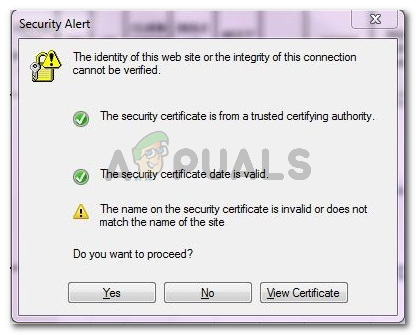
Old certification invalid dialog was terrible. I believe most people just ignored it. https://cdn.appuals.com/wp-content/uploads/2018/11/identity-...
Yes, that’s why I found the assertion that it didn’t exist so odd since almost anyone who supported web sites or browsers back then was familiar with that dialog.
Links:

Everything you Never Wanted to Know about PKI but were Forced to Find Out:

<http://www.cs.auckland.ac.nz/~pgut001/pubs/pkitutorial.pdf>

Godzilla Crypto Tutorial:

<https://www.cs.auckland.ac.nz/~pgut001/tutorial/>