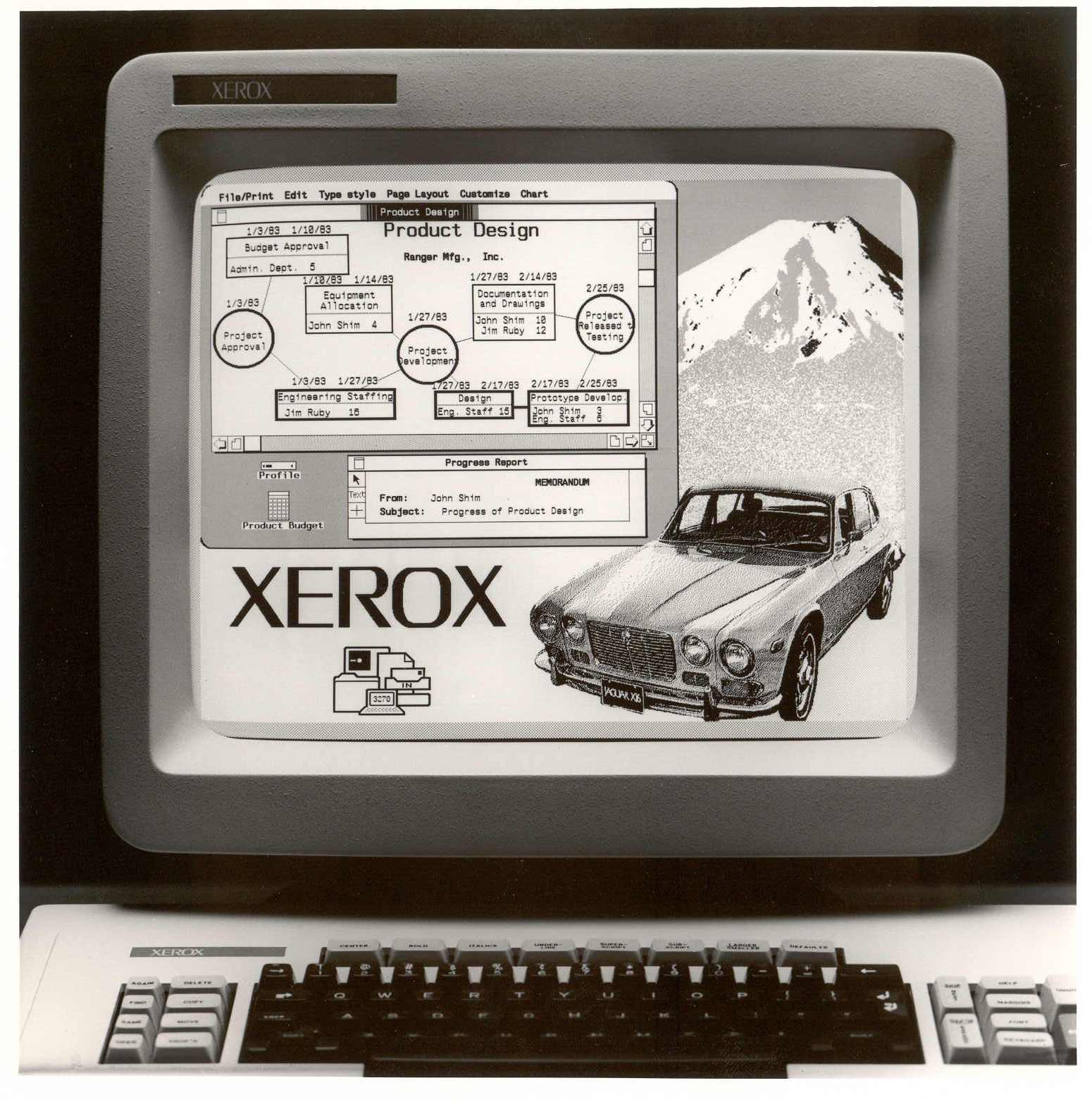
An interesting detail is the substitute Lisa system font.
(I'd conclude, this is either a handmade drawing, or a screenshot of a prototype before Apple settled on the final font. Maybe used as a comparison showing off the use of bitmapped images on the Star, something not available on the Lisa? And/or, as indicated by another comment, comparing screen sizes?)
Also, mind the slight angle at the top edge, where the screen content and the monitor meet. I guess, this is not a screenshot but a montage.
The screenshot seems to be based on one from a Lisa brochure here: https://archive.org/details/AppleLisaBrochure/page/n12/mode/... (page 13 if link doesn't go to the right page, the LisaProject example). Seems to be some sort of remake as beyond the brochure example being very low res things like text spacing are different (circles cutting off bits of text inside them is obvious one on the Alto shot).
The Lisa was in development at the time, so apparently someone at Apple shared it. Strange thing to show off in your Xerox demo! (showing how much larger the screen was is my guess)
Lots of Lisa history on that. The only real thing if I remember correctly that Lisa copied from Star was the desktop itself after viewing a the NCC.
Software architecture wise however the two systems shared many concepts (but not tools or languages) that probably are traced back to the same roots at Xerox but otherwise were independently developed. For example Apple used Clascal (object oriented pascal) while that added an object oriented layer to Mesa. (Mesa itself was pretty much cloned as Modula 2 later if anyone wants to know more about it.)
Mesa was really a great language that was really only missing first class support for Object rather than the way it was takes on which made star a closed system. It had to do with the ‘trait’ system and the static analysis that had to be done to determine the optimal layout or class objects. It was also overly complex because of multiple inheritance. The layout was important because object size directly related to filed document sizes because the filled document was just a relocatable memory mapped image! Basically a filed heap.
Star was pretty much rewritten latter to open it up using the Basic Workstation Software although the document editor itself still used the trait system. But even then the one feature that ‘required’ multiple inheritance was rewritten to not require it (it was the tables feature).
Easy, specially if you compare his evolution as language designer in pursuit of minimalism, from his point of view both Xerox systems were too complex.
You can get hold of his opinion on this ACM session.
As nobody person in the world of computing, I don't agree with him though, I would rather have Active Oberon[0] than Oberon-07, his final language in pursuit of minimalism.
[0] - He did not took part in Active Oberon design and evolution, and it is closer to Modula-3 in features.
The image of the Lisa desktop was not running on Star. Star was software, the hardware ran many different Xerox systems. It was running under some other Xerox system/OS. Hard to say what it was. Could have been XDE (unlikely because I don’t see process bar at the bottom) or Interlisp. But defiantly not running under Star.
Almost certainly not real, or at the very least not contemporaneous. The graphics shown on screen have varied pixel pitch which isn't consistent with the Star's monochrome display. Or, for that matter, consistent with the non-square pixels you would expect from a Lisa screenshot.
I was wondering why that window has a menubar at the top! I even went through the other screenshots to see if it appeared in other places--made me wonder if pull-down menus were actually also invented at PARC.
(I'd conclude, this is either a handmade drawing, or a screenshot of a prototype before Apple settled on the final font. Maybe used as a comparison showing off the use of bitmapped images on the Star, something not available on the Lisa? And/or, as indicated by another comment, comparing screen sizes?)
Also, mind the slight angle at the top edge, where the screen content and the monitor meet. I guess, this is not a screenshot but a montage.