Hacker News new | ask | show | jobs
by thaumasiotes 1148 days ago
> Keep in mind about a third of the English language comes from Latin (the precursor to French) and another third from French itself (thanks to the Normans).

This isn't a defensible set of claims. If the French spoken by Norman vikings one thousand years ago counts as "French itself", it has an equally good claim to count as "Latin", the form of French spoken two thousand years ago.

2 comments

It's not really about who spoke it.

English contains many words which roots come from french

There is as much separation between the language of Alexandre Dumas and the language of William the Conqueror as there is between the language of William the Conqueror and the language of Theodosius, Emperor of Rome.

But you'd like to say that William the Conqueror was speaking French and not speaking Latin. Why?

The real question is: Given a text by William the Conqueror and Theodosius, how many words could a French or English speaker identify based on similarities with words he/she commonly uses?
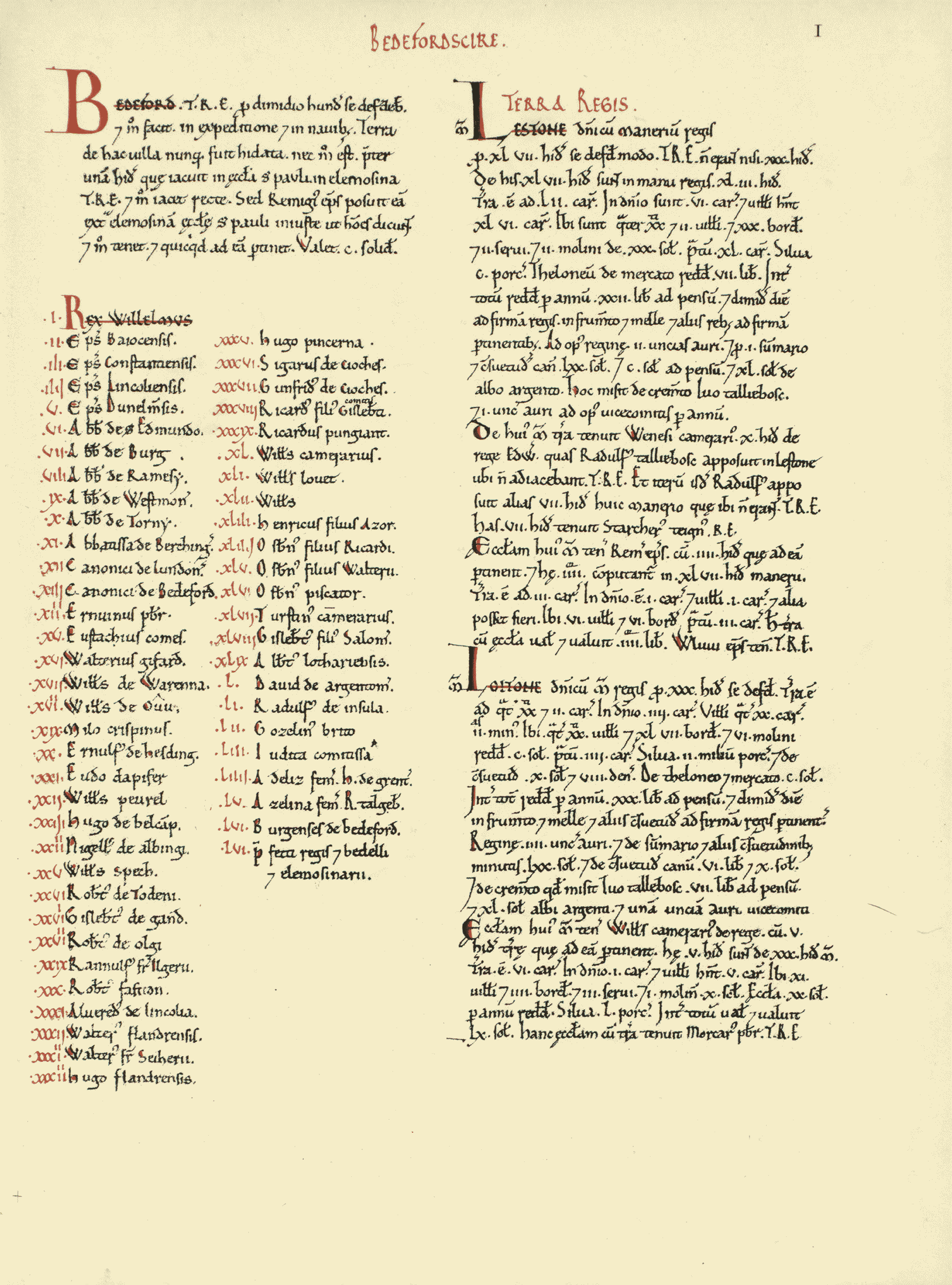
That probably isn't the question you wanted to ask. But in case it is, you can see a book compiled by order of William the Conqueror here: https://opendomesday.org/book/bedfordshire/01/

High-resolution image of the same page: https://opendomesday.org/media/images/bdf/01.png

Why do linguists consider French and Norman to be mutually intelligible?
Do they? I don't think there are good records of 11th-century Norman French. But Geoffrey Chaucer wrote in 14th-century English and he is not intelligible to a modern English speaker.

(More accurately, he is intelligible in large part! But if you try reading one page of his work, you'll notice some serious problems.

http://www.sd-editions.com/CantApp/GP/ will even read it to you in reconstructed pronunciation.)