Hacker News new | ask | show | jobs
by Latty 1166 days ago
Often the kind of thing people hate for a while, and then with enough time becomes iconic and you'd probably end up with an article about how they were debating whether to preserve it or not as it aged.

I think about this a lot when it comes to "eyesores", particularly wind turbines. When you think of how windmills are considered picturesque, it always makes me a little surprised when people moan about modern wind generation, because I think they look great. Especially when most of the areas they are put up are crisscrossed with overhead power lines anyway, which are much less appealing.

9 comments

Yeah I don't understand why people hate them so much either. I think they look nice too. Better than old-fashioned windmills.

Where I'm from in the Netherlands there's is much less resistance to them anyway because we know the alternative is for our country to be under the sea ;)

The "Levels" in Somerset (UK) were drained from the C12th much of which involved Dutch engineers later on. It's not quite the same as your polders but quite a lot of village names here basically mean "island". Glastonbury Tor may well be the origin of the fabled Isle of Avalon. The Tor is a hill that was surrounded by marshland and waterways - it was only accessible by boat. Nowadays you drive up to it. There's a tower on it - the Tor.

You may not be a fan of the old school windmills but I think they are a marvel of engineering. They were built without finite element analysis, CAD and all the rest. Take a look at say the iconic row of mills on Kinderdijk. They are pumps with sodding great archimedes screws that shuffle water from low to high. It has to be said that the Netherlands really go to grips with mills.

The old school job is a tower mill - a tower with some sails on it and a simple pair of gears or a pulley system to turn a grooved round stone over another one to mill flour.

I believe that most of the subsequent innovations in windmill technology were largely invented in the Netherlands and then copied or sold to elsewhere. By the time your forefathers (and mothers) had finished with them, you have things like a smock mill (the upper section looks a bit like a smock worn by rural workers) with a tail vane that automatically rotates the upper section of the mill into the prevailing wind. The sweeps are adjustable and can be rotated like an aircraft propellor - even feathered for a storm and the sails can be reefed much like a sailing boat's sails.

There was the post mill - with a wooden trestle that a boxy shaped mill sits on with the sweeps and sails attached. The post mill was ideal if only wood is available and no bricks or whatever to make a tower. The smock was handy if you have some bricks to make a base and a lot of wood to make a lighter structure on top. The tower is basically very strong. There are several more options. There is an awful lot more to mill construction and design choice than you might idly imagine. Stuff built 300 years ago was absolutely using what we might consider cutting edge design decisions.

Some relatives of mine renovated a towermill with an onion cap and tail vane to move the cap in Northamptonshire about 30 years ago. It took quite a few years but the flour it eventually produced was delightful. On the opening day we had to use long poles to get it started because the breeze was a bit naff. The bread baked from its flour in a big old wood oven tasted amazing.

(edit - speling)

People just hate change

source: am people

Not a blanket statement to say all change is good tho

Change is awful, so is a lack of change. We should hope the balance wheel of progress is kept near centered and that we get needed change, but somewhat slowly.
I find Americans really don't like change. Still using a penny, still using dollar bills, not using the metric system, still using Fahrenheit.
Dislike of change is a worldwide constant, like gravity.

Also, all measurement systems are functionally arbitrary - be it the kings foot, a rod in a library, or some mathematical constant - all are arbitrary, ours is just a little less rational and certainly less relational than others.

Fahrenheit is just fine however thank you. (My ideal system would be a zero to 200 system, water would freeze at zero and boil at 200, gives you the best of both worlds, and less need for half degrees in measuring the weather - or other human centric temperatures.)

The US government is an original signer of the Metric Treaty, and if you deal with the federal government you're often supplying measurements in meters and weight in kilograms. The military is metric too. Just not so much anything else.

Even bolts on our cars are metric, at least mostly. Every car I've had from MY1986 on has been more metric than SAE.

In fairness however, we're not the only English speaking country using miles still. For that matter, aviation (in most of the world) still uses feet too - inventors privilege I suppose. ;-)

Most Americans are aware of the metric system and have a vague idea of how long a meter is for example, we also know the 0 is freezing in Celsius. I don't think the costs of changing the places we use customary units would pay for the benefits, our soda cans even are usually clearly labeled at 355ml.

I agree we should get rid of the penny, and probably dollar bills, but for a bunch of historical reasons americans don't like dollar coins. (Mostly the size we picked is too close to the quarter)

> Also, all measurement systems are functionally arbitrary

It's not a question whether they are arbitrary, it's a question if they are technically consistent within themselves.

The metric system is: Everything is orders of magnitude, powers of ten, throughout all the measurements. Consequently, everything measured by base units of distance and mass follows the same rules: A Watt is 1 Joule per second, which is 1 Newtonmeter per second, which is 1 kilogramm per meter squared per second per second per second. 1 Grey (Gy) is 1 Joule of radiation absorbed in 1 kg of mass. If I have to do a calculation, I simply put the different weights and whatever in, and everything just falls into place on its own.

Additionally, measurements of distance and mass are not independent, but based on one another, also by powers of ten. 1000 cubic centimeters (a litre) of Water at maximum density is 1kg of mass. 1 Millilitre of it is 1 gram of mass. 1 m³ of it is 1 metric ton, which is 1000 kg.

Not only is that consistent, it also fits into our radix 10 numerical system like a hand into a fine glove.

I have yet to find any internal consistency in the various imperial systems of measurement. Everything is based on yet another arbitrary comparison with real life objects or references, and so nothing is consistent with anything else. A mile is 8 furlongs, a furlong is 10 chains, a chain is 4 rods, a rod is 5.5 yards, a yard is 3 feet, a foot is 12 inches. Land is measured in acres, which is a furlong by a chain.

Measurements of mass don't follow measurements of distance. A ton is 160 stone, or 160 * 8 "hundredweights", or 160 * 8 * 14 pounds, or 160 * 8 * 14 * 16 ounces. Not only is it not dependent on the distance measurements, the conversion rates are also dissimilar.

> Measurements of mass don't follow measurements of distance. A ton is 160 stone, or 160 * 8 "hundredweights", or 160 * 8 * 14 pounds, or 160 * 8 * 14 * 16 ounces. Not only is it not dependent on the distance measurements, the conversion rates are also dissimilar.

Woah woah woah, don't put that evil on us in the USA, that stone madness is all British.

A US hundredweight is 100 lbs.

The metric system didn't invent water volume and weight correspondence -- a pint's a pound the whole world round. 1 pint of water weighs one pound, and one fluid ounce of water weighs one ounce.

> It's not a question whether they are arbitrary, it's a question if they are technically consistent within themselves.

It's important to note that the US does not and has never used the "Imperial System" which didn't even exist before 1826 which is post-revolutionary war. US Customary units evolved around the same time as the Metric system and used names from the Dutch and English systems for historical reasons. The motivation being global compatibility, not internal consistency. The US was an original signatory of the treaty of the Meter. The British Empire (and thus, Canada) was not.

Personally I think internal consistency is overrated. It's nice to have but really reads like marketing wank. What matters to people doing work is if they can do their jobs. In those contexts change is far more costly than conversion to a new system. Tooling will already be built to deal with appropriate units.

One example of this is in metalworking machines. Those tend to last for decades and entire companies have built portfolios of designs and programs in thousandths (base 10 for those playing along at home) of an inch. It is unlikely that converting all those designs to microns would justify the cost, so we don't.

Almost all food packaging in the US has both systems printed on it but I am unclear how my dinner will taste better if I measure the ingredients in SI units. It just doesn't matter in that context.

In terms of arbitrariness, note that your "traditional" units are only actually defined in terms of the SI system ("metric" units). Metrication is expensive and although the US is rich it declines to spend the eye-watering sums it would cost to do adequate metrication separately for its own unit system, so the pound is defined as some number of kilograms, the inch is defined as some number of metres and so on.

As a result to the extent all the systems are arbitrary, all the traditional units are automatically one step more arbitrary.

The number of layers of arbitrary dont bother me very much. We've metrified our industry (gradually over 50 or so years), dealing the the government is metric, etc. I think we've adopted the metric system in the most important places - I dont think our competitiveness is harmed or helped if I have to buy meat by the KG at the grocery, or the weather forecast comes in celsius or not.
> for a bunch of historical reasons americans don't like dollar coins. (Mostly the size we picked is too close to the quarter)

I'm also surprised you like the dollar bills all the same size and colour. I don't know how I'd pay in a bar while drunk lol.

Though I guess like most people these days I just slap my phone on the reader.

They are now subtlety different colors, anything 10 dollars and above has their own shade. I dont personally I think it matters very much, I actually mostly carry 2 dollar bills around, for novelty (and rememberability) factors (they make great tips).

And.. basically yeah, we pay with cards now, lol

Anyone involved with chemistry uses the metric system. As does anyone who plays soccer. It's everywhere. Go look at any item in your pantry, metric units will be printed on it.
The metric system is great but measurements in football (aka soccer) pitches are more naturally expressed in yards than metres given its historical standardisation in Britain.

I only played during PE lessons but don’t recall anyone ever referring to measurements during play. Just “the box” or the “halfway line”.

https://en.m.wikipedia.org/wiki/Football_pitch

Yeah, that was largely my point, everyone who complains about america not being metric has not been to the store, I think we're around as metrified at the UK, the one difference is we still use Fahrenheit, and anything sold bulk measure is sold in pounds - packaged goods have Metric on them either because of a legal requirement, or because of bleedover from Canada and Mexico, most store scales can do KG or Pounds - but are set to Pounds.
> really don't like change

> Still using a penny

Sorry, too easy... :)

Americans use the metric system every day. And what's wrong with a penny? Decimal currency has to retain a fundamental unit or there are some amounts that can't be created.
I don't have a horse in this race, but I think what the commenter meant was, some places don't use the penny any more.

In Canada, the penny is gone. It was too expensive to keep (cost of producing them is just silly, for their value of 1 cent.). So prices are just rounded when using cash:

https://www.canada.ca/en/revenue-agency/programs/about-canad...

In as the penny was effectively worthless even a decade ago (when this was done), it just makes sense. I can't think of a single person, or retailer, who cared.

Most approved of it.

So, that's probably what someone meant by the penny comment. Whether the US should do the same? I don't know. I just know it worked out very easily, and well, in Canada.

> cost of producing them is just silly, for their value of 1 cent.

I don't understand this argument. A penny is not disposable. They last for decades, being used in thousands of transactions. It only has to generate more economic value in its life than it cost to produce. The face value is irrelevant.

Dropping the penny just means you changed the resolution of your currency from 100ths to 20ths. Can I still run a credit card transaction for $1.17 in Canada?

> I just know it worked out very easily, and well, in Canada.

What benefits did Canada realize with this change?

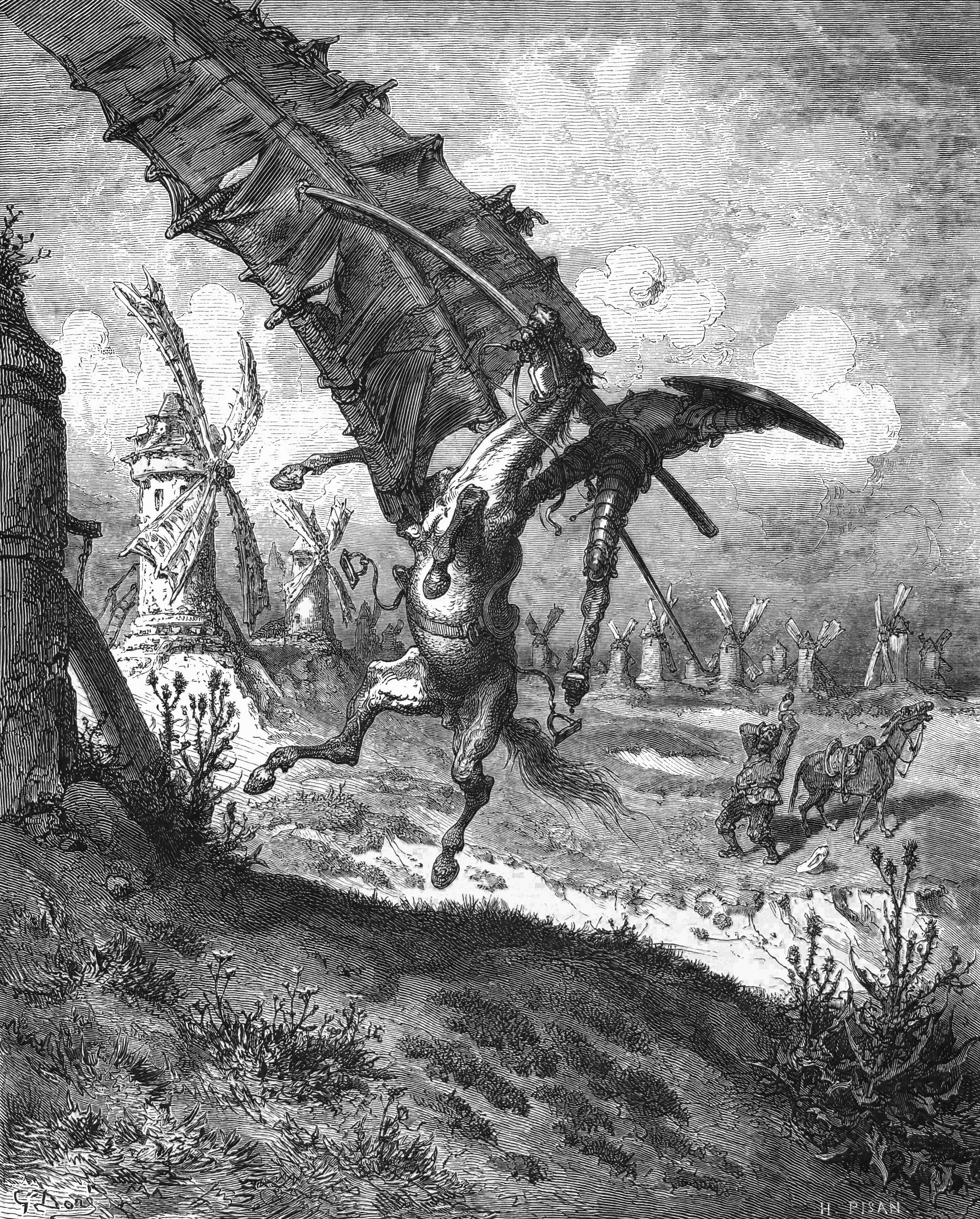
I've corroborated this by reading the fictional book Don Quixote

https://upload.wikimedia.org/wikipedia/commons/4/4d/Don_Quij...

It's not so much a wind turbine, as when you have dozens or hundreds of them in view at the same time.
Living in the North East of England, we have several dotted around in the surrounding fields of my home. There are about 8-10 turbines across a 360 degree view.

I think they look great, but I agree, there is a limit to how many people will tolerate.

Some of them kill a lot of birds and bats.

On top of that, they of course need access roads for maintenance crews to come do their thing once in a while, if located in a former pristine environment that isn't ideal. To say nothing of when the construction actually takes place, again, if it all happens in a pristine location then it's not ok.

House cats kill an order of magnitude more birds and bats than windmills. Practically no one calls domestic cats ugly, or suggests to ban them.

Access roads required for wind generator maintenance are neither large nor busy: there's no fuel to bring, and no ash to take away.

I hope people don't let their cat go to outside. problems are problems.
Cats belong outside where possible. And birds have predators, it's just nature.
Birds have predators, but most predators don't have humans to shelter them at night, feed them when food is scarce so they are always well fed when they hunt, and take them to the vet to protect them from disease, parasites, and heal their injuries. And human development has pushed out most of the predators that would keep cat populations in check (like coyotes)
Indoor cats live longer and have fewer health issues. Sorry kitty, I like the idea of native wildlife existing and less vet bills more than your freedom.
yes but we killed off or drove off many of those predators.
I've always been suspect of the 'kills birds' argument. I lived near some turbines on an extremely windy coast, and never EVER saw any dead birds anywhere near it.

Daily cleaning up the evidence with ruthless efficiency or just FUD by the NIMBYs?

Some wind turbines in some places kill some birds sometimes. There is research going into reducing it with different blade coatings or paints. Fox news and AM radio turns this into "Wind turbines kill thousands of birds" as if they suddenly care about birds like some make love not war hippies.

It's an issue, but if they were that concerned about birds they would be screaming about glass windows and skyscrapers.

The 'pristine location' you're talking about was most likely already formed by humans. There's barely any location on earth which hasn't been significantly altered by humans already. It's an arbitrary standard.
As a kid that grew up on the south plains (Texas panhandle). I have a love hate relationship with those windmills. On the one hand it's neat seeing all that green power generation. On the other, it does ruin the landscape to some extent, it can be visually jarring to be driving some back road, go over a rise that, and be smack in the middle of a wind farm. It also can be a little distracting at night, where the darkness is awashed in blinking red lights.
I think the red lights make them more mysterious at night.

Especially when you drive over a hill and it's all foggy, and there's this big field of red dots flashing. It's like the robots are coming :) I like it.

I love the red dots. My partner and I drive out to Big Bend every couple years to spend a week or so there, and on the drive back there's a stretch of road where at night there's a huge number of the dots juuuust barely visible over the horizon, and then you start to crest a certain hill and suddenly BOOM there's even more! It's always glorious and I wake her up everytime so at least one of us can fully appreciate the majesty. Unfortunately my partner doesn't drive these days, her epilepsy has gotten bad enough that they (honestly thankfully) yoinked her license, so I don't really get to take it all in since I'm also driving the car at the same time and trying not to die while staring at the pretty lights :(
Everybody likes to tell their "...and that's what inspired me to go into a technical field" story.

We had several radio masts in an opening near our home growing up. I'm going to start incorporating those into my story. "It was then, gazing at those red lights as a two year old, that I knew I was destined to spend my life writing YavaScript."

Probably some truth to it, tbh. That and locomotive engineers honking when we'd drive by making the universal "honk the horn" sign.

After seeing a video of someone showing how the nearby windmill cast a rotating shadow on their living room window some months of the year I understood it is a legitimate issue for some.

But generally I’m with you. I just don’t get it. Windmills look neat and do neat things.

For sure, not saying there are no issues (sound, shadows, etc...) especially when very close, but some people object to them literally just being in sight, which is wild to me.
People hated the Eiffel Tower for a long time.
It is said that Guy de Maupassant ate lunch everyday at the base of The Eiffel Tower, because it was the only place in Paris where he couldn't see it
It's a great story, but surely even at places that had a clear view of the Eiffel tower he could simply sit facing away from it?
I live in an area with lots of windmills, where land owners of otherwise useless scrub ground have made good money providing a space for them. It has become a political issue for people literally "titling at windmills" as it were. Any conversation you have with them isn't about the windmill at all, apart from as you point out, some highly subjective statements about "eyesores" (which is ironic considering the ground on which these things are most commonly installed).

The "real" complaints tend to be some absolute insanity about "medical issues" that are caused by the windmills. Or harm to wildlife, even though study after study debunks these views. Sometimes they try an environmental move, bringing up the waste from retired blades - all while ignoring the alternatives and their environmental harm.

The real story is, these are people who just don't want progress. They don't want change. They are perfectly content with their Folgers coffee in a styrofoam cup and iceberg lettuce with ranch dressing. They want their news in paper form. Those windmills are just totems representing a world that scares them because it doesn't fit into their neat little navel-gazing bread basket.

What I've noticed is that anger toward windmills in our area has grown over the decades since they started installing them rather than dissipated, as more of those angry old grumps realize that they won't get their old world back.

People like a single windmill, standing picturesquely in the middle of the village.

I don't think anyone would ever have gone for a field of tens or hundreds of them.

I kinda wonder what is gonna happen to them when they reach end of life.

Knowing the history of these kinds of things, they will be left to rot and dangle in the fields they were planted.

They're replaced obviously because we really need the electricity they produce.
Not if solar keeps improving or we get the fabled affordable nuclear.
Solar and wind peak at different times, and windmills don't compete with farmland. They're complementary.

(Sometimes farmers do complain about windmills - that's because farmers are a kind of landlord and their actual problem is that it's harder to sell the land with a windmill on it.)

They're buried in places like Wyoming currently.
They are obnoxious at night when a large cluster of them are all flashing their warning lights.
Here are some gif showing the effect: https://www.nrk.no/nordland/mdg-mener-vindturbin-i-vindpark-...

The article is in Norwegian, but look at the pictures. It must be stressful to have all those read warning lights blinking all night.

>It must be stressful to have all those read warning lights blinking all night.

Why?

Because what was once a dark hill side is now lit up every 5 seconds by bright flashes.
Looks beautiful to me.
The modern wind turbines are absolutely massive and dominate the landscape in a mocking, domineering, ignorant hatred of nuclear power.
the only time I'd appreciate windmills from an aesthetic point of view is when they are very very far away. Nearby, they are horrible to all senses.