I wrote this a while back comparing Intel 12th Gen to AMD 6000, and power/perf should apply even more to the 13th Gen vs 7040 (Zen4 + RDNA3):
The reason that people want AMD CPUs is simple - they’re much better than what Intel is offering. We can see empirically how wide this gap is now since we have independent reviews of identical laptop platforms from Lenovo and HP’s ultrathin business laptops (the same segment as Framework):
HP EliteBook 840 G9 1280P vs HP EliteBook 845 G9 6950HS [1] - these are both respective flagship parts, and we can see the AMD version has both a +23% performance rating and a +23% better battery runtime. Note, that on the HP website currently, the same configuration AMD version is also >30% cheaper.
Lenovo ThinkPad T14s G3 6850U vs 1235U [2] - since the Intel version reviewed isn’t a top of the line model, it’s not fair to compare performance numbers, but even with the significantly lower TDP Intel part (15W vs 28W), the AMD version of the laptop ends up with an even bigger lead with a 35% better battery runtime. The AMD version is also 10% cheaper than their Intel counterparts from the Lenovo site pricing.
In both these cases, the AMD version wins significantly on processing power, battery efficiency and price. The 7040 should extend the lead on the latter, and that's not taking GPU performance into account [3], where the AMD Radeon 680M simply crushes the Intel Xe 96EU by an average of +88% in game performance, and +135% in synthetics (and again, the 7040’s RDNA3 GPU and Xilinx AI core will extend the lead even more for the upcoming generation).
Well, I have USB3 problems with all my AMD machines which makes e.g. attaching a VR headset reliably difficult. Random quickly repeated disconnects of devices due to a buggy chip from ASMedia/ASUS that AMD uses everywhere. I like TDP of the current gen though AMD turned to an even worse company than Intel in how it treats Threadripper users. DisplayPort over USB-C might not work either.
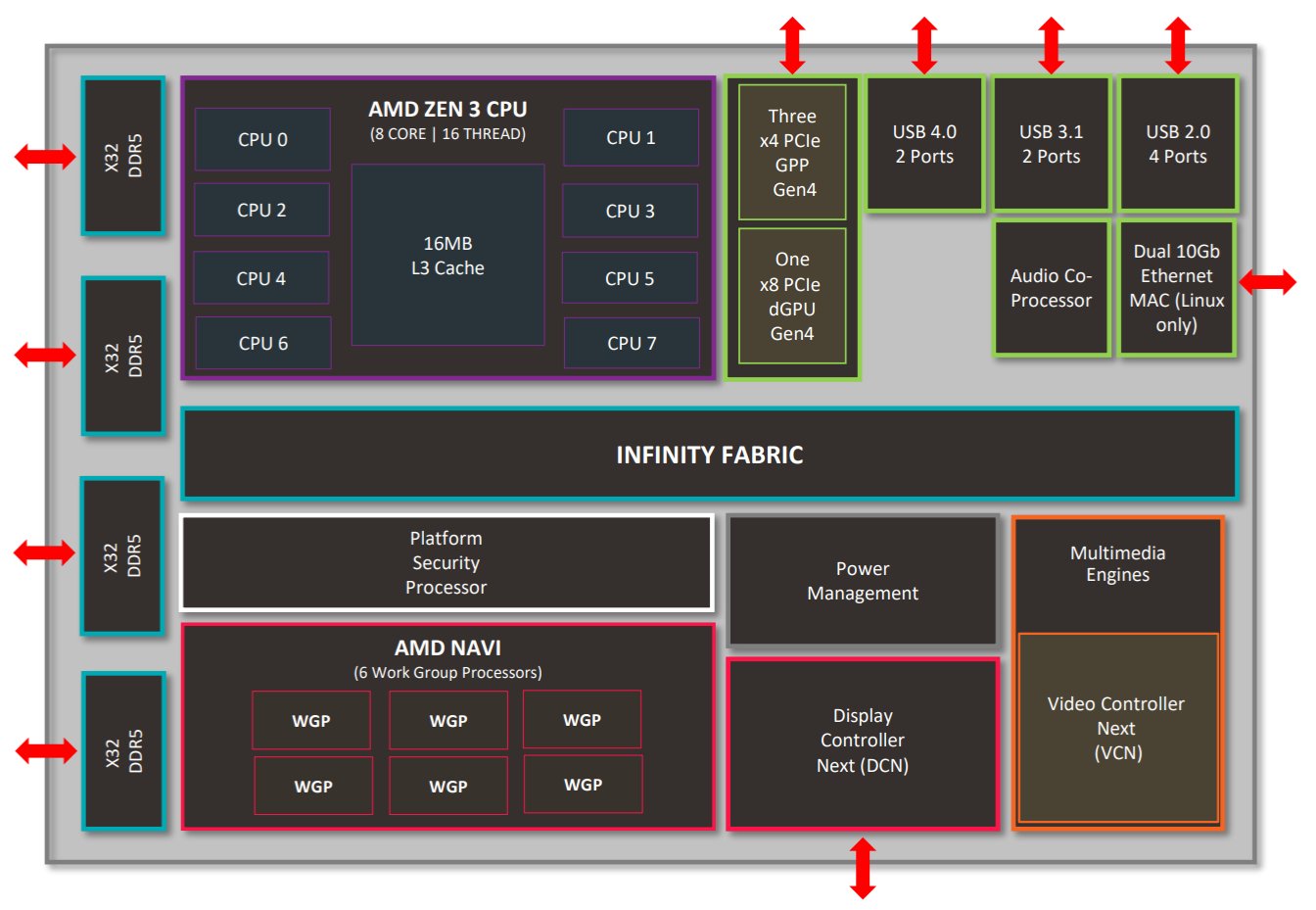
While having hardware compatibility issues suck, I'm not sure what your problems have to do with AMD's mobile APUs, which have their USB2/3/4 controllers implemented on-die (block diagram: https://cdn.videocardz.com/1/2021/12/AMD-Rembrandt-Diagram.j...) not using an external controller.
USB features depend ultimately on the laptop manufacturers' implementation (eg neither the HP or Lenovo models linked implement USB4 but they are in other models like the Lenovo Z13), but I haven't seen any that claim to have DP-alt support not be able to support it. As the Framework will have USB4 (and DP-alt and PCIe encapsulation are mandated by Microsoft for Windows 11 compatibility), I don't think that's a real worry for anyone.
Glad to hear that! My 8-core AMD laptop from ASUS with 3080 is almost 2 years old now so things might have changed. My Threadripper still has USB issues and I don't like e.g. inability to type text or move mouse for 10-20 seconds just because the USB controller on the most expensive Threadripper board decides to have a game of disconnects.
Again, I agree that hardware compatibility issues suck... Personally, I think life's too short to live with glitches like that - ASMedia chips are used in a lot of PCIe USB cards these days as well, but I've had good luck w/ Renasas cards in the recent past (when I was running VFIO). These USB cards are all pretty cheap ($20-40), so I'd order a few to try and keep the one that works the best.
AMD have been thrashing Intel in performance, thermals and battery life for several years now. Intel are also a rather unpleasant company, I'll happily go with a competitor whenever it makes sense.
When Ryzen first came out, Intel still used the number of cores to differentiate their consumer and enterprise lines, which meant you could get a bucketload of cores from AMD without paying "enterprise" prices.
AMD still tends to have lower actual TDP than Intel, which is more efficient in a laptop and easier to cool in a desktop.
If you're going to use the integrated GPU, RDNA generally performs better in games.
I have linux a notebook with the AMD Ryzen 7 5700u and a Mat screen. Its pretty great on battery (6+ hrs). Even the built in gpu is good enough for general use. I think these newer AMD cpus are even better and worth the wait.
My home linux machine is a ninth gen intel with Nvidia. Its technically a notebook, but more like a portable workstation. Its powerful, but battery life is terrible (<3) and you can hear the fans. It can game quite well however.
On Linux AMD drivers are by far some of the best, and the driver support is miles better both on the end of the 1st party support as well as 3rd party software support.
There's a few instances where AMD GPU drivers even outshine their windows counterparts like in OpenGL performance. Intel's driver support is great as well, but their performance recently has not matched AMD, and their iGPUs don't compare to AMD's iGPUs.
Also for beefier laptops with discreet GPUs, intel up until very recently would need an NVIDIA card to get decent performance which would require NVIDIA drivers, which are notorious for complicating things on Linux. On the other hand AMD laptops with discreet AMD gpus already have their drivers built into the kernel which removes almost any potential complication.
Also there's personal preference, which in my case leans toward AMD because of their generally more open stance with their new technology, like raytracing and FSR which is contrasted by NVIDIAs typically closed off approach to the same things. Intel isn't as bad as NVIDIA in this department either but this is just personal opinion.
Lastly AMD CPUs are generally cheaper than intel, and in the last few generations performed better overall than intel.
TL:DR AMD on linux has great drivers with good support, the synergy between AMD's CPUs and GPUs and their combined APUs are very good, and personally I appreciate AMD's more open approach to technology like FSR, even if they aren't anywhere near perfect.
The reason that people want AMD CPUs is simple - they’re much better than what Intel is offering. We can see empirically how wide this gap is now since we have independent reviews of identical laptop platforms from Lenovo and HP’s ultrathin business laptops (the same segment as Framework):
HP EliteBook 840 G9 1280P vs HP EliteBook 845 G9 6950HS [1] - these are both respective flagship parts, and we can see the AMD version has both a +23% performance rating and a +23% better battery runtime. Note, that on the HP website currently, the same configuration AMD version is also >30% cheaper.
Lenovo ThinkPad T14s G3 6850U vs 1235U [2] - since the Intel version reviewed isn’t a top of the line model, it’s not fair to compare performance numbers, but even with the significantly lower TDP Intel part (15W vs 28W), the AMD version of the laptop ends up with an even bigger lead with a 35% better battery runtime. The AMD version is also 10% cheaper than their Intel counterparts from the Lenovo site pricing.
In both these cases, the AMD version wins significantly on processing power, battery efficiency and price. The 7040 should extend the lead on the latter, and that's not taking GPU performance into account [3], where the AMD Radeon 680M simply crushes the Intel Xe 96EU by an average of +88% in game performance, and +135% in synthetics (and again, the 7040’s RDNA3 GPU and Xilinx AI core will extend the lead even more for the upcoming generation).
[1] https://www.notebookcheck.net/HP-EliteBook-840-G9-laptop-rev...
[2] https://www.notebookcheck.net/Lenovo-ThinkPad-T14s-G3-AMD-la...
[3] https://www.notebookcheck.com/Iris-Xe-G7-96EUs-vs-Radeon-680...