Hacker News new | ask | show | jobs
by yyy888sss 1213 days ago
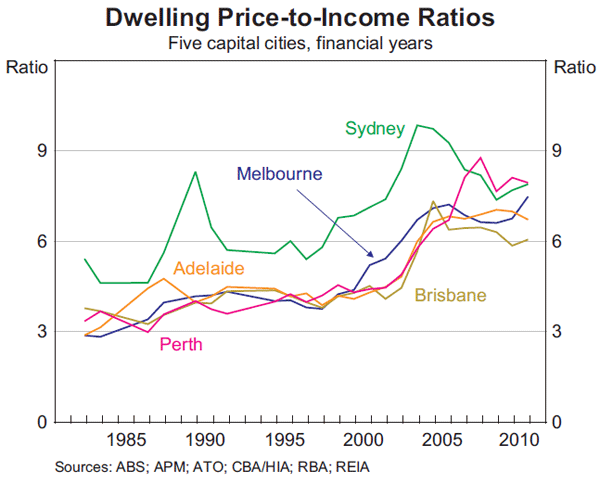
Inflation is a monetary phenomenon. Prices are rising in Australia because the Central Bank created $450billion out of thin air during the pandemic [1]. The bank has persistently kept interest rates low, creating a massive housing bubble [2]. For everyone saying there was 'low' inflation in the 2000s despite cheap money, remember that China and Asia were rabidly growing, flooding the world with cheap manufactured goods and lowering real prices (often 10x reduction). The inflation can still be seen when looking the price of Australian real estate, or stock markets such as Nasdaq. As for this article, companies would always like to increase prices and profit. They can only do so in unison if there is suddenly more money sloshing around.

[1] - https://www.rba.gov.au/chart-pack/central-bank-balance-sheet... [2] - https://www.rba.gov.au/publications/bulletin/2012/dec/images...

1 comments

inflation is any time prices increase. there are multiple reasons why prices might increase.
No its not, it’s a sustained increase in prices across the board, i.e. devaluation of money

Oil prices going up and causing food prices to increase is not inflation.

There are two possible reasons:

- The supply of money goes up.

- The demand for money goes down.

Neither wages nor profits are capable of affecting the supply. They might affect demand somehow, but it's not the first thing you'd look at.

Doesn't the supply of stuff also matter? How about people's expectations of future prices? How about global-market linked prices of economic inputs, foreign money supply creation? Etc.

I think I could come up with 50 reasons why prices might increase if I sat down long enough.

Yes, understand what the parent is putting forward is a fringe theory. Some schools of economics like Austrian economics are obsessed with the money supply and ignore other factors that clearly matter a lot.
Before you describe something as a "fringe theory", you might want to check whether it is taught by major textbooks in the field.

(In this case, try reading https://www.macmillanlearning.com/college/us/product/Macroec... )

> Doesn't the supply of stuff also matter?

It matters.

> How about people's expectations of future prices?

These also matter.

Now ask yourself how they matter. Any fall in the value of money must come from an increase in supply or a decrease in demand. If we expect future prices to be much higher than they are now, we will seek to hold less money (because its value in the future is lower) and this drop in the demand for money in the present will drive down the value of money in the present.