It will resonate with any builders in the HN audience and give a ton of context behind the thinking here.
> You know, some people like to be regarded as being an analyst. They think that’s a term of endearment. I treat it as a personal insult if somebody calls me an analyst. A personal insult. If you’ve read the last paragraph, I’ve showed there are two things you have to be able to do: analyze and synthesize. Analysis and synthesis. And if you can do that in many different areas, tactics, strategies, goals, unifying theme, you can run businesses, you can do any goddamn thing you want.
I find his discussion of Clausewitz's "friction" and the idea of speed as always being relative to one's adversary incredibly useful, even for my day to day work in Tech.
Would be amazing if that talk is available as a recording somewhere. I was several pages in before I looked at how big the transrcipt is. Will have to come back to it. Huge thanks for posting it!
Some Googling led me to this: https://geekboss.com/blog/boyd-patterns-of-conflict
It does have 4 youtube videos that seem to be of a presentation he gave, though I don't think it's the same one as the transcript (apologies, I haven't watched them yet, only briefly skipped through them). They are a bit potato quality, but might still be of use.
Of course! It was hugely influential on my thinking/approach to problem solving under uncertainty/adversity.
And yeah the other commenter provided a link but there is no actual recording of this exact transcript -- the ones that I found on YouTube just frankly are not quite as good as this one (which is why this one has been preserved, I assume)
Sometimes the transcriber missed a question or you need to fill in the blank yourself a bit (which I think actually meshes perfectly with the content of the talk!), but it's worth it!
Every discussion I see of the OODA loop is almost always ridiculously oversimplified to the point of being useless or just plain wrong. I watched a ~2 hour interview on YouTube with a guy who worked alongside Boyd when he was developing the idea, and the way he explained it just clicked and was one of the most beautiful ideas I've seen to date.
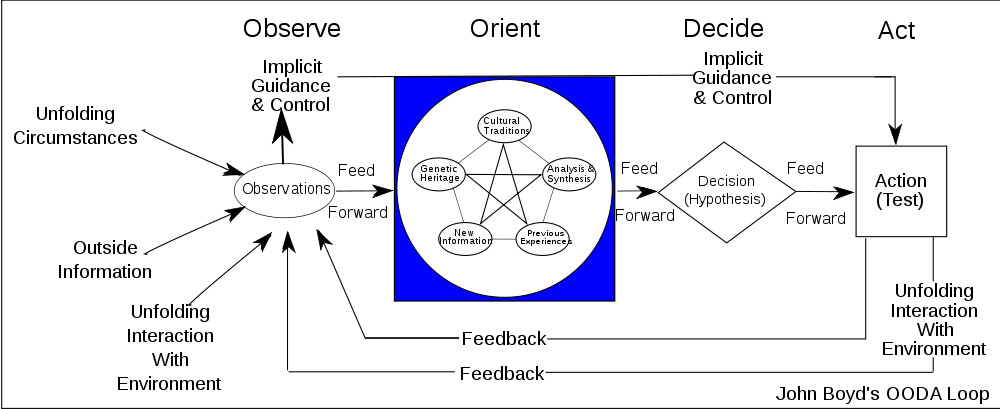
You mostly see it depicted as a circle, well forget that as it's completely meaningless in that formulation. Search up the original diagram of it and you see that it's actually a set of loops through which there are some different pathways.
It starts with an observation that comes from the outside world, and proceeds to the orientation phase which is about how you interpret the situation, and from the orientation phase it can go one of three ways. In one path you aren't sure what action you need to take so you form a hypothesis upon which you act, which generates a change in the external world which then becomes a new observation and the cycle starts again. Another path is that of a reflexive or instinctual reaction in which you have no need to form a hypothesis but rather you have a heuristic upon which you act, and so you are able to act quicker, and again your action generates a change in the external world which becomes a new observation and the cycle starts again. The third and most important pathway, and they key idea/realisation, is that new observations can be generated directly from the orientation phase and this can be exploited! Why? It's a positive feedback loop that is devoid of any information from the external world, so the more iterations it goes through before finally breaking out and going through one of the paths that do interact with the external world it will be more and more detached from reality and hence the action will be less effective at moving you towards your goals.
I recall the guy saying that Boyd's key insight was the exploitability of that positive feedback loop that was detached from physical reality and if one can purposely trigger it in their adversary they can make their adversary behave in a way that takes them away from their goals. To me that's such a neat observation.
The most obvious and classic example is "getting in your head" when you catastrophize about things and just sit there ruminating on them. None of it is actually really happening to you, but you react to your own thoughts with more thoughts and this can take you really far off course.
The other is the effect that "the element of surprise" has on your adversary where they have very little information as to what is actually going on and hence have to make a lot of internal assumptions about what might be going on.
My takeaway is basically if you can get an adversary to "think about things" and make long chains of inference without doing 'reality testing', the longer the chains of inference become, the lower the probability that they are correct. This is advantageous to you.
Tangentially, Taleb tweeted a nice quote yesterday, "You don't do well by trying to be right; it is impossible for humans. You do well by figuring out when you're wrong faster than others do."
There's value in shipping an MVP (or multiple MVPs) fast, sure. Cull the failures and iterate the successes. Better than trying to achieve perfection with a forever-delayed product that never ships.
But even the sloppiest, most minimal MVP has to get something extremely right. You need to solve some problem for the user in ways that others haven't.
If you don't get things right enough, you've just trashed your entire brand. Game over.
And sometimes, getting things "right" is literally your entire unique selling point. Look at Apple nailing the iPod's features in ways that its predecessors didn't. Look at Tesla nailing their vehicles' features in ways that its predecessors didn't. Etc.
I have no idea what Taleb actually means, but to the extent it isn't dramatic rhetoric, I imagine his claim is based on the idea that humans can never be completely right, due to the limits of our perception and memory. The best we can hope for is to be right enough to survive until the next iteration of our learning process.
Strongly agree. We need to put out a constant stream of low-quality products, and iterate quickly to achieve our goals.
I used to do the opposite: write high-quality well-tested code, but very often the results weren't useful to the business by the time I was done. It would have been much better to produce a couple "sketches" of the feature first, then the business could kill or refine it as they want. Everyone wins!
(disclaimer: writing a book, featuring feedback loops)
Isn’t most of our business code just glue, forms and api? I appreciate the quick way, but also believe that our tools at hand have a plenty of room to improve. Sometimes I drop a project because it induces “ah, here we go again”
mood. Quick mudballs that could be bricks that could be panels, but there’s nowhere to order them. The worst part is when the idea actually works so that mudball becomes your home.
Which references this 1986 version of the presentation:
https://www.ausairpower.net/JRB/poc.pdf
I met John Boyd at Eglin when I was a kid, and later in the 80s when I was a Marine. Dude was a complete nut. But I mean that as a compliment. Preaching a brand of war-fighting at odds with the dominant narrative, I would not have been surprised to see Apple feature his image in a "think different" commercial.
The Air Force was slow to warm up to Boyd (and the OODA Loop) -- but the Marines were ready to hear something new. Here's a page with some decent info, including a link to a short video where John Schmitt, Van Riper and (my old boss) Al Gray discuss the "intellectual renaissance" in how they thought about war-fighting. If you're not a military history nut, the 5 minute video is good to give you an idea for how "novel" ideas permeated the US military in the 70s and 80s. You don't HAVE to be an Air Force pilot or Marine to make use of the intellectual underpinnings of Boyd's "Patterns of Conflict." But you MAY miss out on some critical detail if the only thing you read is about the more-generic, not-specific-to-the-military OODA loop.
Which is to say... even if you're not inclined to study military history or operations, you may get some decent context on the formation of the OODA loop by investigating the environment in which it arose. "Maneuver Warfare" is much more than the OODA loop, but it was definitely influenced by Boyd's E-M Theory, Patterns of Conflict and the OODA loop.
Here... the videos on this page total just over 10 minutes. Worth a watch.
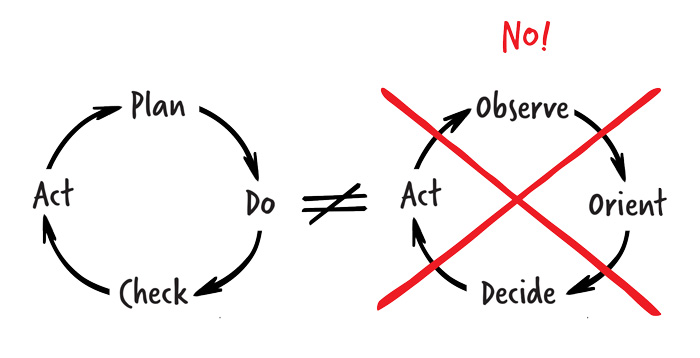
Compare also PDCA [1] which is used more by civilians.
Every time people rediscover rapid iteration in tight feedback loops, and every time so far it's gotten watered down to nothing again by people who get the rituals, but don't quite grok the underlying concept. [2]
On the other hand, you could do practically any sort of ritual or even just laze around in bed: if you understand the underlying concept, you'll still get decent results. [3]
see also: [4] for a short bit on OODA when actually flying an aircraft.
PDCA is entirely unrelated to OODA. There are a bunch of graphics that confuse people into thinking they're related, by showing O-O-D-A-> in a circle. That's dead wrong.
    The OODA loop is complete gibberish. It's describing the tip of the iceberg in the most complicated way possible, in an attempt to impress people too incompetent to understand it, written by a man unqualified to talk about it.

    It's a complicated subject, over-simplified and then re-complicated to appeal to people who like to put words inside of boxes and connect them with arrows.
Iterating OODA faster is not the same as getting inside the adversary’s OODA loop. That’s a common misconception. It’s more that, you are able to drive the adversary’s OODA loop so that they start doing things in a way you control. Sometimes that means iterating faster, but if you are not controlling the adversary’s OODA loop, you are more likely to be “observe, overreact, deny, apologise”, just doing it faster. That’s something you should be doing to the adversary, rather than something you yourself should be doing.
For example, a friend told me this story. He doesn’t know OODA as a formalism, but he knows human nature and practices martial art. He was at a party and some dude hits on his girlfriend and then challenges him to a first person shooter game. He told me, he doesn’t have great reflexes, but he knew how people behave and act, and so he was able to dictate the entire engagement.
He didn’t give me details, and even if it were, it would be highly situational. There is nothing concrete here. If you understand the underlying principles, you would be able to broadly and deeply apply it in many contexts.
It is better to draw examples from your own experience in adversarial games, even perfect information games with fixed turns like Chess or Go. Take the game you are most skilled at, and see if you remember playing against someone who was so unskilled, that you can see their moves and mistake a long way coming. And if you weren’t teaching them, you can close off avenues long before they are even aware of it. If you pay attention, you might even know the minute they realize something, only it is far too late. There is a sense as if you are inside their head, knowing what they are going to do — must do — before they are even aware of it themselves.
It’s like that, only perhaps with a peer adversary.
I'm sorry, but isn't this just... obvious? Like, I'm not sure how else one would conduct themselves if they have a serious problem they have to think through? Blind panic and reaction?
Think of an army, where the generals are making decisions based on outdated reconnaissance reports and commanding the troops on the ground to behave in ways that no longer fit the situation.
Switching to OODA would allow the troops in the field to make live observations and (to a reasonable extent) orient, decide, and act on thir own.
I think you might be missing the game theory aspect to the OODA loop.
The OODA loop is not a reasoning methodology for difficult problems persay.
I would distill the idea behind the OODA loop as leveraging small quick actions that create larger reactions in your opponent. Essentially, it's an attempt to make an opponent commit to an action that you can later make sub-optimal by reacting faster.
As an example, let's say there are two competitors in fashion:
Competitor (A) is a small nibble startup. They produce 10x units per month, can change what they make each month, and produce at one unit of cost.
Competitor (B) is a large copy-cat operation. They follow the trends set by the little guys, they produce 1000x units per month, but they commit to what they make for six months at a time (but at a quarter the cost).
If competitor (A) and (B) both make black clothing forever, (A) will get crushed. But, if (A) can change the industry trend faster than (B) can change production, then (A) will win. Example, black is the it clothing, (B) is on track to make 1000x units every month for six months. (A) being a trend setter sees this and makes "brown" the new trend. (B) reacts to this by ordering their next production line to be "brown". Now they are committed to making black clothes for a few more months and then "brown" clothes for 6 months. (A) sets the trend again to "blue" clothes. (A) has now won, (B) will make "brown" clothes for 6 months and at a time after nobody wants them. All the "brown" clothes made by (B) will be behind the trend and all wasted.
In short, if I can make you react to me with an optimal move, if I can then change the game faster than you can react to then make what was your previously optimal move now sub-optimal, I can win (even if on paper you may have the better specs).
Another example, let's say two people are playing chess, but one side has a big material advantage (like more pieces, more queens, or they are super-good). Though, the side with the material advantage has to announce their next move and commit to it while the other is free to make whatever move they want on their turn. While one side has the material advantage, the other side that can adjust and turn what was a good move into a horrible move. For example, the advantaged side says "in response to your bishop going to B2, I'm moving my knight to C3, and my next move will be to move my queen to D5". The idea behind the OODA loop is the orient step is seeing how the knight and queen are moving. You then decide on a course of action, namely to move your bishop to threaten D5. Dutifully the advantaged side moves their queen to D5, your next move is to take out their queen with a bishop.
So, in the game theory, while you might be able to respond better, if my counter response is faster, than I can turn your better response into a bad move simple by changing the situation faster than you can react.
Another example would be football and running at a linebacker. If moving one space to the right causes the line backer to move two spaces, then all I need to do is move one space to the right and then move to the left. The OODA loop comes in because maybe the line backer does not move. In this case I just need to move to the right twice more and the line back won't be able to move faster enough. No matter what the line back does, because I can move faster than they can change their direction, I can game it to make sure whatever they do will be sub-optimal in the end.
(small apology for the overly verbose response, I do enjoy game theory and posing these examples)
I always find formalized metacognitive tools like this very interesting. Having ingrained "memory items" that can be called on as if they were instinctual requires a huge training investment, and for highly dangerous situations the tradeoff of time spent to value is much clearer than for, say, software engineers. That said, having the right metacognitive tools deeply embedded in one's thought pattern might still be very valuable for those of us that fly desks rather than jets!
This is not untrue, but a more applicable interpretation of this conceptual framework might go as follows:
In an AAR[0] operators explain risks, causes, and limitations of the system. This provides a formal structured language for describing how, precisely, supporting systems can be improved and how they impact all specific aspects of operator interaction.
Since the operator is viewed simply as a networked control-system in this case, the cognitive path from structure, supporting physical system, and then physical quantities needing improvement is unmistakably clear, as is required in successful planning, acquisitions, operations, and maintenance.[1]
Essentially it makes subjective experience concrete, and is prophylactic against bikeshedding/blame-gaming.
The thing about OODA is, everyone needs to be onboard.
I've had higher upd override my decision and go "nah,we're just gonna act, not gonna let you observe or orient" basically as well as peers thay go around you and take actions that prevent your observe+orient attempts.
It is intuitive to just act.
I work in infosec for context. One of the biggest non-technical issues I have is convincing people to ignore their intuition. Especially technical people who don't do IR. Like maybe you spent 50 years as a ninja coder or netadmin but I am still gonna want the threat actor loose until I have some idea of their intent or scope of compromise unless I have reason to believe they're acting on their objectives.
Actual military brass get this, you need to understand the situation before you can react. That's how ambushes happen or you get flanked.
I have no intention of being snarky and I'd like to engage in good faith, but I'm aware of how this will read:
How is it a useful metaphor? I don't understand how you can use it to extrapolate from a situation in which you vastly outmatch an opponent to one of equals or you being outmatched. It seems too general and abstract to be worth more than "that's neat" status.
Other HN responders seem to be using it to mean a variety of different concepts including tempo, having superior heuristics built via prior observation or simply "thinking then acting".
For me, OODA really clicked when I mapped it to the Weinberg-Satir Interaction Model:
Observe -> Intake
Orient -> Meaning
Decide -> Significance
Act -> Response
Highly recommend checking out the work of Gerald Weinberg and Virginia Satir. HN people will probably appreciate Weinberg more than Satir as Weinberg was a programmer for NASA back in the day so his books are aimed at technical types. People from an arts background will prefer Satir who was one of the all time great counsellors/therapists.
- think of the whole thing as a set of interconnected OODA loops of different time scales
GTD and OODA actually go very well together - it explains for example why the easiest way for GTD to fail is to skip the weekly cleanup. You're just left with the daily loop, which is very much not enough. Proper GTD has organized loops up to around one year. It also a great way to force you to think on longer time scales, stuff like "what do I want to do the next 3 months?".
If I were to summarize it to a 5 year old I'd use the analogy of rhythm games like taiko drum master. Once you make a mistake your timing is thrown completely off and everything going forward is wrong unless you can get your timing back. OODA is way of thinking about things to help you "get into the rhythm" of a situation faster than an opponent.
I teach the OODA loop in Martial Arts. Watching the pattern develop in my child was fascinating.
First object permanence, then two and three and eventually four dimensional tracking. Throwing is easy. Catching tool effort and developing these skills. I recall him reaching blindly at objects as he could recall their position in space, orient his body, and grab them without looking.
Having him catch Frisbees and racquetballs at 2 years gave me insight into what skill and observational development was required. At some point he was able to transition between projecting the path of a rolling object vs a thrown object.
This reminds of the concept of D.I.E. that we use in the social sciences, describe, interpret, and evaluate. It is important to separate the stages clearly, because if you interpret while describing, this taints your observations. Evaluate can be seen as a precursor to action, because it is from the implications where science then moves forward.
OODA is a lot more than that. Since it is something developed for adversarial interactions, you’re also talking about disrupting or overwhelming the adversary’s OODA. Or another way is feeding the OODA bad intel (tainting their observations), and then stepping up the tempo so that they are making worse decisions faster. Another is taking advantage of the adversary’s “frame” (the orientation) and using that to drive the adversary into diverging from reality. (Sun Tzu talks about direct and indirect actions for that).
There’s also a version of OODA where things become intuitive and there are shortcuts within OODA as well.
Oh wow, cool. Thanks for the explanation. This is very stimulating as a concept, I will dig deeper then. Actually, this can be quite productive as a research strategy.
I built a startup around 2005 based on a variation of OODA that I independently devised before I learned of it. Unfortunately the critical hardware features I needed weren’t caught up yet and it didn’t work out, but the competitors to this day still don’t have feature parity. Thinking in the framework of feedback loops is super powerful.
Casually a trained badass (or a sufficiently unhinged person) will ignore that punch and proceed to destroy you.
So unless you're a super trained boxer and can knock out everyone in one, it's a waste of time.
You lost the element of surprise and tempo.
If you want to do some damage, do it, not rely on the opponent obliging or complying.
Certainly it's better to punch them than not punch them. Many many times overwhelming violence is sufficient to win a fight. Trained people might not be as phased, true.
It will resonate with any builders in the HN audience and give a ton of context behind the thinking here.
> You know, some people like to be regarded as being an analyst. They think that’s a term of endearment. I treat it as a personal insult if somebody calls me an analyst. A personal insult. If you’ve read the last paragraph, I’ve showed there are two things you have to be able to do: analyze and synthesize. Analysis and synthesis. And if you can do that in many different areas, tactics, strategies, goals, unifying theme, you can run businesses, you can do any goddamn thing you want.
I find his discussion of Clausewitz's "friction" and the idea of speed as always being relative to one's adversary incredibly useful, even for my day to day work in Tech.