Hacker News new | ask | show | jobs
by cjensen 1231 days ago
That's not a prediction that can be evaluated. For example, I could say "there will be a 7+ magnitude quake somewhere in the Pacific Rim tomorrow" and if I publish the same prediction every day it won't be long until my prediction is true. I might even be right the very first time.

A real prediction should include exact time period, magnitude, and geographic area. And every prediction made must be documented. This lets you do two things: first it lets you clearly decide which predictions came true. Second, we can look at historic probabilities for the predicted quake and evaluate the chances of blind guessing being correct for that exact set of predictions.

In this particular instance, if you look at the predictions made on his twitter stream you'll find that he's clearly a quack who predicts stuff constantly. Not super surprising he got one right. EDIT: Also... surprise! There was a foreshock a couple of hours before he made the prediction.

5 comments

Look at his youtube and Twitter for 5 minutes, he draws "bands" all over the world predicting nonsense everyday, and probably has a positive prediction rate of 0.5% and he bases everything on some nonsense call "Atmospheric Fluctuations"?

Quacks like a duck.

He does have some predictions with time but yeah, being vague (while having lots of knowledge) can make you seem prophetic.

> EDIT: Also... surprise! There was a foreshock a couple of hours before he made the prediction.

He is probably more knowledgeable than the average person and has access to latest data on earthquakes.

> He is probably more knowledgeable than the average person and has access to latest data on earthquakes.

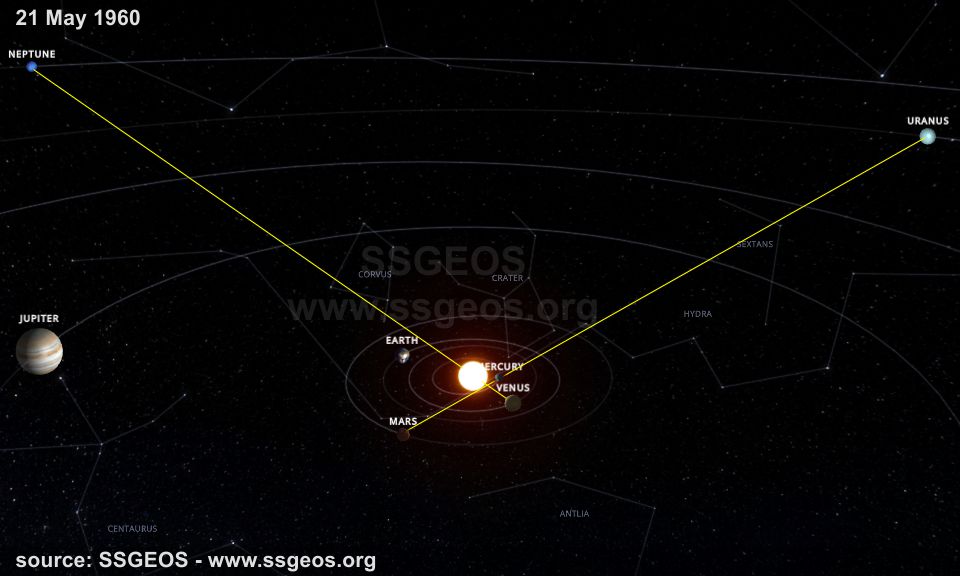
The person in question's area of "expertise" is claiming that when planets line up to form geometric shapes (e.g. when earth, uranus, and neptune form approximately an equilateral triangle) that this somehow affects seismic activity on our planet. The claim isn't that it's closeness of celestial objects causing this effect, mind you, it's the fact that the planets, however distant, happen to be in a configuration that resembles a geometric primitive.

It sets off a lot of my woo detectors. Here's their website: https://ssgeos.org/

Two ways to verify this:

- Enough data that the correlation becomes strong enough.

- The physics community chimes in? I mean the effect could only be due to gravity unless there is another mechanism we don't understand. But given how small the earth is, and how big other planets are, I'd suspect the physics people to see this effect somewhere else?

No, absolutely not - gravity is an inverse distance squared force.

The sun dominates our gravity environment and planets at those distances have negligible effects (really effectively zero) certainly not seismic size perturbations!

The gravitational force from the other planets does slightly affect the Earth's orbit, but the gravitational pull from the other planets and the Moon is still very small. The gravitational pull of the Moon on the Earth is only 0.55% of the gravitational force between the Sun and the Earth, other planets even less than that. Unlikely, very unlikely to trigger earthquakes!

> The gravitational pull of the Moon on the Earth is only 0.55% of the gravitational force between the Sun and the Earth, other planets even less than that. Unlikely, very unlikely to trigger earthquakes!

Playing the devil's advocate, but doesn't Moon affect the movement of water on Earth (i.e. low-high tide) and these are massive movements of mass which could potentially trigger an earthquake?

The moon, sure. Neptune, not so much.

One would also expect this effect to be a function of distance, not of how prettily lined-up the planets are or the shapes they make when viewed from above.

My claim isn't that it's unlikely that any celestial body can affect earthquake likelihood. It's that it's unlikely that earthquake likelihood is affected by pretty geometry of planet arrangements that do not include our own.

For example, on the "About" page of their website, they show this image:

https://ssgeos.org/images/planets/1960/1960-05-21.jpg

They go on to make the claim that earthquakes were more likely on Earth, because if you draw a line from Venus to Neptune, and another line from Mars to Uranus, those lines cross at right angles.

But isn’t this earthquake microscopic in the scale of the earth?

But I get your point. The sun should be responsible for most of these earthquakes (if gravity was to play a role) unless its gravitational field is prefectly uniform.

I better give up on this because my understanding of gravity and general relativity is based on youtube videos.

> - The physics community chimes in? I mean the effect could only be due to gravity unless there is another mechanism we don't understand. But given how small the earth is, and how big other planets are, I'd suspect the physics people to see this effect somewhere else?

To be totally honest, we don't actually know what specifically causes earthquakes. That is to say, we understand that earthquakes are essentially the sudden, violent release of stress due to crustal deformation, but we don't have great ideas for understanding what causes the stress to be released so violently. As a result, even basic tasks like earthquake forecasting or merely distinguishing a mainshock from a foreshock (before the mainshock occurs) have turned out to be miserable failures.

But as for planetary orientations having an effect via gravity... well, let me put it in perspective. To exert the same gravitational pull on an object on Earth as Jupiter does, the average human being would have to stand does math 15cm away.

> if you look at the predictions made on his twitter stream

The way to do this is to make the same prediction every day, and then delete the tweet when the prediction ends up not coming true. That way, when someone goes and looks at your profile, you'll have a 100% track record. (Or probably better, just a prediction mixed in with random pictures from your dog walks.)

You're missing one important thing: confidence level. You can probably make a 7+ magnitude prediction every day as long as your confidence in it is -- I guess, not knowing much about the Pacific Rim -- less than 1 %.

It's the 10 %, 20 %, 50 % confidence level predictions you have to be a bit more sparing with!

I completely agree that a more advanced model would use confidence levels too.

And I forgot to mention this isn't my idea at all. This framing of what is a prediction was invented at USGS. Mea Culpa.

Are some of you scientists? I was searching for how trustable this person is. This man claimed to be a scientist have catched attention of many Turkish twitter user and they've started to fallowing him. And some news sites shared this man as a Dutch scientist who predicted earthquake 2 days ago. Like there isn't enough misinformation about earthquakes.