Hacker News new | ask | show | jobs
by gigaparsec 1250 days ago
The number one thing that bothers me the most in the "netflix aesthetic" is the weird looking background bokeh that every scene seems to have.

It looks like a cheap gaussian blur filter applied in post production and adds to the fakeness. This is probably due to the optics in some of the latest Red digital cameras, but it's still not convincing. Kinda like 48 vs 24 FPS.

9 comments

I will never accept the hate for 48 FPS. 24 FPS looks like garbage. Panning shots are a stuttery mess. 24 FPS looks somewhat okay when the camera is still and only the people in it are moving, but the ridiculous choppiness ruins any moment with camera movement.

A higher refresh rate is simply an objective improvement. I don't care that you associate it with bad soap operas.

What you're saying is equivalent to:

"Impressionism is objectively worse than realism. Look at a Van Gogh painting, there's hardly any detail. It looks coarse, and grainy and the brush strokes are so wide I can hard tell what's what. Starry Starry Night would be objectively such a better painting if he had just reach for a finer brush and included more detail. Adding more detail would have made it far more realistic, and thus objectively better"

You see your premised is founded on the false pretense that realism is the goal. The Cinema frame rate of 24fps (while not chosen to achieve this, but by a happy accident) happens to be at that perfect balance between too choppy and realism. It's just off from reality enough to trigger that "impressionistic response" in our brain. The same thing that happens when we look at a Monet painting. Out brains find impressionism appealing because it's specifically not what our eyes see in the real world. It's an interpretation. It's someone else's view of the world. More detail is simply not the goal.

24fps Cinema is impressionism.

It’s more like complaining about higher resolution reproductions of a Van Gogh, because you grew up with dial-up internet and could only view highly compressed JPEG reproductions of Van Gogh so “that’s just how Van Gogh is supposed to look, these high fidelity digital reproductions look like desktop wallpaper.”

No one is saying that filmmakers couldn’t use lower frame rates as a deliberate stylistic device, similar to how 12 FPS can be used in films now (or black and white, or out of focus images, etc.), or even that all films previously shot in 24 FPS would be better if the frame rate was doubled with no other stylistic changes.

Playstation 2 and it's games were designed to look its best on Sony Trinitron TVs. When viewed on modern TVs, the games don't look like they used to, and the games can seem kinda dull in color but jagged in detail (anti-aliasing seems to have been in part the responsibility of the CRT itself). If the console was redesigned for today's TVs they'd look better.

I think the problem today is that the art of cinematography and technology evolved together up until ultra high-def digital came about, and now the art isn't keeping up with the advances in tech.

> anti-aliasing seems to have been in part the responsibility of the CRT itself

Yep, and it goes much further back than the PS2. The original example I saw was of Zelda II on the NES, but here's a whole bunch of examples in a whole bunch of games/systems: https://www.youtube.com/watch?v=ao-1uCCXBwc

The problem with higher frame rates is the same as higher resolution. It emphasizes even more the poor quality of the content. The low fidelity masks some of this, leaving more to your imagination (which is how impressionism works). If the content were of higher quality then it wouldn't be as much of an issue.
On the other hand, low frame rates put a ceiling on some measures of quality, just as low resolution does. A fast-paced fight scene or a panning shot over a field of gras in the wind is very limited by what 24fps can show.
Gemini Man was a poor movie, but it was really interesting how it tried to use and explore the opportunities offered by high frame rate. I'm 100% in the club of people who can barely look at 24fps pans on the big screen, and wish 48fps and higher became the norm, were explored deeper so they could find solutions for the "soap opera" look - most likely figuring out a new look.
Throw in as much garbage as you like, the human brain is only wired to appreciate a certain degree of information before it all gets washes out as noise. This is why imho the last 20 years in cinema has been a slow skid toward meteocracy.

The race to shove more crap at the screen to the appreciation of a younger and younger demographic to chase other tertiaries like toys, collectables, games etc.. means that the films are almost unwatchable by older people. I guess they're making their money so whatever, but it means that films feel more dead than ever before for myself. Admittedly, this may be more biased by aging out of existing target demos anyways, so shrugs.

We need to go back to 480i to increase immersion.
What I find funny is looking at older TV shows that were clearly meant to be shown on old analog 4:3 CRT's but shot in film anyway. Now these shows show up in syndication and all that film got scanned as 16:8 HD. Some examples include Seinfeld, Friends, even Wizard of Oz. Many times it feels like you are watching a play instead of an immersive show. All the props look like props instead of something "real"
The lofi tv scene is waiting to explode.
I have no problems with non-realistic art forms. I think 12 FPS hand animation can look amazing, and the 12 FPS is part of the artistic expression. You're right, realism is absolutely not always the goal, and being unrealistic is sometimes the point.

But for the kind of movie that's supposed to take place in a world very much like ours? The kind where it's just a camera filming actors in a street or whatever, and there's no intentional impressionistic art style? An "impressionist" frame rate is totally inappropriate in such a context.

EDIT: I'd actually be very interested to know why people are downvoting this comment. I'm accepting that there can be artistic merit to low frame rates, but I'm rejecting the idea that impressionism should be forced on art which isn't trying to be impressionist. What's objectionable? (I see the comment is in the positive now, it was at -1 when I wrote the first edit)

Its like if people loved combustion cars because you get high on petroleum fumes, and rejecting electric cars because they don't stink the same way and dont make as much noise.

Its a cult.

An "impressionist" frame rate is totally inappropriate in such a context.

Start with the shakey cam effect, often added post production, which does what no human head/eyes do during fast movement.

(And often used to cover up poor quality fight scenes)

Second using an incapable camera person, the camera jumping around like my grandma doing video on her phone. Steady cams, and gear, and booms, are a century old!

While I am open to looking at all modern issues, I'd prefer getting rid of purposeful garbage first.

> The kind where it's just a camera filming actors in a street or whatever,

Hopefully this image search [1] answers your question. The photographs in each of these was "simply taking a photo of a street, a common real-life thing". Yet, when you look at them, almost every single one of them is highly stylized. Whether it's simply by being B&W (yes that's not reality), having pronounced bokeh, strong silhouetting, or even vignetting, etc. They're all absolutely not what I'd call realism.

Realism is just boring. And artists don't find much appeal in producing it.

[1] https://duckduckgo.com/?q=street+photography&t=osx&iar=image...

That's also an opinion and you are stretching the art comparison quite much, 24fps is a standard and limitation and photo/film most often is to capture some reality and not so much an interpretation of someone else's view in Monet sense? Most often the cinematic art part comes in on other dimensions, even if for some few it is those 24fps and other limitations.
It’s hard to argue that it’s an intentional artistic choice if the overwhelming majority of compositions use it. It would be like saying a Monet being viewed through oxygen/nitrogen atmosphere is an artistic choice.
And even more so when it was 100% driven by technological limitations. The original Hollywood filmmakers of the early 1900s didn't choose not to film at 1000 FPS. There was simply no feasible way at the time to get above 20-30 FPS. The current standard was never chosen.
Many paintings were too "never chosen" and were made in that medium because photography didn't exist back then, Henry VIII probably would have hired a professional photographer instead of a professional painter if it had been possible, despite all that painters still exist alongside photographers in modern times.
Not necessarily because art does happen in eras. So maybe everyone were impressionists for a batch of years it was the de jure way to paint but in a 100 years it moved on but we still appreciate them. Sure, 48FPS may be the way of the future but that doesn't mean the flavor of 24 FPS won't be appreciated in the future.
No it doesn’t. Lots of different artistic schools have existed at once all through history. Just because some style was invented doesn’t mean that everyone dropped what they were doing and became surrealists.

There are people painting what would be considered impressionist painting now (literally now, I have a friend who frequently paints on sundays and texted to ask before writing this).

My understanding is that once photography was invented, painters somewhat abandoned realism in favor of impressionism and other more experimental forms. Since painting was no longer needed to fulfill the boring need for reproducing reality. Not to say, that realism doesn't continue to this day, but honestly, most painters don't aspire to it even now.
I never said intentional. Up until the last decade, filmmakers had little choice but to distribute films in 24fps. I'm ignoring the few titles where they did indeed experiment with higher ones, like Oklahoma at 30fps and Brainstorm.
Yes, an I did indeed state that it was a "happy accident". 24 was chosen for pragmatic reasons but happened to, simultaneously, result in an amazing impressionistic effect. Both are possible.
> What you're saying is equivalent to: "Impressionism is objectively worse than realism

Type 'art' into google, how many pictures are impressionism, 1 in 10?

Pick a movie at random, what are the chances it's made in 24 fps? 99.9%?

Why do you thin TVs have motion smoothing? Because, we, normal people, are sick of you impressionist-obsessed people controlling everything.

TV as a medium is different from the big screen. People watch sporting, talk shows and live events on TV, rarely at the movies. And the convention is for those types of things to be viewed at higher frame rates. Films can be viewed at higher frame rates but then they tend to have a TV-ified look. Which is ok, if you personally dislike the film look and prefer movies to look like daytime television. But for many people, film shot in high frame-rate, particularly in slower, less action-oriented scenes, looks too much like a broadcast experience and too little like a cinematic experience.

On a recent episode of The Filmcast, David Chen speculates that there's something of a generational divide to the preference [0]. He thinks that younger people, brought up on big screen TVs, 120 fps oled smartphones, and 240 fps gaming action, may just come to prefer high frame rate for everything, whereas older folk might be more nostalgically drawn to the traditional slow frame rate for movies.

[0] https://podcasts.apple.com/us/podcast/ep-700-avatar-the-way-...

>He thinks that younger people, brought up on big screen TVs, 120 fps oled smartphones, and 240 fps gaming action

This might be true farther in the future. But the vast majority of kids now were certainly not brought up on 240fps games and 120hz smartphones.

The iPhone 14 is still 60hz and the Galaxy s21 is the first Samsung phone to have 120hz and it was released in 2021.

And 240fps gaming monitors are a thing, but not really mainstream yet.

The only pictures of realism google image search for “art” in the top ten is the Mona Lisa, The Birth of Venus by Botticelli, and the Consequenses of War by Rubens slightly out of the 15.

Compared to two Van Gogh paintings, a Hugo Simberg painting, an anime mural, a digitally rendered skeleton covered in flowers, and abstract stock photos of an colorful eye, and two impressionist paintings.

So to answer your question it’s 3/10 are impressionist. 4 if you have a liberal definition of Impressionism and include the skeleton.

So all cinema and all producers are targeting precisely the same level of impressionism? None desire any more or less realism?
Well a few experimented with slightly more realism. Todd AO was a film format that ran at 30fps. 20th Century Fox shot Oklahoma in that format. I've seen it projected at 30fps and it certainly has one foot in the "soap opera effect" door.

The movie Brainstorm also experimented with using the HFR as part of the story telling. But being in the film days, it was difficult to project/distribute.

Avatar 2 is the first modern equivalent to Brainstorm, where the filmmaker opted to "turn a knob" to digitally change the frame rate in a variable fashion throughout the film, depending on what the content needed. (Not the final content appeared to be 48fps, but the apparent frame-rate within that container varies from 24 smoothly to 48fps.

I agree with your point on realism vs impressionism, but I still buy the explanation what we prefer 24 fps movies because we're conditioned to, not because of a preference for impressionism.

I also like my wine expensive and with nice labels.

I think I reject the "conditioned" argument. If I saw this [1] painting and compared it to a hyper-realistic painting (or photograph for that matter) I suspect the photograph would be boring in comparison. Certainly not world famous.

No one would say, "well you're just conditioned to like the impressionistic form better". I think it's just objectively more interesting. An iPhone snapshot of the same scene is just boring. If anything, my point is proven by what people attempt in their photographs. They add vignetting, color treatment, bokey, etc. All these things are forms of impressionism. No one wants a perfectly realistic photo.

[1] http://4.bp.blogspot.com/-YiHuMtP-658/Usi_fBZsLSI/AAAAAAAADA...

Cool, so people that want that effect on their movies can use it, it hardly sounds like something everyone would want every time though.

Or is impressionism the only valid art form?

Also -

> happens to be at that perfect balance between ...

Yeah na, it's just what you're used to.

> Cool, so people that want that effect on their movies can use it, it hardly sounds like something everyone would want every time though.

That's not what GP said. GP was arguing that 24fps is a genuine artistic choice, and that an argument that 48fps is intrinsically superior is absurd. GP was arguing that frame rate is a choice artists can use to tell their stories, that 24fps is Impressionism and 48fps is realism.

Also, cross examining (e.g. "so, you're saying...") is against HN policies. Misrepresenting what someone said is also not great.

> GP was arguing that frame rate is a choice artists can use to tell their stories, that 24fps is Impressionism and 48fps is realism

Okay, where is 77 FPS movie for surrealism, 12 FPS movie for abstractionism, 174 FPS for cubism?

The whole argument is fictitious

Well that's just not how the physics works. It's a single dimension that slides from hyper-impressionism (at low low Frame rates) to hyper-realism at high ones. And BTW it's been shown to top out around 75-80fps. Any higher and there's no additional perception of realism. Realism is just the single axis.
> GP was arguing that 24fps is a genuine artistic choice

Yes, and I'm saying that's spurious argument because if it were an artistic choice we'd have a lot more variation of said choice.

> cross examining (e.g. "so, you're saying...")

Where did I do that? I was making the point that impressionism is not the only art form. I know the GP wasn't arguing it should be, but again, that's where their analogy breaks down.

See my other sibling reply regarding the "conditioning" argument.
I'm afraid I don't really buy that. I know, having lived through the transition away from PAL/NTSC and (worse) VHS that people will make arguments as to how the old tech softened things, made them look nicer, softer etc. How such and such an existing standard is perfect, and does this, this and this to the brain. How HD is unnecessary and just shows off actor's bad skin and who wants that?

Habituation is powerful, and even if this effect you're talking about does exist, well firstly it's not going to be appropriate for every subject matter. Secondly the technological limitations which led the industry to arrive at that standardised framerate, the chance of that landing on some sort of optimum spot... it's just not believable.

I watched the new Avatar movie with HFR. Some scenes were in 24fps, some in 48. Everytime it switched to 24fps it became unpleasant for a few seconds. Like playing a video game and getting a frame drop. Sometimes they switched like 5 times a minute. The effect going from 24fps to 48fps was very satisfying though. I don't understand how people can think 48fps looks bad or "fake".
To me, 48 fps per se doesn't look fake -- it's the fake stuff in the shots that 48 fps reveals to be fake.

The first Hobbit movie set me against 48 fps for this reason. The weapons on the characters backs bounced around as if they were made of foam -- because they presumably were made of foam. 24 fps hides this imperfection and lets your brain fill in with a more appropriate interpretation.

The same bugs me about rerenderings of 90s television at higher resolutions. The sets suddenly look fake -- because they are -- but in standard definition you simply can't tell.

Any improvement in media fidelity must be accompanied by a complementary improvement in set/makeup/prop design to avoid this problem. Problem is, at a certain point -- this extra work simply surpasses what is relevant to tell a good story, and is left undone -- and high fidelity reproductions belie this shortcoming.

That could actually make sense. I remember I was never a fan of high frame rates, also due to the Hobbit.

But I found myself filming (as in home videos) mostly in 4K/60fps now, because it just looks more realistic.

I suspect that sitcoms, YouTube stuff, home videos, etc. work better as 60 fps because the content in them is real. There aren't props, fantastical settings, or other elements requiring suspension of disbelief.

I wonder if likewise, 48 fps would work well for drama/comedy movies, where the sets and settings are realistic, vs. action/fantasy films it tends to be advertised on. I haven't knowingly seen such a movie.

I was thinking of asking in the comments if a single film could be mixed. So thanks for mentioning this. Though I will say I didn’t notice in Avatar!
They also showed the film without HFR (24fps completely), maybe you watched that
It was projected in constant 48fps. They doubled the 24fps frames.
Higher refresh rate is objectively an improvement in the sense that it is definitely the case that there are shots that would look like a stuttery messy in 24fps, which they can pull off in 48fps. I mean they can pan twice as fast, clearly!

But 24fps restricts the director to certain types of shots, and I think the statement of preference for 24fps is mostly a result of that. Scenes where the camera is mostly still are the ones that focus on the actors and their acting. This is well known enough, I think, that it is basically an implicit statement of preference toward the acting and shot-framing aspects, and away from the technology/action/sfx aspects of film-making.

The former focus is generally seen as more prestigious and artistic so it isn’t surprising that there’s a subset of the population that prefers it. It also isn’t that surprising that that population is over-represented in the movie-discussion space. However it seems that the latter group buys more tickets!

How low frame rate looks is dependent on the display technology. It looks good when the the frame or pixels are displayed for a very short amount of time (like on a CRT or a film projector) or when the transition between frames is gradual (like on TFT and IPS panels). It looks not so great on an OLED screen where the pixels are continuously lit up and the transition is near instantaneous.
You'd hope that cinemas use a display technology which is optimized for looking good at low refresh rates, _especially_ those big expensive IMAX cinemas. Yet big panning shots at 24 FPS looks like a choppy mess there too.
Newer OLEDs can be configured to do Blank Frame Insertion (BFI), sold under various confusing marketing names.
Only problem is it massively reduces perceived brightness—an area where OLED already lags behind LCD.
As someone who very much likes how 24fps looks, it’s still worth noting that 24 was only chosen to balance film usage with smoothness.

I’m willing to buy into the idea that lower framerates cause our brains to “fill in” details and thereby improve immersion by some impossible-to-measure metric, but let’s not pretend that’s why 24 was chosen. It was chosen because 30 or 48 or 60 would cost more to shoot.

Display tech is also a big factor. It took me a little while to adjust when I first got an OLED TV. The lower response times of LCD give it a sort of natural interpolation between frames, but OLEDs are fast as hell and you can absolutely see the difference.

Considering the heat generated by lighting, the relatively low sensitivity of film stocks, and the relatively small aperture, uncoated lenses available at the time (1926) 24 fps was standardized, I suspect exposure requirements may have also played a role in preferring one of the lowest feasible frame rates.

It may or may not have been a coincidence that 24 divides 120, potentially simplifying the design of electrical devices (lighting, motors) powered by 60 Hz AC; I don't know enough about the technologies involved to say.

I also believe 24 has more "mental penetration" (excuse the wankiest term to ever be ill-conceived) by being in between a series of still images and something fluid. Maybe the same reason we were so absorbed by lower resolution games.
The benefit for 48fps is mainly for smoother special effects. People are so used to 24fps now that the stuttering you're talking about is part of the collection of characteristics that people call "cinematic".

It's not a video game, you're not in control, so the standards are different.

In a high CGI film, like Avatar 2 for instance, where the entire film is mainly CGI, then shooting in 48fps has an advantage and looks much better. You simply have more clear information on the screen per second that way, which helps for 3D and for CGI detail.

The only issue really is that camera movement needs some experimentation to get right. Some movements in 48fps are too quick or too smooth and this makes them jarring to general audiences who are used to 24fps. Actors also move a certain way for 24fps (they slow down certain motions for instance), so they'll need to fiddle with that as well in 48fps.

I'm currently watching through House of Cards. Not exactly a high CGI series full of special effects which need high FPS to look smooth. Yet the incredibly low FPS is jarring at times. Turns out people like to put big sweeping camera movements even in non-CGI movies.
On the contrary, I think HFR can make improvements (or unlock new possibilities) for very routine shots, like panning and zooming.
> Panning shots are a stuttery mess.

It's worse in some movies than others. I don't know all the photography lingo, but from what I understand it looks worse when the shutter speed is high, giving each frame a very short exposure and therefore little motion blur in each frame. With longer shutter times, each frame has more motion blur and therefore a 24fps pan doesn't look nearly as bad.

> I don't know all the photography lingo,

It's called "shutter angle," see e.g. [https://www.red.com/red-101/shutter-angle-tutorial]. The angle, as a fraction of a full circle, is the fraction of the shutter time that the frame is exposed to light. Larger shutter angles give more motion blur, and smaller angles give a more stroboscopic effect.

When shooting on real film, an obvious complication is that the set lighting has to be well-balanced for the chosen shutter angle. A dim scene can't easily be shot with a small shutter angle, and a bright daylight would overexpose a large angle.

Special effects, including postprocessing trickery, are almost the opposite. The default state of a render is to be perfectly sharp and to exist outside the flow of real time, and both focal and motion blur are deliberate additions.

Digital sensors are in theory compatible with arbitrary "shutter angle" equivalents, but your phone's video camera is more likely to set the shutter speed as necessary for auto-exposure.

At the end of the day I can’t really fault someone for having a genuine aesthetic preference one way or the other. And yet it’s difficult for me to understand complaints about HFR as a genuine aesthetic preference distinct from the complaints that likely existed about talkies, color film, HD video, etc.
Same. I'll say, with no disrespect for those who prefer it, that when I was a kid and super into videogames, 60 fps seemed cool because it was new. But it always feels slightly hyperreal, kinda in that uncanny valley.

24 fps feels best to me. Better than 30, 15, 16, 12, 6, 4. Better than 60+. Even slightly better than 25.

Those numbers may seem odd and random, but doing a lot of animation using various framerates, 24 matches up with reality more closely than other framerates to me. Might be subjective, who knows. But when I'm noticing persistence of vision, for running, cycling, driving, I like 24 fps.

Pans & scans & tracking shots & dolly moves & steadicams, and how they convey motion via the aperture & ISO speeds & f-stops, will determine if the images will have more blur, or be sharper.

In Saving Private Ryan, Spielberg made the settings be super sharp so each image has no blur and is in great detail, to give the sense of like, kinda being on edge and your focus is super sharp to your surroundings. I think Chris Doyle in Chungking Express does some crazy open-aperture stuff with super low frame rates, creating a kinda like, trippy surreal staccado blur, sorta kinda on the opposite end of the spectrum of what Spielberg did.

I dunno. I'd only go for other framerates if projects demand it. But 24 feels great to my eyes because it seems to feel the most natural in persistence of vision in motion.

I agree that higher is objectively better and more realistic. I think in a few years we will start seeing media catch up with this.

The current trend is higher refresh screens. All new phones support 120Hz, and next generation MicroLED TVs will support at least 240Hz. MicroLED TV and phone screens have practically no refresh rate limit (nanosecond response times[1]), so they can easily be made to update at the limit of human perception (1000Hz or more[2]). The only bottleneck is that we are waiting for better HDMI or DisplayPort bandwidth.

Another trend we are seeing is vastly improving AI upscaling (and interpolation). We are not necessarily far from the point where the filmmaker can no longer make the choice for you, and if you want to watch a Nolan classic at hundreds of FPS, you can simply run an AI frame interpolator to do so with very few visual artifacts. See NVIDIA DLSS for a current real-time example of both AI upscaling and interpolation for video games[3].

Related to the AI improvements are improvements in compression. This is not really something that is seen yet but the level of semantic understanding that AI algorithms have should let them far surpass traditional "dumb" (manually human-programmed) compression algorithms. This will make you realistically able to store many 16k 12-16bit 1000FPS+ HDR films, and can also be used for increased transfer bandwidth efficiency.

Lastly is the impact of VR technology. Immersive viewing experiences, like watching the Avatar movies in 3D with VR goggles, are vastly more immersive at higher frame rates. As VR tech becomes better and more widespread this is another incentive to provide high frame rate media to the public.

[1] https://www.pcgamer.com/samsungs-new-microled-tvs-are-five-m...

[2] https://blurbusters.com/blur-busters-law-amazing-journey-to-...

[3] https://www.nvidia.com/en-us/geforce/news/dlss3-ai-powered-n...

In the old PAL/NTSC days we already had 48/50 FPS in terms of refresh rate. In fact those were only half frames, toggling between displaying only even and only odd line numbers. In fact this was very clever. Horizontal movement looked fluent but had a lower resolution but the latter disadvantage was not very noticeable because of fast movement, where fps matters. Still pics or slow movement provided more detail (24/25 full res pics per second). There was a rather long time of analog/digital transition era where I liked analog better.
> 24 FPS looks like garbage. Panning shots are a stuttery mess.

For what it's worth, I think 24 fps looks a lot better on my DLP projector—which has basically zero motion smearing—than on a standard LCD. (This is also assuming I've set my projector's refresh rate to a matching 24 hz.)

But I do agree higher frame rates are better.

Even 48 is barely enough for panning shots to not cause headaches and nausea, I want at least 60. It’s only at 120 that diminishing returns really begin.
Headaches and nausea?

Panning shots typically only last a few seconds.

That’s all it takes, at least for me. Instant (minor) headache at low frame rate panning. Same in games running under 30 fps. I get migraines and nausea from longer exposure.
I'm somewhere in the middle. I'd like to see movies use HFR like some movies use the IMAX aspect ratio.

Imagine Spider-Man: Far From Home in 24 fps, except it transitions to 48 fps in the Mysterio illusion scenes. Granted, this would spoil some moments in the movie, so it's not the perfect example.

I wish Avatar: TWoW was entirely 48 fps, OR it handled transitions better, like keeping it consistent across entire scenes.

> 24 FPS looks like garbage. Panning shots are a stuttery mess.

This depends on the TV, of course, but I prefer 24 FPS over the soap opera effect.

That's the thing I'm talking about though. I don't care that you associate better motion with bad soap operas.
I don't associate it with bad anything. I just don't like the way it looks.
I agree wildly and I'm seriously shocked that the guy above is arguing in favor of it. I can't stand the weird motion smoothing on modern TVs and would not buy any TV where it can't be turned off.
I'm not arguing in favour of frame interpolation at all. Footage that was shot at 24 FPS should be displayed at 24 FPS. But footage should be shot at a higher FPS.
I get it, maybe, if the source material was filmed at that rate. Interpolation of 24 FPS content to higher rates just looks unnatural.
Higher frame rates and resolution is great for real things like sports and news. For fiction I much prefer lower, it allows for a greater suspension of disbelief. When I watch less than perfectly shot movies (almost all of them) in high res/fps I'm aware that they are actors and of their less than perfect acting.
Motion perception is also affected by exposure time, not just framerate. Adding motion blur in post or intentionally increasing shutter duration to induce blur is still somewhat of a work in progress, so maybe you’ll eventually get what you want.
A higher framerate increases the chance of experiencing "uncanny valley", because it starts to look too real, but clearly isn't. For example, you see more subtlety in actors' motions (the movements that prove "they are a real living human" to your lifelong-trained eye), and it also makes the animatronic or computer-generated characters/elements that much more distracting (they much more obvious when compared to the observable organic properties of living actors).

The more granularity you are provided, the more accurately you can discern the natural or unnatural properties of the things you're looking at. The movement of a lifeless prop goes from "oh wow that was creepy" to "oh that is a piece of plastic with some paint on it". Our ability to discern what things are is pretty strong.

When everything is rendered down to (or shot at) 24fps, the film gains a slightly more dreamlike or fantastical feel. This supports the ability to suspend disbelief, because your imagination fills in the rest, and the aforementioned granularity is not there to betray how much fake stuff there is on set.

Increasing the framerate is not an objective improvement, because the factors I mention are factual, and will not be considered an improvement for all types of films. The more the film experience matches reality, the more glaring any deviation from that becomes, thus breaking the suspension of disbelief.

Put more frankly, when I watch a film, I do not want to see how the sausage is made. I want to be "tricked" into believing what I'm seeing is plausible, and high frame-rate (alongside super-high resolution) is a factor that makes that less likely to succeed.

Like, high frame rate is fine if I'm watching, say, a documentary. It will look utterly stupid and uncanny-valley-triggering when I watch some sci-fi space adventure with tons of computer-generated elements. It was horrible watching The Hobbit at 48fps, and made it WAY harder to see it as a fantasy world. It looked more like "these are actors walking around on a set", and I couldn't shake that perception for the entire film. Again, this is demonstrably not an "objective improvement", it basically sabotaged the experience for me.

> The movement of a lifeless prop goes from "oh wow that was creepy" to "oh that is a piece of plastic with some paint on it". Our ability to discern what things are is pretty strong.

You can really start to see this when watching older movies (say, 30 or 50 years old) in HD. These movies were never intended to be viewed on a 16:9 1080p or 4k screen. A good example is Wizard of Oz (1939) or White Christmas (1954). -- the whole movie just feels like a set. You can clearly see the makeup they are wearing.

Even older shows like Seinfield or Friends can have this kind of feel. These were always intended to be shown in 4:3 480 on some crappy CRT. Not 16:9 at 1080p...

Oh yeah, I have a family member who watches these old TV series, and the increased fidelity of TV broadcasts today makes so many fake props blatantly obvious. For example, at about 24 seconds into the intro to "Green Acres", you can see quite clearly that the background is a painted backdrop: https://www.youtube.com/watch?v=DrbPAt1_vc4 ... If you watch an actual episode of the series they use these painted backdrops with quite some frequency.
Yeah or Hitchcock's Rear Window. Even though they built actual buildings apparently, the backdrop of the sky is clearly a painting. These movies were not meant for modern resolutions.

Still, I don't think it really takes away from the movie. But with others of the same era that weren't such masterpieces it's more annoying.

It sure would have been nice if people who disagree with what I wrote actually say something, rather than just downvoting my thought-out good-faith post and burying it out of sight. I have thought a lot about the subject of framerate in cinema and came to the above conclusions/thoughts, and if someone disagreed with that I'd be interested to hear about it (as long as it is similarly thought-out and not some kneejerk response), rather than just having my contributions to the conversation buried.
Before I ever seen it I thought that.

But damn HFR really looks terrible. Maybe 30fps or something might be optimal.

The Hobbit and Gemini Man looked awful to me.

24 FPS looks like garbage. Panning shots are a stuttery mess.

100% that's your TV, or media player making the mess, not 24fps.

My TV or media player is making a mess when I'm at the cinema?
It's probably your theater then, many converted to digital instead of film.
Set the refresh rate of your display to 24hz that should completely eliminate the stutter that you see if 24 FPS.

https://www.youtube.com/watch?v=5SSU-s0AUH0

This is an example of judder, matching the refresh rate to the frame rate gets rid of it.

Sure any kind of frame rate conversion makes it worse, but lots of 24fps footage has visible judder. The camera can pan fast and the frame rate is too low to show fluidly.

It’s part of the 24fps look, and film makers need to be aware and avoid it as best they can. But judder is definitely a thing at 24fps.

The shutter angle (how much of the 1/24th of a second the film/sensor is exposed for) also makes a difference. The larger it is the more motion blur you get, but it looks smoother. The lower it is the less blur in each frame, but the more obvious the judder as they’re played back.

I agree. I truly do not understand how people accepted first sound and then color in movies but now they are completely balking at frame rates higher than the completely arbitrary and actually-too-slow 24fps. 48fps makes motion so much smoother.
agree agree agree
High refresh rate makes people feel sick. It's "too real", such that the brain can't synchronize what it's seeing to what it's feeling motion wise. Ultimately a 2d plane is not optimal for a realistic experience. By it's very nature, film is impressionist.
Do you have a citation for that? Lots of people play video games on big screens for hours at a time and don’t get motion sickness.
There were lots of reports of this with the hobbit, e.g. https://theweek.com/articles/469863/why-isthe-hobbit-making-....

Being on a big screen probably makes it much worse.

Also I’d conjecture video games are different. It’s like driving a car. Since you are directly controlling the camera usually, I think this helps your brain avoid nausea. Although there’s plenty of people who can’t play FPS either because it makes them feel sick.

Those reports were about the imax version though, and I have personally seen that happen in imax theaters showing 24fps content. That’s field of view, not framerate.
People who play games typically don't typically feel sick during cutscenes, even long ones, even when they're running at 60/120/144 FPS.
Sorry, but my personal experience with motion sickness and games says it's triggered by too-low framerates. Early 2000s laptops were particularly unbearable.
I'm not sure what you think "objective" means, but typically it means independent of experience. When you say "objective improvement," in what sense, independent of experience, is higher frame rate better? Obviously there are 2x the visual data because there are 2x the frames, but that's borderline tautological.
I'm confused.

You don't think having 2x the visual data is better independent of experience?

> Obviously there are 2x the visual data because there are 2x the frames, but that's borderline tautological.

Isn't any straight forward application of a dictionary definition borderline tautological?

> You don't think having 2x the visual data is better independent of experience?

What does "better independent of experience" mean? The experience is the whole point, and its quality is not linearly proportional to the amount of data on screen.

That's like saying white images are better than black ones, because white is encoded as 0xff, 0xff, 0xff, which is numerically greater than 0x00, 0x00, 0x00. Quantifiably better! We're taking a totally subjective preference and saying one is objectively better, based entirely on some arbitrary measure of the "amount of visual data". I personally think "greater visual data" looks worse than "less visual data." This is a totally subjective preference! Is this preference objectively wrong?
I'd say its like saying white images are whiter than black ones. Whether or not you want a white image is subjective. How white a white image is objective.
Better for whom or for what purpose? Remember, we are using value-laden terms here.

The parent essentially said higher frame rate is better because higher frame rate is better.

There are many reasons for which higher frame rate is worse.

2x frame rate requires twice the file size. It makes CGI, practical effects, costuming, and lighting more difficult. Most importantly, the audience doesn't like it.

Higher frame rate makes CGI special effects harder to make convincing. E.g. the Hobbit.
It is clearly the case that twice as many frames is an objective, quantifiable, technical improvement. That’s objective. The problem isn’t that the original poster misused objective, it is that they didn’t ask the follow up question — does that objective improvement result in a better subjective experience.
See how you qualified your use of "improvement" with "technical?" The parent post did not, which is why I commented.
A technical improvement is a type of improvement.
The purpose of a movie is to give the illusion of motion. A higher refresh rate creates a better illusion of motion than a lower one.
> The purpose of a movie is to give the illusion of motion.

Argument?

This trend started when the first video-capable full-frame DSLRs appeared on the scene about a decade ago, and they led to a mixing of the visual language of photography and filmmaking. Combined with the fact that camera lens developers are working hard to remove flaws from their products, making their picture more and more perfect, but also removing any character a lens can have.

The classic Super35 frame size is more akin to APS-C in digital photography, whereas the new top tier cameras use full frame sensors, which are 1.5x larger in diameter.

The larger the sensor, the more bokeh you get, with a shallower depth of field.

Modern tech for focus pulling allows for extra shallow depth of field even if the actors and the camera are moving. Something that would have been mostly out of focus footage 30 years ago can be easily shot with a small crew.

Large aperture photography lenses and large sensor also means much better low-light capabilities. Which means you can shoot with less studio lights, in a much lighter setup with less crew, less planning etc.

Blurry backgrounds also allow for cheaper sets.

Which means the cheaper the production budget is, the more likely they'll go with shallow depth-of-field shots.

And we the viewers will inevitably connect the cheapness of production with these visual cues.

In contrast, when an older movie had shallow depth of field scenes, those were expensive shots that had to be carefully planned, and painstakingly executed with "flawed" optics which gave them a lot of character.

> The number one thing that bothers me the most in the "netflix aesthetic" is the weird looking background bokeh that every scene seems to have.

I complained about this with a group of friends the other day and it seemed I was the only one that even noticed it. I feel like I'm taking crazy pills here.

Sure, when you focus on something the background is a bit blurry. But on some modern movies, EVERY shot has a bokeh background. Like, imagine sitting down for dinner, you focus on your sandwich and suddenly the plate and table are blurred and out of focus. It's exaggerated to the point where it seems more unrealistic than if they hadn't done any post-prod.

One reason this change happened is the move from super35 to full frame sensors combined with moving to ever faster lenses. f/4 on super35 used to be common, now it's all f/1.4 on full frame, increasing the bokeh massively.
I noticed that too. And I guess this is a way to offset the high resolution that shows every minute details. It must be cheaper and easier this way.
This background blur becomes a necessity if the filmmakers are using the "LED wall virtual set" technology. Otherwise, you could see the individual LEDs if the background was in sharp focus.

E.G.: "Why 'The Mandalorian' Uses Virtual Sets"

https://www.youtube.com/watch?v=Ufp8weYYDE8

This is why the scene in Mando that’s clearly just some random hill outside LA still looks so much better than anything else in the show. Andor has some great scenes that are shot on location in Scotland.
IIRC the Netflix blur on the top/bottom of the frame is actually from using 1970s anamorphic lenses. It's super distracting to me because sometimes it blurs the foreground too
It's called falloff, I think.

And yeah, it's the effect of some anamorphic lenses.

I think one of the reasons everybody keeps producing content with massive background bokeh is because of digital video formats[1], having a blurry background and a relatively still subject in focus requires relatively little video bandwidth, so the video can still look good even with a kind of crummy 2-4 Mbps encoding.

1: edit, I guess it's mostly about having to stream it over the internet

As the other comments say, that's probably just the choice of lenses. The effect that's much worse is the vignette effect added for reasons I can't fathom.

I took some screengrabs of The Serpent Queen on Starz, here: https://imgur.com/a/pAfcZg1.

It's actually an excellent show, with good production values and plenty of good cinematography, but the overuse of digital vignetting drives down my enjoyment. Sometimes it's used to darken an overexposed sky (an ancient trick; Kubrick's opening scene in Barry Lyndon famously uses it, and it looked bad then, too), but it's evidently also an attempt to add depth and to highlight the characters in the center of the screen in post rather than during filming; it's just lazy filmmaking, and I see it constantly.

I don't like the use of anamorphic lenses since I find the corner distortions distracting, and I generally dislike the use of super widescreen aspect ratio that a lot of filmmakers use (4:3 is often a much more natural format, especially for less epic dramas), but at least this is an artifact of the technology used and one that goes back half a century or more.

Yeah, maybe since everybody has to stand out, they came up with that color grading setting.

But what do I know. This article opened my mind to compare and contrast between movies. I was not one to critic video, but watched for the story.

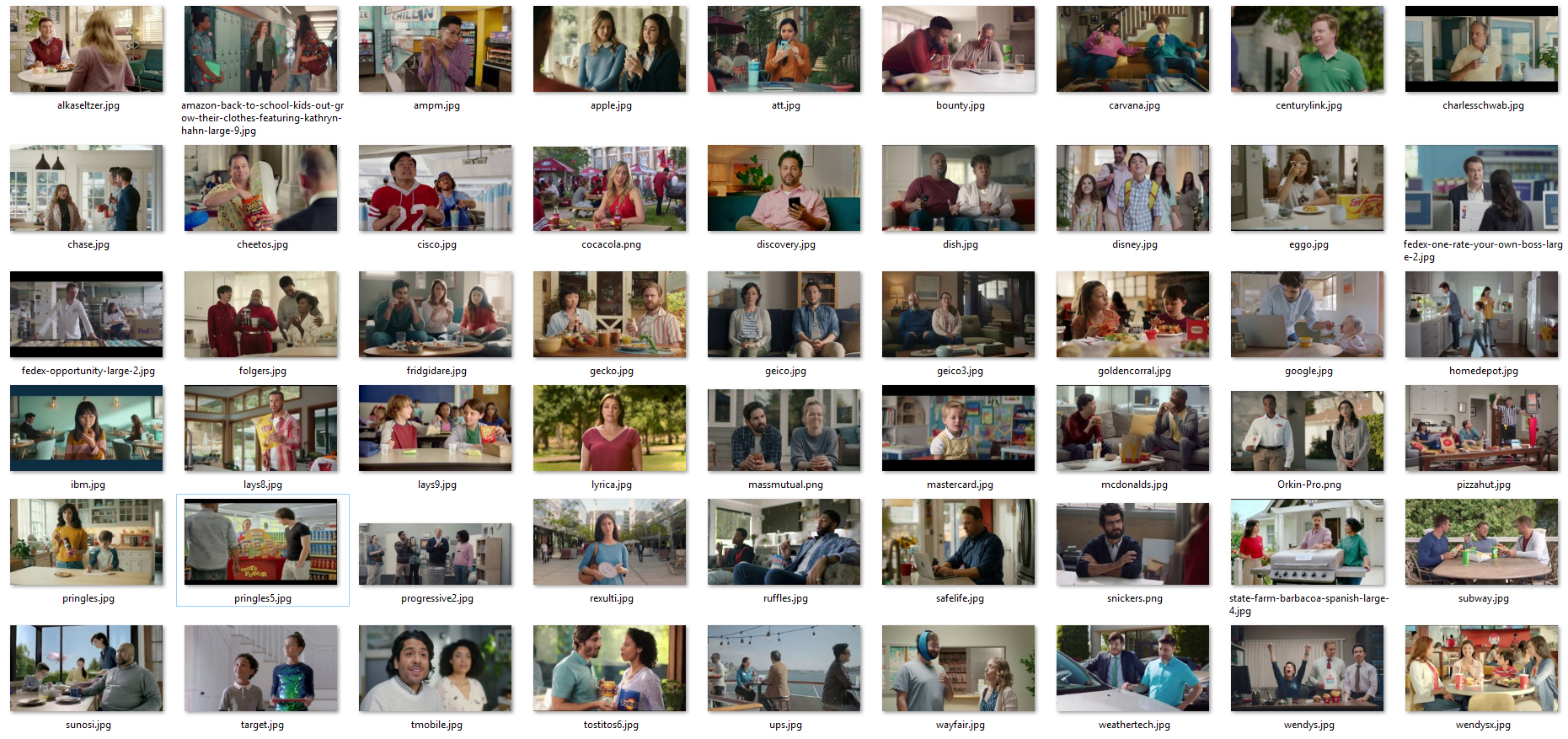
some thumbnails of television commercials exhibiting this slightly out of focus background https://i.jollo.org/jiWn4jTj.png