Hacker News new | ask | show | jobs
by smoldesu 1249 days ago
> Widespread adoption of generative AI will act as a lubricant between systems,

I largely agree with this article, but I feel like you have to be careful with these general predictions. Many technologies have purported themselves to be this "business lubricant" tech (ever since the spreadsheet), but the actual number of novel spreadsheet applications remains small. It feels like the same can be said for generative AI, too. Almost every day I feel the need to explain that "generation" and "abstract thought" are distinct concepts, because conflating the two leads to so much misconception around AI. Stable Diffusion has no concept of artistic significance, just art. Similarly, ChatGPT can only predict what happens next, which doesn't bestow it heuristic thought. Our collective awe-struck-ness has left us vulnerable to the fact that AI generation is, generally speaking, hollow and indirect.

AI will certainly change the future, and along with it the future of work, but we've all heard idyllic interpretations of benign tech before. Framing the topic around content rather than capability is a good start, but you easily get lost in the weeds again when you start claiming it will change everything.

3 comments

"but the actual number of novel spreadsheet applications remains small."

That's not my experience, I am continuously amazed by the amount of tasks worker bees manage to do in excel.

I kind of wish MS access was more of a thing, because when eventually it doesn't scale and you need a "proper" system, it takes a rewrite.

That's fair enough, I've seen some pretty cool things in spreadsheet software too.

My larger point, though, is that most people end up using spreadsheets to do the same thing. It's fun to imagine novel uses for a spreadsheet, like a DAW or video game, but ultimately it's not very useful for that. Similarly, ChatGPT is great for writing convincing text - that's what everyone uses it for. Can it solve math though? Not very well. Future applications of the tech are more likely to be specialized, in that sense.

Mostly, I'm a curmudgeon and I despise these "flying car of the future" articles. Popular Mechanics printed them for decades, and half a century later nothing has changed (not even the culture writing them).

I think we knew from the get-go that spreadsheets would be used for pretty much anything to do with numbers. That there aren't any new applications past that understates their general applicability.

I agree though, chatGPT isn't a real flying car. Imagine if someone revolutionized the paper clip. The day-to-day of millions would be forever and irrevocably changed; and almost nothing would happen.

>Mostly, I'm a curmudgeon and I despise these "flying car of the future" articles.

When you understand how the sausage is made it is hard to be overly excited. I fail to be "mind blown" by ChatGPT because every time someone claims it can do task X they only managed to scrape by within its significant limitations.

If you want superhuman intelligence you are going to need to break through the short term memory limitation of humans. If the AI can memorize a 1 million line code base then it will be practical but everyone is only working with small code snippets or generates the entire code from scratch and then extrapolates that to a million line codebase even though that isn't possible. That is the height of impracticality.

And before anyone accuses me of moving goalposts. I'm not the one moving them. It's the people telling me it can make manual programming obsolete. Why not just stick with what it can do instead of making these claims?

It's not just that a system built in MS Access facing scale concerns needs a rewrite from an engineer's perspective.

It's that the business will also accept that it needs a rewrite. As opposed to the current status quo where they'll ask what's wrong with continuing to use $Slick_and_Fancy_Tool (then act surprised when it stops scaling with regards to whatever business, performance, or compliance barriers you've then reached).

I always tell people that spreadsheets should be used to display data, not store it. As soon as you use spreadsheets to store data you've begun the descent into darkness.
> Our collective awe-struck-ness has left us vulnerable to the fact that AI generation is, generally speaking, hollow and indirect.

This totally resonates with me. This is absolutely correct. Thinking about the future of work, there's much of what I do every day in my job that is hollow and indirect. And I would be totally okay if I could have something like ChatGPT do it for me.

Weren't we all supposed to be lollygagging about, as our robots did everything for us, by now?

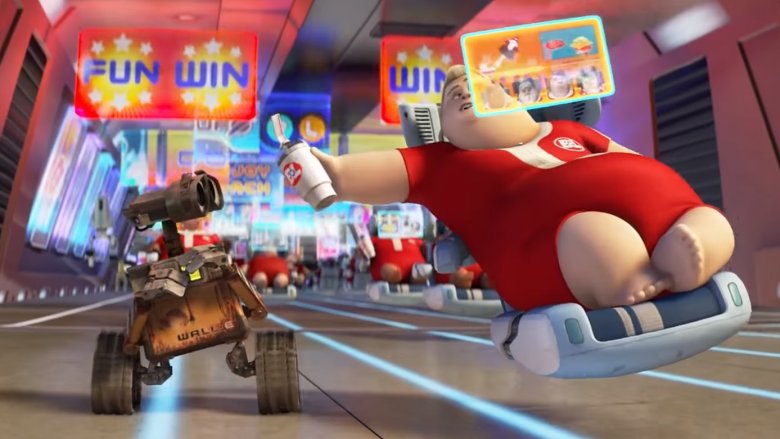
I can't wait for Wall-E!

https://www.thelist.com/img/gallery/things-only-adults-notic...

Wall-E was about as much about post-scarcity as it was about escaping reality. To me it looks like we've focused on the second part and we got pretty good at it.