As someone who lived in the Eastern Block (not USSR though), I can tell you: struggle and no hope.
Struggle to get the basics for life: heat, food, clothing, books, disposables. It all took queues, friends, relatives, and black markets.
No hope for the future: no matter what you did, how hard you tried, there was no way to improve your lot in life. It was all outside your influence, all controlled by The Party.
The only dream we had was to somehow escape to the Free West. It was dangerous and you could lose your (or your loved one's) life in the process, but for many it was worth it.
Middle class in a big city on Urals, late USSR (1970-1980s):
My grandfather was repressed (forced labor) in Stalin times, but later became a worker at very large steel mill and made very good money there, even traveling to Egypt as a consultant. He had a good car — Volga (white, the black ones were reserved for party VIPs), moved to a new apartment couple times. We spent enjoyable weekends on dacha (a small plot of land with a house and a garden) or went to a nearby lake to swim or to fish. Spending a week or two in sanatorium in the mountain area was also possible (I think this was sponsored by trade union — still a thing in some large companies in Russia).
My parents were engineers back then, they also had a good job, separate apartment (no morgage, no expensive payments) and dacha. Travel abroad wasn’t really accessible (my father was in Hungary once), but within the country it was a normal thing, flights were relatively cheap.
This was the lifestyle of many our family members and their friends. Of course, there were many people which lived much worse, but for sure life in SU was not eternal suffering of everyone and you did not have to be a party member to live well.
Congrats, your grandfather was part of nomenklatura (establishment), that's 2% of the population. They "repressed" each other, no surprises here. It had nothing to do with the "middle class" (in an alegedly "classless" society, lol).
If you are truly interested and not just negative, I don't know how it was in the USSR apart from anecdotes, but I was born in the GDR in 1972 and lived there until the wall came down, and for that Eastern country I can speak.
Some countries like Rumania had rulers that were the typical tyrants, enriching themselves in the process. But that was not so in all Eastern countries. YES, the party members and governing people did have it better - but the gap between them and the rest was waayyyyy lower than that in Western countries.
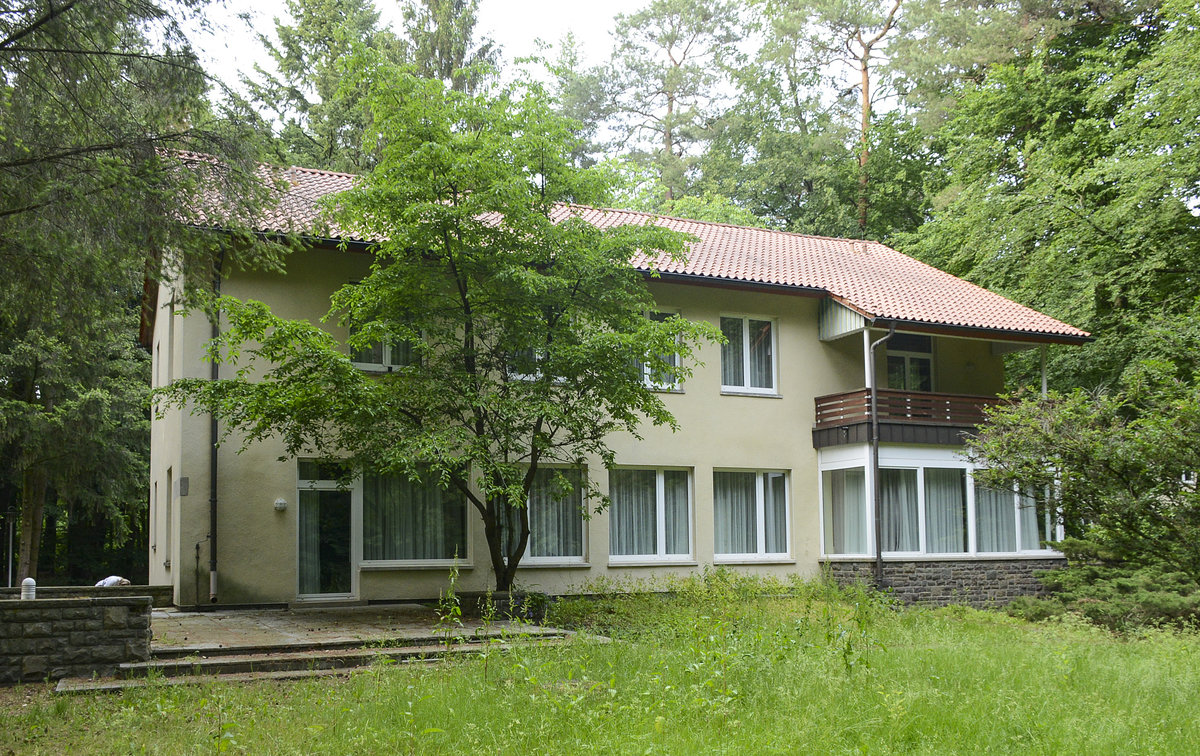
Here are two pictures of Erich Honeckers house, the leader of the GDR, in the protected area where several of the leaders lived, front and back:
He explicitly states in that text that every well working and connected GDR craftsman, movie actor or pub owner would have laughed about the size and everything in there, and that after being the first journalist to tour the place his sense of justice was not triggered at all while seeing it all from the PoV of a regular GDR citizen. Which is exactly the same impression I myself had too when I saw the pictures on TV.
The had a pool! I'm sure every American is very impressed knowing that. They had a better food selection, like the famous bananas that GDR people were always longing for, but it's not like the rest of the country was starving. I remember 40% bad food at school and later in the factory (especially pasta, it was really bad), but at home it was always really good. Only more exotic imports were hard to get, like said bananas, or oranges (other than the terrible Cuban ones).
Honecker did have some privileges, like a hunting ground, but that really is not much, hunters in Germany all have theirs too.
I heard that in Russia it was somewhat similar: While the nomenklatura were better off, e.g. they had Volga cars, but in the end all their advantages pale to anything some middle class person in the west has, never mind the truly rich. The "Getting rich and become a billionaire" thing only started with the economic chaos of the 1990s.
I was one of those in the rallies leading to the fall of the wall (I was 17), and I had always known the fortified GDR borders were keeping us in, and not the Westerners out. But I have to admit the leadership was NOT doing it for their economic benefit. It was truly political and ideological. And it was truly meant to be for the benefit of the "working class". They did care a lot about everyone especially worker and farmer children to get the same good education (well, always plus "political education", but they really believed what they taught, unlike Putin and his cronies today who I think know they are lying to their people and behave more like Mexican cartel bosses) - see my other comment.
They had the ultimate privilege: unlimited power over their fellow human beings. They were much closer to royalty in that respect than to today's billionaire.
What you call "small" advantages: car, pool, VCRs, bananas - put them so far about their average citizen that it was like having a private jet and yacht today.
They justified that amazing power to themselves by saying they did their duty to us... the people. But make no mistake, they were never elected and they didn't give up their power willingly.
> What you call "small" advantages: car, pool, VCRs, bananas - put them so far about their average citizen that it was like having a private jet and yacht today.
At this point at the very latest, if not your first sentence already it is clear that you are nothing but a troll.
But tell someone who actually lived there, me, your nonsense - sure.
> and they didn't give up their power willingly.
They did. I lived there in 1989. Nothing happened. They could have given the order to fire, the troops were listening and obeying. They never did. You tell lies. What a twisted, biased, one-sided world view, on a site that's supposed to have open-minded discussions. Truly disgusting, and I say that especially because this was my live, right then, right there, and you do speak nonsense, which sounds not less ideologically blinded than the worst I heard in the GDR, sometimes personally (to me, a teacher, 1989: "Sie schwimmen im Fahrwasser des Klassenfeinds!").

Struggle to get the basics for life: heat, food, clothing, books, disposables. It all took queues, friends, relatives, and black markets.
No hope for the future: no matter what you did, how hard you tried, there was no way to improve your lot in life. It was all outside your influence, all controlled by The Party.
The only dream we had was to somehow escape to the Free West. It was dangerous and you could lose your (or your loved one's) life in the process, but for many it was worth it.