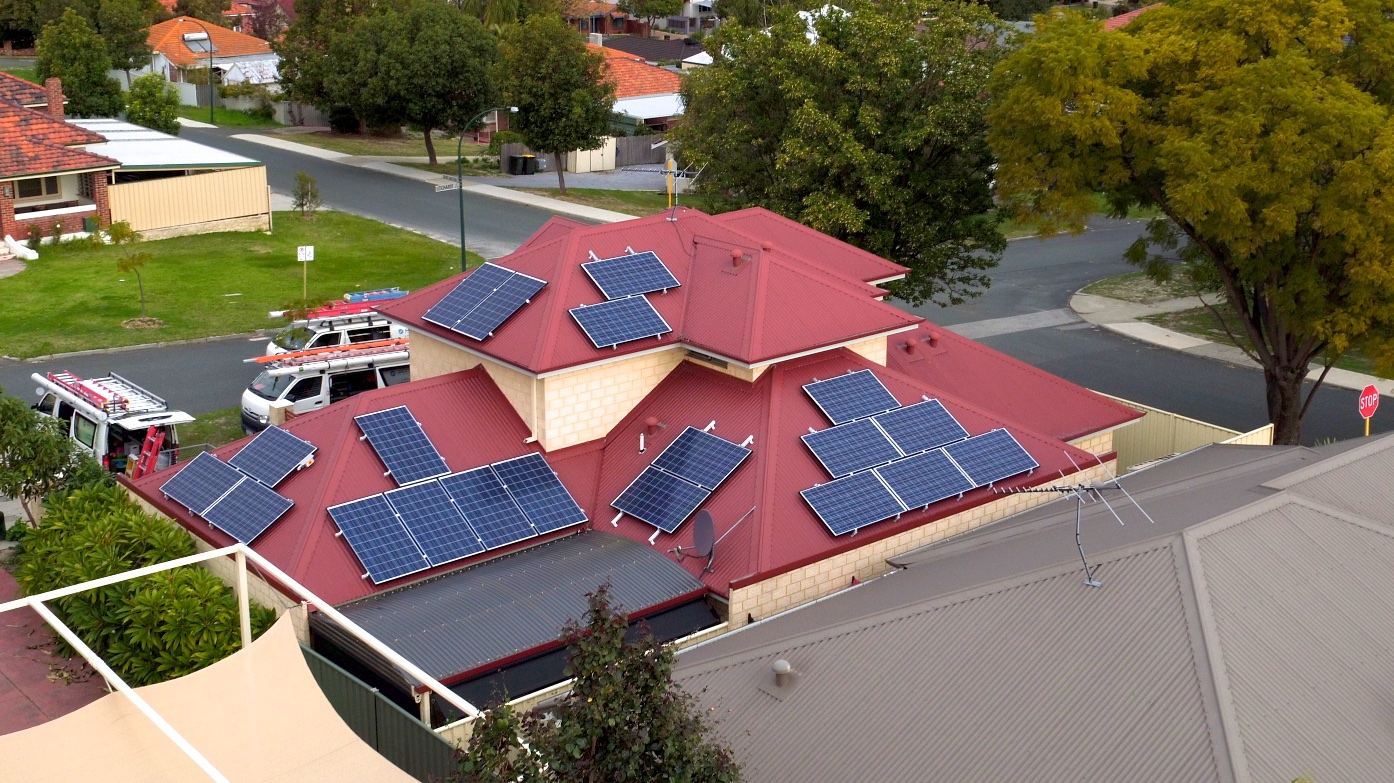
Having 21 panels requires a rectangle 17ft by 24ft (each panel is 5.4ft by 3.25ft). That's far from an estate: if it's a two story home with a flat roof you're talking 816sqft compared to a US median of 2,300sqft.
1. Most roofs aren't flat.
2. For pitched roofs, you're only going to want to install on the south or west facing sides. So only some percentage of your roof area is ideal.
A pitched roof and installing on only half doesn't change it that much. If your roof is 45deg then you're talking about a 24x24 building. If that's two stories this is 1152sqft, still less than half the size of the median US house.
There are roof designs where even on a large house 21 panels won't fit, but looking around my neigborhood most houses could easily do that many.
If my math is right, 21 panels is 38.2 m^2 or 411 ft^2. That's not a huge amount of roof space. Depends on the roof pitch, but I think it could cover just the south facing sides of a roof of a 2000 ft^2 home.
I live in a much hotter and much more humid area than the author does, and my bills are not even remotely close to these. I do run my AC through the summer, probably more than most
~$135 1190kWh (charged at ~$0.114 / kWh)
~$10.50 tax
~15.50 other fees/riders which can not be recouped with panels
OP is somehow paying ~25c/kWh, though I have to believe they are counting the connections fees etc in their estimate, based on natl averages they would be an outlier for most states. https://www.eia.gov/electricity/state/
I don't have A/C, do have net metering and do have solar panels, so I intentionally picked the plan with the highest costs during the day in the summers and I pay 24c/kWh only in peak hours during the summer.
Author may be a high energy user and on a tiered monthly-usage plan rather than a TOU plan; if that is the case than the solar panels may be saving energy billed at the highest marginal rate which might be 25c/kWh. My previous house had in-ceiling electrical resistive heating only and I accidentally got a 4-figure electric bill the first January I lived there because one thermostat was broken. IIRC everything after the first NkWh (where N was a crazy high number) was billed at around 25c.
California rates (not sure the OP is in California, but still) are just high. Lowest Off-Peak rate is $0.22/kWh in my area, and On-Peak (4-9pm) can be as high as $0.62/kWh.
That's wild. I live in an extremely hot and humid part of the country, in the Gulf Coast; probably the area with the highest AC demand in the summer. I routinely exceed $300 a month in the hotter months.
Do you have a particularly small or recently-built, well-insulated house?
New England is generally not that hot and humid especially outside cities--except for fairly brief spells. That said, some people do regularly run the AC to keep houses cooler in the summer. His savings are probably more than I pay in electricity in a given year (with oil heat and a small window unit AC in my office if I bother to put it in.)
This is a great point. Avg cost for me last year was less than half, around 11c/kWh
Though, https://www.eia.gov/electricity/state/ makes me wonder how you are getting 25c/kWh prices, as author estimates. Maybe higher price tiers due to usage.
I don't find his methods particularly rigorous. He's just taking total generated kWh and multiplying it by current utility rates and then saying this represents savings.
Does it, though? We don't know how much of the generated power was actually used instead of sold back into the grid, or if this is even a grid tied installation, and what the return sales rate would be.
The only way to actually compare this is to look at the actual bills. What did you pay last year, what did you pay this year? That's _actual_ savings. This is calculated plausible savings. It's not at all clear they're the same thing in this scenario.
Finally.. if you're in a position to even say you're _saving_ $233/mo, then how inefficient is your home in the first place? How many people live there to generate this large of a bill? How much of a difference would it have made to make that house more thermally or electrically efficient instead?
If you live in a place that does net metering, it truly just is as simple as generated kWh * utility rate. That's what net metering means. Each kWh you provide via solar offsets the cost of a kWh from the grid.
Additionally, if you live in a place where power is $0.20-$0.30/kWh, then $233/mo is not a particularly large amount of electricity, especially for a single-family house. At $0.30/kWh, that's only ~775kWh of electricity.
There are a few different forms and a few different rules surrounding it. I can probably assume what he means, but a more direct comparison would obviate any of these factors.
Right.. but that's not his total cost, that's his total savings. So, with those factors; which make sense for New England, he's got a 7kW system getting light for about 3 hours a day on average to net that 775kWh to earn the $233 savings in a month. Would that be right?
If the system was totally efficient, then yes, but the 7kW nameplate number is peak efficiency... so most likely it's some averaged number (say, 4-5kW?) that is across a longer period of time.
I am too. My last energy bill was $39 for 174kWh for a house built in 1926. Considering that I pay ~$12 in grid connection fees, the payback period is functionally never.