Hacker News new | ask | show | jobs
by roenxi 1271 days ago
This article is dancing around the issue; making fast progress has been made systemically illegal. Now we have evidence of exactly how damaging the regulatory state is in the the medical world.

1) Turns out those heartless capitalists could be producing vaccines in ~2 years. The tech is there, the regulators aren't ready for the level of risk in the COVID response as a routine thing.

2) Turns out that people aren't going to inject themselves with uncertain technologies, to the point of irrationality. Contrast this to one of the usual response to "we need less medical regulation" which is that people are stupid and will hurt themselves with unproven products. My suspicion is that over the long term this irrational looking swarming behaviour actually turns out to be pretty good at managing risk no matter how crazy the individuals in it are behaving.

The problem in building, construction, technology and mining is pretty consistent. We see the strategies that work in Asia and maybe eventually in Africa - if you let capitalism happen it has powerful enough results at a such speed vs. central planning that it can be rightly called a miracle.

2 comments

Do you have any evidence to suggest mRNA research was slowed by regulation that was loosened up in the face of COVID? My understanding is 1) it builds on decades of publicly funded research, originating in military programs, and 2) it was being developed nonstop and every prior attempt had serious adverse effects (specifically serious allergic reactions).
Are we quibbling over definitions? Before Covid it was expected that a new vaccine would take years to develop and go through all regulatory steps.

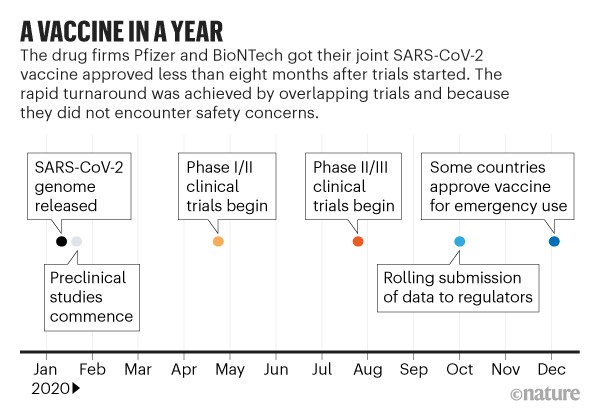
https://media.nature.com/lw767/magazine-assets/d41586-020-03...

That doesn't have anything to do with mRNA per se, the Uk vaccine AstraZeneca was ready even faster.

It’s not quibbling over definitions but over causes. Vaccine development has always been and will continue to be relatively slow compared to COVID due to lack of commercial incentives.

Insofar as there is any progress made on vaccines in the absence of strong market incentives, it’s due to government funding, not benevolent capitalists choosing to take on decades-long loss-leading blue sky research projects.

The approval happened quickly not because there was some crazy regulatory overhaul but because drug regulation is always a cost-benefit analysis. In this case, the vaccines themselves worked phenomenally well, their risk profile was extremely good, and the costs of doing nothing was extremely high.

It’s not strange for drugs to conclude trials early based on strong early data and strong patient need, just most drugs in most scenarios don’t meet that bar.

Then where are all the other mRNA vaccines? If it is a tech change rather than a regulatory exception there should be a whole bunch of other vaccines coming out by now, they've had long enough.

COVID appeared in March, they had the vaccine in clinical trials by April. The technical aspects aren't a factor here - the time taken to develop a vaccine is basically instant.

Covid vaccines were a repurposing of MERS vaccine research which is also a coronavirus and has a similar spike protein. So, some vaccine companies had a leg up as they were already pursuing MERS vaccines. The problem was that progress was slow because nobody was willing to put large amounts of development money behind a vaccine for a disease with such a small number of cases.

Covid poured accelerant on MERS vaccine research. Suddenly, there was a disease with lots of cases with lots of people willing to sign up for trials. In addition, there was a lot of money sloshing around so companies were willing to take the financial risk to combine Phase II and Phase III trials (to be fair--a Covid vaccine passing a Phase II trial was always going to pass a Phase III trial until we had many different vaccines). And, please do remember, nobody knew if mRNA for Covid was actually going to work.

Other mRNA vaccines are in the pipe. However, they have to go through trials with a lot less funding and a lot less money at the end. Rabies(!) got a Phase I trial--but it's hard to get to Phase II since rabies is so rare. mRNA flu vaccines are in Phase III. mRNA HIV vaccines are in Phase I and may be in Phase II by now.

What you see is that if we drop the equivalent of the Manhattan Project at producing a vaccine, we can pretty much produce a vaccine for a virus in a hurry. However, if we're not willing to drop that kind of cash, progress is slow.

If you want more vaccines, tell some of these multi-jillionaires to quit fucking around with virtual crap like Bitcoin and Twitter and start dropping some non-virtual gigabucks on vaccine companies that are trying to produce real products.

The COVID vaccines were rolled out on the basis that they were more-or-less safe and probably efficacious. A lot of them turned out not to be as safe as anticipated - eg, the blood clotting issue in the Astra-Zeneca virus or the myocarditis issues in the Moderna vaccine that have gotten its use limited in Scandinavian countries [0]. It turns out that the evidence that was collected at speed wasn't actually enough to justify the actions taken.

That was a good standard and an appropriate thing to do. But that standard is lower than what the medical regulators usually accept. As you point out, Phase 3 trials are good to do but it is going to make it a lot harder to get a vaccine to market if people have to take them seriously. Vaccine makers should be allowed to sell vaccines that are merely safe and effective; they shouldn't have to pass a higher standard than that to sell the things with a disclaimer label.

As an aside I'd also question the efficacy results as the vaccines are probably a lot less effective now. It appears the virus has mutated quite substantially. But that hasn't changed the vaccine approval status, raising interesting questions around why efficacy is even a requirement to sell the thing. Why not just a safety study with the requirement that efficacy data will be collected and made available? We need to figure out if something is efficacious, but there will be more money to do that - and better data - if it is allowed to go to market. As we can see from COVID, jabs in arms and money are the two things missing to make vaccine development fast. The normal regulatory framework makes both those things hard to get.

> If you want more vaccines, tell some of these multi-jillionaires to quit fucking around with virtual crap like Bitcoin and Twitter

Didn't most of the wealthy people in Bitcoin make their money in Bitcoin? There weren't a lot of ultra-wealthy people putting serious money behind it as I recall.

[0] https://www.reuters.com/world/europe/finland-pauses-use-mode...

You're completely ignoring just how big of a threat Covid was, which is a part of the risk-to-benefit ratio of a Phase III trial. The same vaccines, with the same P3 results, may well have not been approved for, say, a mild cold virus, but would have also been approved for Alzheimer's.

The reality of drug approvals is that they always take into account proven benefits and risks (including some room for yet-unknown risks) compared to the available alternatives (including other vaccines, other medication, or even not treating the disease at all).

This calculation was not necessarily changed for Covid in some special way. The bug difference with Covid was that governments pumped billions into getting the research done, as did the companies themselves knowning that they will likely be able to literally sell tens of billions of doses of this vaccine if they make it work even a little bit.

Fair enough. This may be where there is nothing more to say. But just in case - why is it necessary to centralise the decision for making risk-to-benefit ratio assessments? Everyone has different risk profiles and may have reasonable disagreements about how dangerous the risks are vs the benefits. We've learned that several widely used vaccines were more damaging than the health authorities realised, but nearly nobody has a problem with them having been rolled out to the masses. This suggests the standards of the health authorities are unreasonably high. When they lowered their standards for COVID there was barely any extra damage done, we're measuring the incidents in single digit cases per million.

A lot of people - dare I say most - have a higher tolerance for risk than the health authorities do. Why is it necessary to hold back progress because of nervous bureaucrats? We could make faster progress by letting people willing to take risks take risks.

I just want to confirm here that you are asserting that COVID-19 appeared in March 2020? Obviously this is not the case or it would be called COVID-20.
Nobody was developing vaccines for it in 2019. I forget when it was sequenced, I suppose that probably happened a little earlier. But it doesn't take much guesstimation to say that vaccine development wouldn't have started in earnest until a little way through 2020.
"ready for the level of risk in the COVID response as a routine thing"

Are patients ready for that level of risk? Are children ready for that level of risk? Outside of emergencies, does anything justify that level of risk?

"We see the strategies that work in Asia and maybe eventually in Africa - if you let capitalism happen it has powerful enough results"

So Asia is capitalist? But other countries are not capitalist? This sentence seems to imply that America is not capitalist but Asia is capitalist. I've seen this kind of writing before. Without a rigorous definition of "capitalism" then this kind of thing quickly becomes "capitalism is all the stuff that I agree with and socialism is all the stuff that I disagree with."

"if you let capitalism happen it has powerful enough results at a such speed vs. central planning that it can be rightly called a miracle"

This suggests that capitalism is the opposite of central planning, but we could clearly design a highly decentralized version of Communism:

https://demodexio.substack.com/p/how-to-build-a-pragmatic-co...