Hacker News new | ask | show | jobs
by GrifMD 1280 days ago
"Sydney has a few crossings where instead of particular directions being open to pedestrians, the whole crossing goes green for pedestrians and red for cars. This seems more efficient to me, and safer since cars aren't moving at all when you cross - often you have to share the space with cars turning left when you cross. I wish we had more of these."

---

These are called "pedestrian scrambles", and I like them a lot more too. I do know there's a few in the Sydney CBD, but I don't recall them being marked particularly well that they are a scramble.

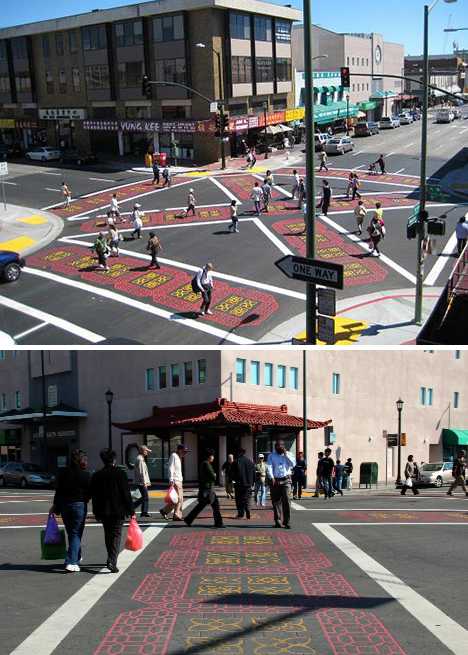
The ones in Oakland (picture below) are very well demarcated, and a study found them to reduce vehicle-pedestrian conflict though did increase the amount of people crossing parallel to traffic when the signals indicated "don't walk".

Picture: https://weburbanist.com/wp-content/uploads/2012/05/crossings...

Study: https://escholarship.org/uc/item/3fh5q4dk

7 comments

One of the side effect issues of scrambles is to obtain the same throughput of cars you have to may have to increase the delay in between pedestrian cycles. When only allowing pedestrians on some axis you can allow cars to run in parallel.

One argument I saw somewhere (I can't remember where) is that if there are enough people to make a scramble worthwhile (and you don't care about car throughput) - you probably shouldn't have any cars there at all!

This comment covers some of the downsides: https://www.strongtowns.org/journal/2018/11/27/a-pedestrian-...

If there are enough for a scramble, then there are probably enough to build a pedestrian layer _above_ the car layer entirely. Isolating large vehicles from fragile human beings is the best engineering solution.
> there are probably enough to build a pedestrian layer _above_ the car layer entirely. Isolating large vehicles from fragile human beings is the best engineering

As far as I can tell, the general consensus among urban planners is that building pedestrian overpasses/Skyways/skywalks is a _really bad idea_.

They suck pedestrian life away from the ground plane and surrender it to cars, which has all sorts of second order effects.

The ground level becomes darker, and more dangerous with less "eyes on the street". Car focused transport planners are more bold to increase traffic volume (with increases in pollution/crashes/noise). Businesses on the street struggle.

> Isolating large vehicles from fragile human beings is the best engineering solution.

It may be the best _engineering_ solution (don't get me wrong, I love some Brutalism and textured concrete), but it's usually a horrible outcome for street life. The best solution for a healthy, livable street is to build large spaces for pedestrians and cyclists, reduce car speeds to 30kph/20mph, or remove cars altogether.

Hongkong has a lot of raised pedestrian infra in the central business district. It is difficult for people with "reduced mobility" (disabled, old, baby cars, etc.) to navigate. As a second order effect, it has turned street level into somewhat of a Mad Max zone where cars drive as fast as possible knowing there are no pedestrians to worry about.

Related: Hongkong also uses (awful) metal gates to keep pedestrians caged into sidewalks. Again: It makes drivers more aggressive. When I visited Shanghai, a lot of sidewalks blended into the street which had an interesting effect: Drivers were much more cautious because people frequently flowed into streets.

Last comment about lower car speeds: I recently drove on Japan (100% grade separated) expressways in Tokyo, Kawasaki, and Yokohama. At first, it seemed so damn slow. Mostly 80 km/h, but many places slowed to 60 km/h. Really, 60 km/h feels like crawling on an expressway! Always two lanes each direction. Very few on/off ramps. However, after driving more than an hour, I could see the effect: Traffic flowed very smoothly, even in very busy areas. I can only guess this is intentional design.

England, especially London, has removed a lot of those railings in the last decade, for exactly this reason.

(I was amazed just how similar the street level design of Hong Kong was to London when I visited. Of course, it had a century of being constructed to the same standards and regulations.)

The Las Vegas Strip makes heavy use of pedestrian overpasses, but I don't find them to have the negatives you describe. Possibly because the area is so lit up (even at night), cars are kept deliberately very separate from from pedestrians (a lot of drunk people roaming around), and in many places the above-ground overpasses connect to the second levels of adjacent buildings, which makes them a more natural part of the cityscape.

I'm not sure that kind of design can work everywhere, but it can perhaps be an option in some places.

Not a ped overpass, you've misunderstood.

Literally raise the 'pedestrian ground level'. I've also realized that construction cranes and other things that need to poke up through that level should do so by rotating and shipping away the cap segments that the pedestrians walk on and blocking off a work site while in use. Though they'd do that anyway for safety.

Yeah, overpasses are definitely the right choice in some places, but I'd quickly grow tired of them if I had to cross a few in a row. The USYD overpass on City Rd is a good example - a lot of people opt to use the street crossing rather than the overpass, and it's pretty easy to access compared to some (e.g. nice long ramp instead of stairs)
> If there are enough for a scramble, then there are probably enough to build a pedestrian layer _above_ the car layer entirely.

What a lovely and fair idea. Make the ones who use muscle power to climb up and down, while not even sligtly inconveniencing those who can accelerate by just changing the angle of their feet.

I wonder if people who think this is okay walk sometimes or become one with their car already.

My town in Ireland (pop 30k) has scramble phasing on intersections. Ireland really doesn't go in for mixed phases anywhere (nor conflicting phases).

We'd generally be better off with most of the traffic lights in town being replaced by humped pedestrian crossings on the legs of roundabouts, except for the two major thru roads. But for some reason, the county council has been putting in signalized intersections (with ~12-16 light poles) for small, 30kph intersections (max one lane each direction).

You could even install a monorail so they could get around the city above the cars.
I agree with your comment about pedestrian volume and removing cars. Two important points are frequently overlooked. (1) Businesses need to receive deliveries by truck. (2) Disabled or elderly people need a way to access the area, usually by car. Regardless, car volume can be dramatically reduced in many of these areas.
> often you have to share the space with cars turning left when you cross.

The UK doesn't allow left through a red, so a green man means no cars will (legally) come at you.

The UK roads have lots of things that are annoying (and lots of good), but that's a good call in my book, even if it means cars at a red can't turn left even if the side-road crossing is (apparently) empty of pedestrians.

Australia doesn’t either. But there will be a green straight-ahead signal that allows a turn through a crossing, or a red arrow that extinguishes. In pedestrian heavy areas these usually happen when the pedestrian light changes from green (cross) to flashing red (complete crossing). Therefore cars can travel through the crossing while pedestrians are still crossing, but the pedestrians get a head start.
On much of the European continent, drivers with a green light wishing to turn left or right must expect to give way to pedestrians who also have a green light.
Another benefit of these is that, as a pedestrian, if you need to go diagonally across the intersection, you can just do so, without having to make two crossings.

An intersection in Honolulu near where we usually stay when we visit just recently (in October) switched to "pedestrian scramble" mode, and it's amazing. This intersection was excessively annoying, because previously one of the four possible crossings inexplicably disallowed pedestrians entirely, so if you wanted to get from "our" corner to the opposite one (where there's an often-visited ABC Store), you'd have to wait for three pedestrian light changes to get there. Honolulu is annoyingly pedestrian unfriendly (traffic light cycles are very long and favor cars), so it could previously take 4-5 minutes to make that simple crossing.

> did increase the amount of people crossing parallel to traffic when the signals indicated "don't walk".

This is a feature, not a bug. With the setup of "two 1 way streets feed into a scramble", crossing safely on a "do not walk" is trivial, with only a single direction to look for many of the most common crossings.

Saw a couple of those in Perth (WA, not Scotland) way back in the eighties, and have been gabbing excitedly about them ever since. Never seen them anywhere else, though.

I walk, I cycle, I drive cars, I drive buses and the occasional truck. From every perspective I should welcome this setup in many, many places.

> These are called "pedestrian scrambles"

Oh cool, thanks for sharing! The ones I've seen in Sydney are hardly marked at all, often just some signs and diagonal green men.

scrambles are great when drivers actually obey the lights. in my experience there's always a car who is watching the cross-direction lights, and drives through the intersection as soon as it goes red.
At least in that case they're starting from a stop, so they can't be going all that fast through the intersection. And yeah I can't say I've every seen that happen.
Where? I’ve never seen anybody do that…
Probably in countries with intersections where the turns lack signals. In the Netherlands most of the time you can't even tell which colour the other signals have, because they point in the direction of the oncoming traffic they are for and have a cover that blocks light leaking out beyond that.
It does happen here in Belgium, at least in Antwerp. But I have to say this is the worst place I've seen in Europe regarding traffic rules violations, and people routinely drive on red at the slightest excuse.
western canada