Can anyone here recommend the best entry point into robotics for adults? I'd like something where I can start with Python, then potentially dig into the ROS and add more accessories over time.
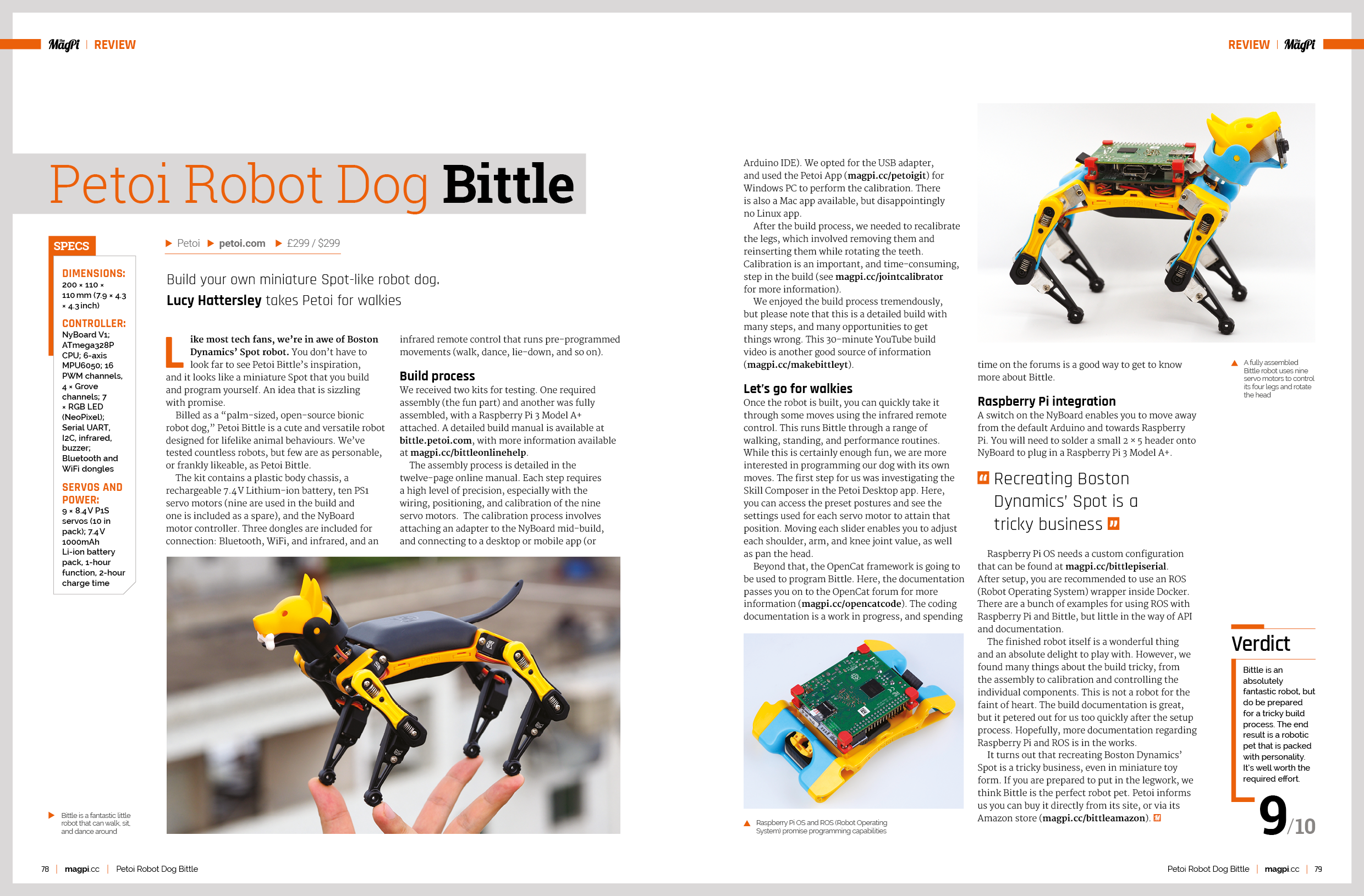
Check out Petoi Bittle robot dog(https://www.petoi.com/products/petoi-bittle-robot-dog) for under $270. It has a complete set of tools for entry-level robotics. The motion controller is a Arduino-like controller and can connect to many third-party sensor modules such as camera, gesture & microphone. It supports C++ and Python API
It runs on open source software OpenCat and can integrate with Pi or ROS.
I recommend the Roomba like Create 3 robot. It's made by iRobot, the company that makes Roombas but for education.
It supports ROS2, is relatively cheap and easy to her started with. You can layer build your own systems.
PS: If you can afford to spend like $5000 and want a quadraped like Spot, you can get one from Unitree. If you are looking for manipulators, you can get one from Elephant robotics for less than $1000. If you are looking for a more useful manipulator, I love Franka panda but it's like 20,000 USD.
Thanks, this is helpful. I was looking at the Create 3, and I like the price point, but the website doesn't include much in the way of accessories or addons. Do you know what people use it for w/out those?
I need to find the link but there is a way to attach camera to it.
Tbh most people use it only for learning ROS. I know you can learn ROS using Gazebo similations but real robot feels better and many universities use such hardware for reaching ROS and robotics basics in intro to robotics classes.
A more useful, affordable "robot" I can think of is Crazyflie nano drone. It has an amazing ecosystem of extensions around it and you can do as high level or low level as you want to. You can develop and tune your own sensor fusion and state estimation algorithms, control algorithms, etc.
Do you want to build the hardware? Cuz if not, Gazebo's [1] a great starting point to just play with the software/build your own. Built from the ground up deeply integrated with ROS.
That's true, but I'd call the smartest robot available to consumers that is relatively affordable.
Their tech blows my mind. They do all the navigation and motion planning based on just RGB cameras, running multiple neural networks in parallel on board the drone. All the depth estimation, including small obstacles likes leaves and power cables, they are doing it all onboard. I don't think anyone in industry come close to that.
I so regret missing interning with them when they were starting to grow in 2018 - they came to my University for recruiting and I was just starting my PhD and decided to not look for internships.
> I don't think anyone in industry come close to that.
Check NVidia. I believe Jetson Nano can do stereo matching from multiple camera pairs in real time. From here one step to 3d points cloud. New Orin will have like 10x performance. Coming in January. So, it's within the reach. I'm thinking, have big stupid drones collecting the dust...
Skydio is too small to design their own chipset - they use Nvidia GPU onboard.
My comment was about people using neural network models for everything needed to fly a drone. I've seen models fail badly in ground based robots. They are flying a drone that's running so many models to be able to track, detect, localize, plan and fly. It's insane.
Jetson Nano can do stereo matching, and perhaps one can manage to even run multiple neural networks at the same time in inference mode. Getting it into production on real world systems is a whole different story. I can't imagine how Skydio manages to produce such robust and consistent outputs. I mean it kinda makes sense why Skydio is the first and the only company so far who's able to do it effectively - Adam's (CEO) been working on it for like more than 10 years now and his PhD thesis at MIT is awesome!
It's getting easier and easier to make such a drone. I mean it's within the reach of a single developer with $1000 budget. When Skydio came out it was some sort of break through (if we forget DJI and Autel), but now it's not that impressive, sort of normal. There are many models and libraries. NVidia has the whole zoo of them optimized for small devices. For free. I'm pretty sure even my level is enough to make a flying obstacles avoiding drone. I would use of the shelf hardware, of course. Objects tracking, waypoints isn't a problem. BTW, this would make a nice open source project. The problem is, in wrong hands it can do a lot of damage.
We don't have to forger DJI and Autel - Skydio beat them in autonomy. Period. You seem to lack the understanding of fundamental difference between how a DJI drone flies around and how a Skydio flies around.
I work on drones for research. I do RL. No one in academia can build something so robust. You seem to think that flying drones autonomously in the real world is same as running an RL simulation. Good luck trying to build it for a 1000$ lol. Sure, go ahead and try your open source project. Good luck to you!
I strongly suggest you to do some reading before talking about things you clearly don't know anything about.
Sounds like you have a good startup opportunity here. For $1000 you could single-handedly replicate a multi billion dollar business. Why don’t you get started already?
Does anyone have advice on whether the Lego Spike kits are actually good for home use? (In my case, for a 9 year old who is very Lego-proficient and has some basic Scratch skills.) They seem very structured for classroom use, but I keep thinking they should probably be flexible enough for to build some fun and crazy bots at home...
Hardware wise they're pretty similar to the Mindstorms kit, just more colorful. Not the exact same, but close. And I think the firmware is different, but you can swap it out for the Mindstorms firmware.
I collected info about the various protocols and interfacing options in 2013, in the course of making a Racket package for the Roomba and Create. https://www.neilvandyke.org/racket/roomba/
I don’t think it’s a public API but you can easily hack the Eufy 30C. I have been using mine with home assistant automations for a few years now. It’s cheap but I love it and I’m honestly considering buying another one. It has gotten a little noisy after 3 years.
Background is that I'm a software engineer.