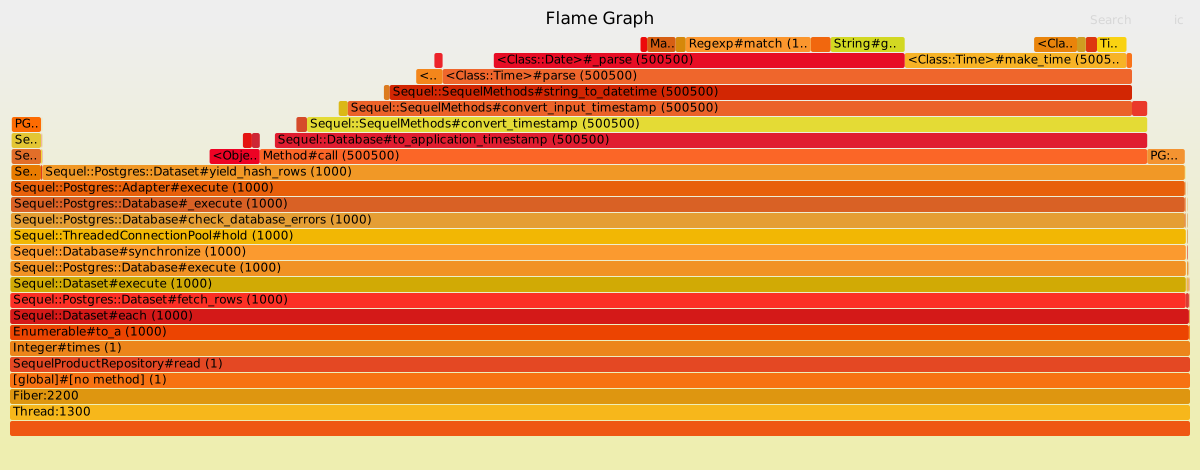
| I was left confused after reading this article. 1. It claims Rust is ~10x faster than Ruby, based on a benchmark that reads a 23mb file, and then iterates over the data a single time. In my experience, Rust is between 20-100x faster than Ruby in purely CPU-bound workloads. But the author's main contention is that most work is IO-bound instead of CPU-bound, so probably not a big deal. 2. The author claims "it hardly matters that Ruby halts all code for 15ms to do garbage collection, if the fastest database-query takes 150ms". I've written applications that query Postgres databases with tens of millions of rows, where the 99th percentile response times are <10ms. I'm not sure why it just needs to be taken as a given that databases will take 150ms to return any data. 3. This flame graph from the article[0] seem to show that the vast majority of the request time is spent in Ruby parsing timestamps, rather than in the database. This seems to make the opposite point that the author is trying to make. I'm not familiar with this stack, so maybe I'm missing something- can anyone explain? [0]: https://berk.es/images/inline/flamegraph_sequel_read.svg |
2. Agreed. 150 ms is extraordinarily slow for a point lookup from a single table. A simple lookup should take around 1 ms since it'll be cached in memory.
3. Also agreed. The actual database time looks to be the first flame. Hovering over it shows PG::Connection::exec which accounts for 2.5% of the time.
I was curious about date parsing and dug up the source [1]. Seems like you could gain a ton of speed back by using a postgres specific timestamp parsing routine. In Go, it's 40 lines [2]
[1] https://github.com/ruby/date/blob/d21c69450a57a1931ab6190385...
[2]: https://github.com/jackc/pgx/blob/a968ce3437eefc4168b39bbc4b...