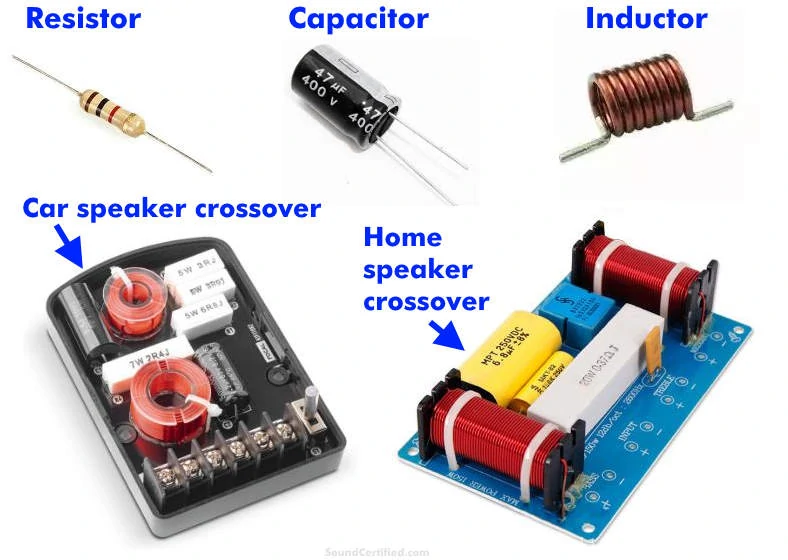
| I think what the comment is missing is that the class of linear f(z)'s is much larger than you might expect. Partly because it just is, and partly because we like it that way. In the land of analog signal processing: any combination of capacitors, inductors, and resistors [https://soundcertified.com/wp-content/uploads/2020/04/speake...] is linear. In the land of math abstractions of signal processing: differentiation, integration, finite-impulse-response (FIR) filters, IIR filters, frequency-domain equalization, etc. All linear. Remember, linearity is with respect to the full time history, so f(z) = z(t) - z(t-1) + z(t-2) is still linear. So we already know the eigenvectors of that whole arbitrary pile of componentry! Given any box of the above components, we can exactly characterize its response to any input -- for all time -- by knowing a list of that system's eigenvalues -- one for each of the already-known eigenvectors. That's the "frequency response" -- the eigenvectors are sinusoids, and the frequency response is the eigenvalue corresponding to each eigenvector (sinusoid). And of course the Fourier transform takes you back and forth from the time domain to the eigen-domain. We liked this analytical framework so much that when we could fabricate nonlinear devices (transistors) easily, we purposefully arranged things so these devices were only used in a linear part of their response curve. Hence, amplifiers: f(z) = 11 z. And then the musicians introduced distortion and f*cked it all up -- our system isn't in a linear regime, our old eigenvectors are meaningless, and we can't predict what will come out. Pure chaos. |