The US exports $25B worth of soybeans per year, which is one of the most water intensive crop. Should these exports be banned? same for almonds, cotton, rice etc.
How? When it comes to pricing the environment, we have a long history of missing the mark by orders of magnitude, due in part to the extremely long delays between cause and effect, and also due to markets and financial vested interests preventing accurate information about costs, and even preventing the analysis of costs. https://scholarship.law.georgetown.edu/cgi/viewcontent.cgi?a...
If the externality currently has no cost, then even pricing it low by orders of magnitude should be better than the status quo. Pricing it high by orders of magnitude would have negative consequences, but that seems unlikely to happen in practice.
> even pricing it low by orders of magnitude should be better than the status quo.
No, while this assumption seems econ 101 logical for a second, it’s not really true and the paper I linked above explains why. The pricing has to match the approximate order-of-magnitude cost of externalities for it to actually prevent any of the consequences we’re discussing here (or more likely be regulated so that Saudi Arabia can’t buy all the water regardless of price). There’s enough price flexibility over water and high enough demand that increasing prices 2x or even 10x today will not slow consumption at all. Water in the US west is already over-subscribed, and people with more money have already lined up to buy whatever becomes available. Increasing prices a little will only change who buys water, not whether it gets used. It has to be high enough that people start choosing not to buy it, which with water is an extremely high bar. In the mean time, draining our aquifers has ramifications for the next several thousand years.
This is the whole problem with cost-benefit analysis and free market thinking. When it comes to things that all humans need, like air and water, we have never yet managed to calculate either the true costs or the true benefits correctly, and reducing the equation to money loses all sense of proportion, and more or less always frames things in terms that let rich people and corporations win and take whatever they want.
I don’t think it is as black and white as you make it out to be.
Yes, there will be large demand for water even at higher prices. But less than at lower prices. Maybe a little less, maybe a lot less, but either way we are better off than now.
Also, there are many other effects to consider besides how much the demand will change. As the price increases, alternative water sources become more economic - trucking water in, building pipelines and canals, building water capture systems, desalinization, etc. Rather than solving the problem by using less water it may be possible to solve the problem by using water that has less environmental impact.
Generally speaking, I find your framework hard to parse. Free market thinking and cost benefit analysis are orthogonal, not two parts of a whole. Pricing externalities, as we are discussing here is not the same thing as cost benefit analysis.
Cost benefit analysis is a bureaucrat sitting in an office and deciding what policies should be enacted. Pricing an externality means assigning a cost to use of some scarce resource, and letting the market decide if and when the resource is worth the cost.
That’s just assumption, and history has sometimes proven this assumption wrong. Higher prices do not automatically yield lower demand. It may take a threshold price increase before consumption changes at all, especially for scarce resources.
It’s true that alternatives change the equation, that I agree with. But the problem with allowing the market to sort it out is that Saudi Arabia might always be able to afford more than small town, Arizona. If you raise prices, you might only price out the locals and surrender your water to foreign interests. Charging money is in no way certain to fix this problem, it might make everything even worse.
> Pricing an externality means assigning a cost to use of some scarce resource, and letting the market decide if and when the resource is worth the cost.
What you just described is cost benefit analysis followed by free market thinking, definitionally speaking.
It's pretty easy, just charge ruinous usage rates for any water use that is beyond replenishment rates.
It doesn't matter if these soybeans are going to China, Mars, or Washington state, the only thing that matters is whether the people growing them are exhausting their region's water supply.
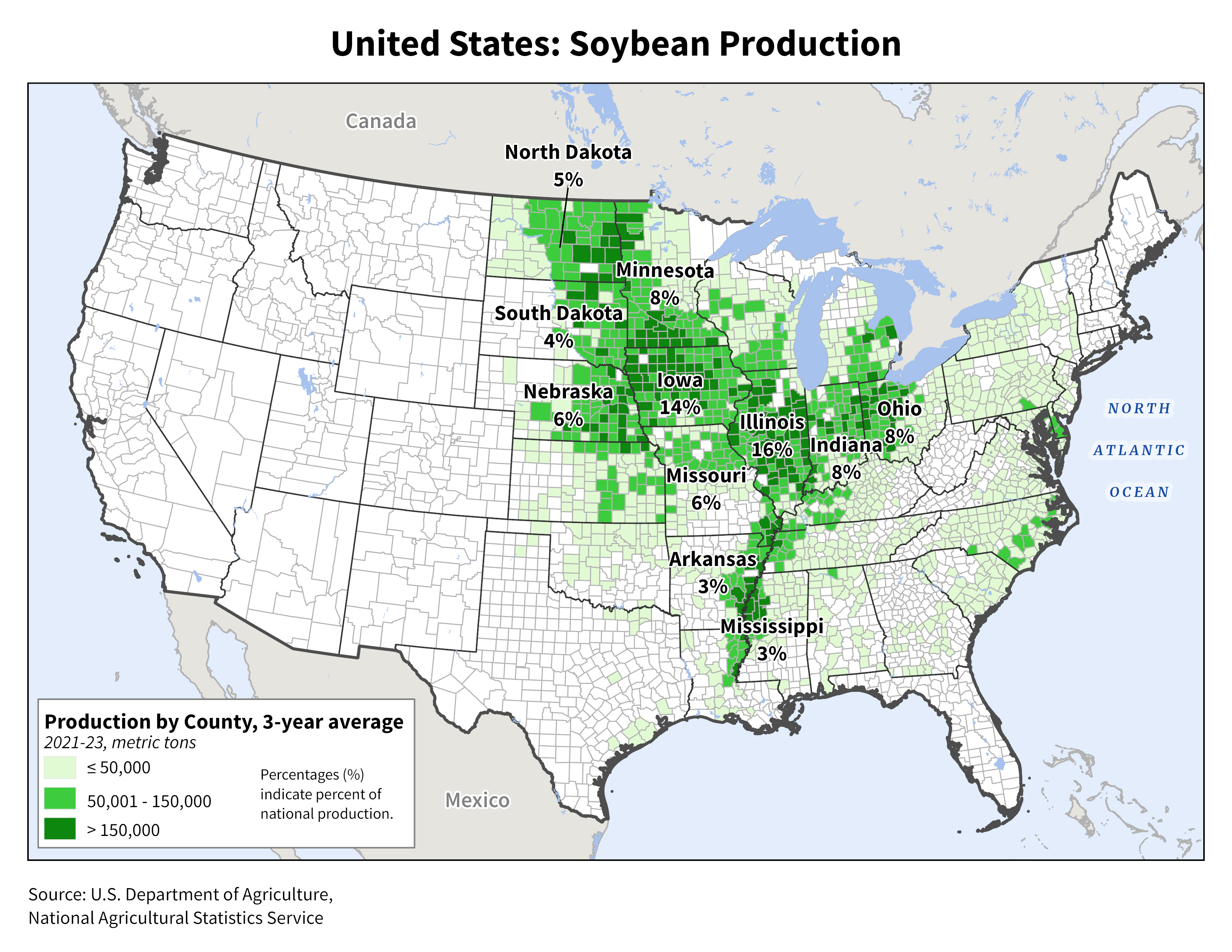
We grow a butt-ton of soybeans in iowa, and I have yet to see anybody irrigating them anywhere. See, we water crops here like god intended - by water falling from the sky for free.
The midwest (not counting Arkansaw in that set, and just going from the labeled state numbers) makes up at least 80% of the total soybean production (Wisconsin and Michigan aren't labeled).
You will note not even a pail yellow on anything west of the Dakotas.
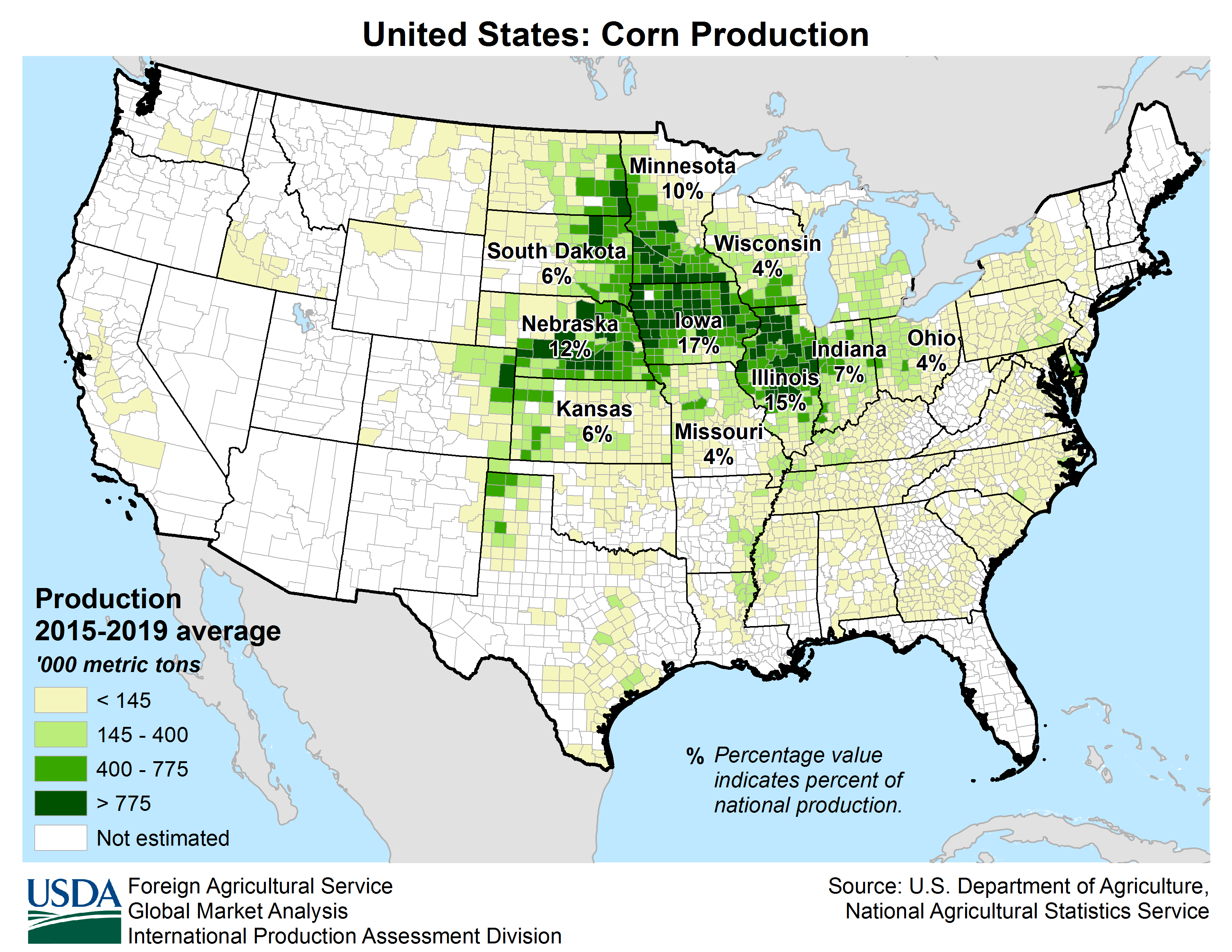
We really shouldn't be growing soybeans or corn in Great American Desert (the vast plains west of the Mississippi and east of the Rockies). That is arid land intended for grass, and then you should raise cattle and livestock on the grass, with at most occasional rotations for crops, say once every 30 years or so. That is why herds of buffalo roamed this area and only small regions were cultivated for corn, and only for a few growing cycles, before it again returned to grassland for cattle.
This is how all civilizations traditionally cultivated grasslands -- as lands on which ruminants were raised, and then you drink the milk and eat the meat of the ruminants as your main source of calories.
Trying to raise crops on arid cattle country requires you to deplete aquifers and then import large amounts of fertilizers because the land itself can't sustain that type of production. It can, however, sustain growing grass, with no fertilizer or water additions required. Then as the ruminants eat the grass, they fertilize the soil and the roots decompose, adding more nutrients. Do that over many generations, and you create a rich soil, and on the rich soil, a few crops can be grown, and then they need to be replaced again with grass and cattle.
The decision to grow millions of acres of soybeans and corn in this desert is a short sighted policy. Milk and meat need to be food products from that region, given the climate. East of the Mississippi, there is a wetter climate, and that's where we should be growing most of our crops.