Hacker News new | ask | show | jobs
by lkrubner 1330 days ago
This article is missing a lot. For instance, it misses the international element completely. It does not mention one of the most important monetary facts of the 20th Century: that the USA dollar was allowed to float 1971. This was the end of the Bretton Woods system:

https://www.bundesbank.de/en/tasks/topics/1973-the-end-of-br...

The floating exchange rate helped the USA to hold on to manufacturing jobs, but caused inflation to go higher. This is a big fact to miss.

"What the Great Inflation Taught Us" leans too much on accounts from Paul Volcker and Warren Buffet. It only shares the point of view of the market and investors. It does not include any point of view associated with manufacturing or labor.

The essay doesn't mention the international context, the fact that inflation was often higher in other countries besides the USA. It doesn't attempt to explain some of the anomalies of the era, such as Japan, where inflation peaked at 26% despite the fact that Japan had a strengthening currency.

The inflation of the era was international, and its beginning and end can only be understood in the international context. I made an attempt to look at this era from the point of view of the relationships between the developed and underdeveloped nations, and their currencies:

https://demodexio.substack.com/p/why-did-the-west-deindustri...

1 comments

Agreed. Also misses the global effect of the Arab oil embargo over US support for Israel in the 1973 war, which was amplified further by the rise of OPEC and the concommitant rise in international oil prices. This in turn caused a balance-of-payments problem, which in turn led to petrodollar recycling and the military-economic alliance between Gulf Arab states and the USA (and also, though this is largely forgotten, the Shah of Iran was a major player in that system before being deposed by the Iranian Revolution).

Andrew Scott Cooper's The Oil Kings covers that in some detail:

https://www.goodreads.com/book/show/12348743-the-oil-kings

It's very relevant today as the spike in oil prices is fairly similar, and current US tensions with Saudi Arabia are not all that different from similar tensions with the Shah of Iran at the time.

Additionally, I'm a bit skeptical about the author's claim that full employment is the number one cause of inflation.

Also led to the invention of the Eurodollar. OPEC decided that world oil markets would be dollar denominated and the Soviet Union was making a bunch of money they didn’t want in US banks. European banks were happy to denominate deposits in dollars, despite being outside the US legal system and voila Eurodollars.
Economics is a thin veneer we paint over thermodynamics because we haven't figured out how to drink oil and eat uranium yet. That high ranking economists can complete gloss over facts like that today is as scandalous as medieval chroniclers who talk about god punishing them for their wickedness with plague and famine without mentioning the sun was blocked out by a volcano for a decade.
> god punishing them for their wickedness with plague and famine without mentioning the sun was blocked out by a volcano for a decade.

You might be glossing over the fact that perhaps god did the punishing by way of volcano eruption. Just like how god was upset about what the dinosaurs did (the blasphemy of those guys!!) by punishing them with an asteroid.

full employment surely can't help, if consumer prices going up is caused by too much demand and too little supply.
As I note elsewhere, the U.S. unemployment rate dropped from 10.8% in 1982 (3.8% inflation) to 6.6% in 1986 (1.1% inflation).. so, inflation plunged while employment boomed... doesn't that completely upset that argument?

Looking through the data, this doesn't really look like an outlier. The 1950s also had low unemployment and low inflation. (Note also that official unemployment numbers don't count the long-term unemployed, so there's some uncertainty in this data). See the following unemployment vs. inflation table:

https://www.thebalancemoney.com/unemployment-rate-by-year-33...

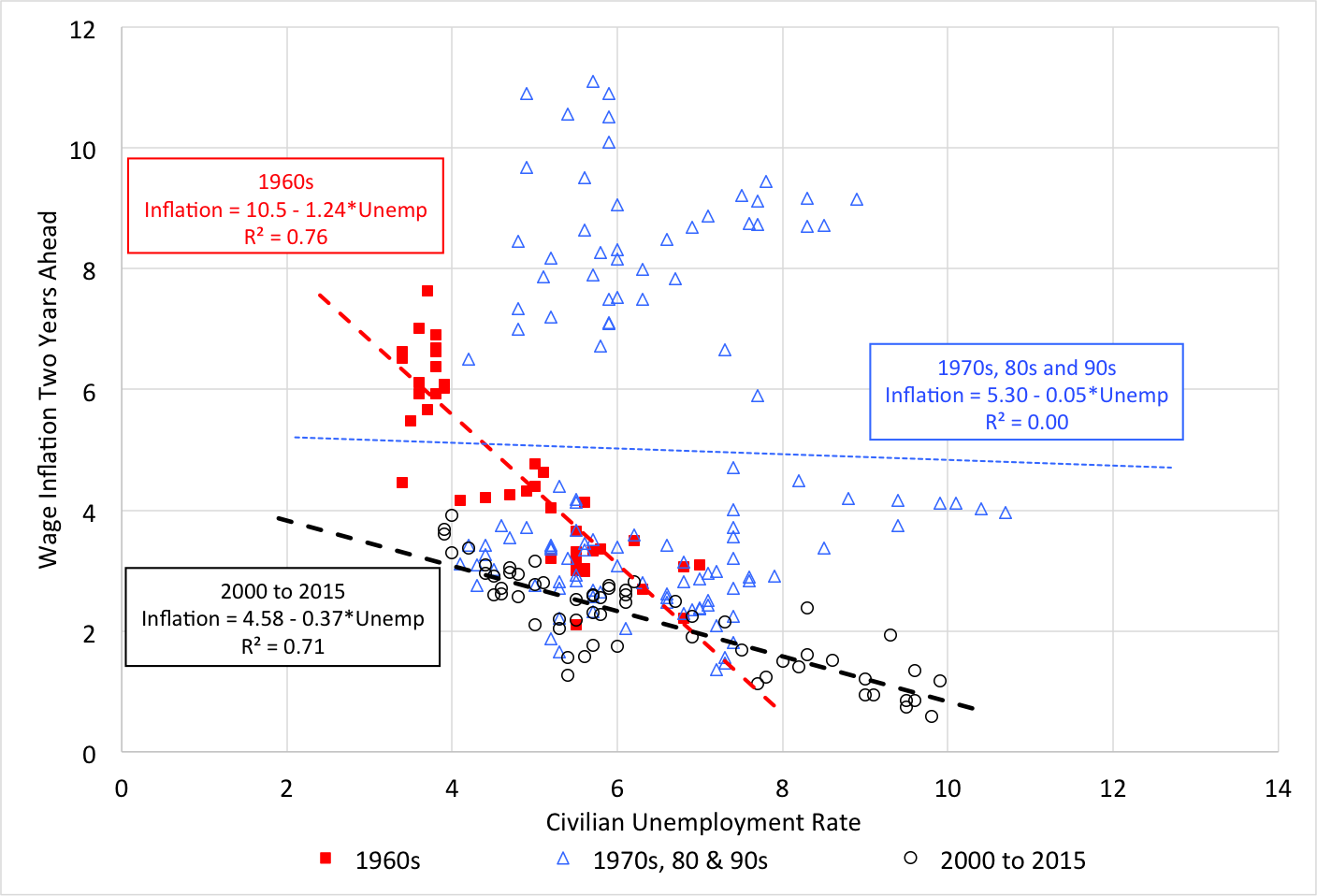
over many periods there has been a short-run tradeoff.

https://images.squarespace-cdn.com/content/v1/52cdc300e4b012...

the phillips curve can shift, that is of course worthy of study. one interesting thing that happened in that period is oil prices collapsed.

you either believe in supply and demand, or you don't. if you believe in it, then greater than full employment leads to rising wages, and inflation if productivity doesn't follow. if you don't believe in supply and demand, then discussion about a lot of economic theory is pointless.

https://www.moneyandbanking.com/commentary/2017/5/29/the-phi...

Supply and demand isn't monotonic across all categories, so treating demand for basic necessities like food and energy the same as demand for luxury items (gaming consoles say) makes little sense. Furthermore, if you look at that data, there's never been greater than full employment (and again, unemployment stats undercount the long-term unemployed).

Clearly, when energy prices spike, everything else follows (including food, which relies on energy for transport and production). Currently, fossil fuel interests are reaping record profits and share values have jumped over 50% since Dec 2021, an even bigger windfall than the defense contractors are pulling in. Ignoring this reality is hard to justify.