Hacker News new | ask | show | jobs
by klodolph 1342 days ago
Virgin olive oil has a strong flavor and very low smoke point, which makes it unsuitable for most types of food. You may like the taste of olive oil better than vegetable oil, but it’s kind of weird to taste olive oil in most foods. Kind of like how you wouldn’t but blue cheese on everything, or truffles on everything, or bacon on everything, even if you like the taste of those things—they taste a bit weird when combined with the wrong dish.

Vegetable oil is chosen in situations where you don’t want to taste it at all, where it’s just used to cook the food.

7 comments

> Virgin olive oil has a strong flavor and very low smoke point, which makes it unsuitable for most types of food.

Extra virgin olive oil (EVOO) doesn't have a "very low smoke point". This table on wikipedia gives the smoke point of "Extra virgin, low acidity, high quality" EVOO at 207°C/405 °F:

https://en.wikipedia.org/wiki/Smoke_point#Temperature

The same page gives standard home cooking temperatures as follows:

  Pan frying (sauté) on stove top heat: 120 °C (248 °F)
  Deep frying: 160–180 °C (320–356 °F)
  Oven baking: Average of 180 °C (356 °F)
So premium-quality EVOO has a smoke point comfortably above the temperatures where most people will cook with it. I suspect the idea that EVOO has a low smoke point comes from confusion between extra virgion olive oil and "extra virgin" olive oil (i.e. between the real deal and the stuff sold in its place). Anyway anecdotally, me, both my grandmothers, my mother, and everyone else I know has been cooking with EVOO for ages and I've never heard of anyone actually managing to make it burn (though I've certainly burned the food cooking in it). And we cook most, or rather, all, types of food in it.

You're perfectly right though that EVOO has a strong flavor. That's the whole point.

Searing or frying meats on the stovetop can easily exceed 400f. Below sufficient temperature the process will take too long and the meat will dry out. A steak seared at 350f will likely have a non-charred exterior. Air frying dense meats after baking and pressure cooking also demands high heat to add a glaze and retain moisture.
The OP said that "virgin" olive oil has a "very low smoke point" that "makes it unsuitable for most types of food" and neither of that is true.
Sorry, yes, most food types do not require high heat.

Non-refined olive oils — even your rare low-acidity example — do have a low smoke point in practice. All store bought “extra virgin” olive oils in my experience also burn closer to 300-350 degrees fahrenheit.

Are you a vegetarian by chance? You said most people cook well below 405 degrees. Traditional American households do exceed that temperature on the grill and the stove.

When olive oil burns, the smoke isn’t always highly visible. Examine close up and from the side. The rising smoke can look a lot like heat distortion.

As a final point, for anyone still here, smoke points aren’t an automatic reason to avoid a cooking oil. Chemical stability is variably correlated, so maybe do some more reading.

> All store bought “extra virgin” olive oils in my experience also burn closer to 300-350 degrees fahrenheit.

Yes, of course. Because of the "air quotes".

I am not vegetarian. I cook everything with olive oil, including searing meats in my French oven. So does everyone I know. I think what you are talking about and what I'm talking about are entirely different substances. I suspect the information on wikipedia, and in your sources, is also far off the reality of olive oil as it's used by people in the region of the world where it's traditionally the shortening of choice. Otherwise, we'd have stopped using it long ago.

> You said most people cook well below 405 degrees.

To clarify, that wasn't me, but wikipedia. I don't personally know what temperatures most people cook with and, I suspect, neither do you. What I know is that there's a few million people in countries around the Mediterranean that cook almost exclusively with olive oil and if it was as easy to burn it as you insist, that wouldn't be the case.

I suspect that you are relying on second-hand information but do not have first-hand experience of a lifetime (and a long tradition) of cooking with olive oil. I've heard more weird things coming from the same place, of lack of first-hand experience, for example that olive oil turns bitter if you heat it, something that I heard for the first time from an American dude with a youtube foodie channel, but not of course from my many friends, family and acquaintances that cook with olive oil as a matter of course. Again, if that sort of thing were true, we wouldn't be using it.

This is really the question to ask yourself: where does your information come from? Is there any evidence to the contrary?

I wasn't citing or referring to anything external, just to my own experiences cooking. Still, I appreciate learning about your culture. If there are extra virgin olive oils that withstand medium-high and high heat, I'm jealous! I think I'll try experimenting with some of our local suppliers.

Edit:

> This is really the question to ask yourself: where does your information come from? Is there any evidence to the contrary?

I cooked almost exclusively with olive oil for many years. You can ask anyone in America about their experiences with it, and it will probably be the same. I can't speak about taste, but the olive oils found in our stores begin to smoke extremely easily.

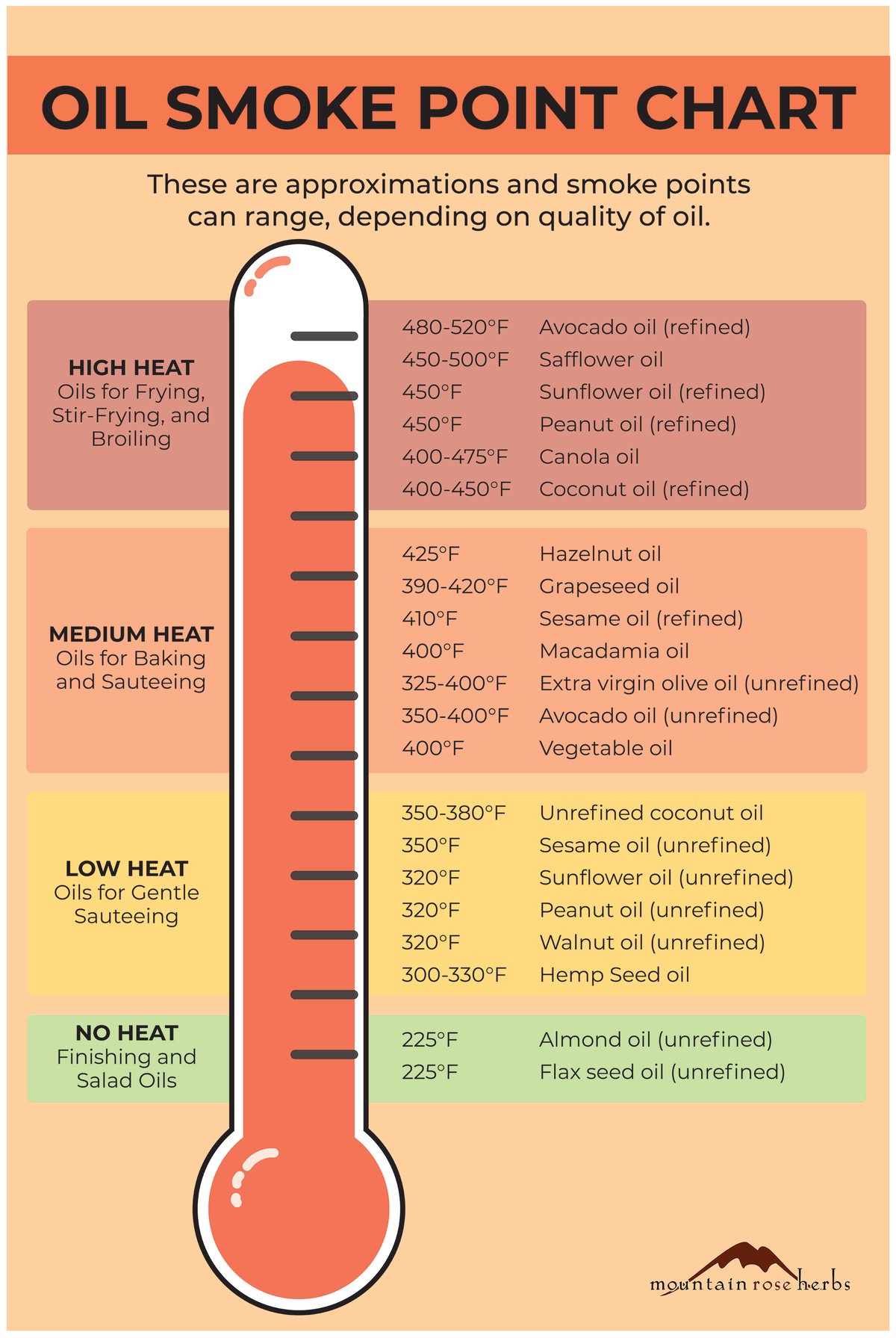
Vegetable oil smokes at a very similar point than olive oil [1]. The only reason people uses vegetable oils is 1. it's cheap. 2. does not add extra flavors.

[1] https://blog.mountainroseherbs.com/hs-fs/hubfs/CulinaryOil_S...

I agree. My partner's family in Spain have some land with olive trees (400 old ones plus 300 they planted recently) and sometimes we go there to help them pick the olives from the trees/ground, for us it's more like some festive days with the family than work.

The thing is, every year they give us more cold pressed olive oil than we can consume, and they don't do it in exchange for our "work", they also get more than they can consume, and no, they don't sell it (not worthy considering the legal/health paperwork and fees that would involve). We love it, its taste is amazing, and we know where it comes from and how it has been processed.

Yet... we still have to buy and use sunflower oil for a lot food! The taste is just too hard for some stuff and is less than ideal for deep frying. Olive oil for a stew? Some cooked rice or pasta? A salad? Toasted bread with garlic or tomato? Sure! But it we are frying anything, from fries to churros, we do it with vegetable oil.

I use avocado or safflower oil. Avocado has the highest smoke point at 520 degrees F.

If cooking with oil, everything cooked with safflower oil tastes better to me.

https://homecookworld.com/cooking-oils-smoke-points/

Maybe it's not a bad idea to remove all the foods that need unhealthy vegetable oils.
> or truffles on everything, or bacon on everything,

Speak for yourself there buddy

I somehow survived the “let’s put bacon on everything” craze of the 2010s but it was not a good time.
I even found bacon flavored chapstick at a bacon novelty store back then.
so, the 2020s appear to be shaping up as the "truffles on everything" decade and I hate it. Maybe I'd enjoy a real truffle here and there but the truffle flavoring I usually encounter is offensive to my tongue.
Truffles, I can handle.

But I'm still scarred from the 1990s "put capers in everything" era.

IDK man. Maybe its because I mostly just eat fish and veggies, but I find that it works well for the types of dishes I cook.
It’s not about the ingredients, it’s about the styles. If you want to cook fish and veggies in a cantonese style, olive oil is going to give it a bit of a weird flavor.