Hacker News new | ask | show | jobs
by lvxferre 1344 days ago
What the link is "conveniently forgetting" to mention is that most industrial hydrogen production emits CO₂ (steam reforming: CH₄ + 2H₂O → 2H₂ + CO₂). And there's a good reason for that: electrolysis consumes a lot of electricity. I won't do the maths here but, if the electricity was generated through fossil fuels, I wouldn't be surprised if the process actually increased CO₂ emissions instead of reducing them.

But let's say that the hydrogen is from fossil-free electricity. You could be plugging that fossil-free electricity elsewhere instead. The press and media link does not mention that.

>Hydrogen-reduced carbon-free DRI is highly metallized

That can mean two things:

1. They're able to retrieve more iron from the oxide. Good, but it isn't enough to replace the current processes; at most to add hydrogen as the "chef's kiss" to the iron produced through another method.

2. Less cementite aka iron carbide aka the stuff that actually makes steel "steel" instead of plain iron. That's great or awful depending on application.

>has superior mechanical [...] properties

Again, it depends on application. I expect their iron to be rather soft and malleable, but lacking tensile strength.

>This new knowledge is a direct result of close value chain cooperation, determined innovative thinking and bold efforts in piloting new technology – a recipe to copy for other industrial sectors,”

>Hybrit Development AB has filed patent applications describing the included inventions to the European Patent Office.

"Guys, we made something to copy for other industrial sectors, except that we're smearing patents on it so you can't copy the process~".

There's another detail that the press and media link doesn't mention: hydrogen makes steel brittle.

______________________________________________________________

Take this link with a grain of salt.

4 comments

Sweden, where this facility is supposed to be built, hardly has any fossil fuel electricity production.

Also you should compare the natural gas hydrogen process to the currently used coke process.

>Sweden, where this facility is supposed to be built, hardly has any fossil fuel electricity production.

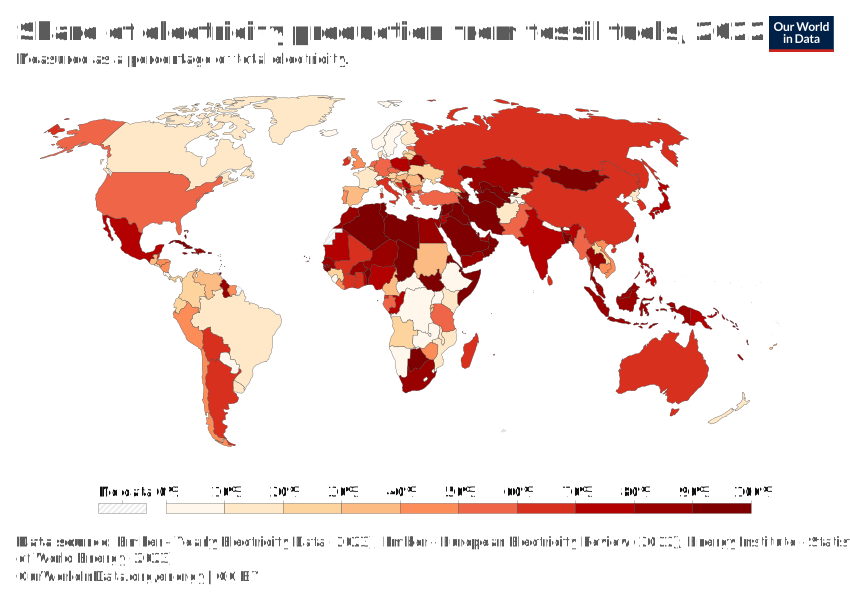
That would make their process suitable for countries that barely produce any iron to begin with. Unlike countries actually responsible for a big chunk of the world's iron production¹, and heavily reliant on fossil fuels; such as China, Japan, India, Russia.

>Also you should compare the natural gas hydrogen process to the currently used coke process.

No, I shouldn't. For three reasons: a) everybody knows that the "traditional" coke process is nasty, and is looking for alternatives; b) other alternatives already exist, as syngas-based³; and 3) the resulting iron is slightly different in properties.

Could the method from the link become more attractive in the future? Sure. Even then I strongly suggest everyone to hold their horses before going "WOOO THAT BIZNIZ SAID THAT THEY'RE CHANGING THE WORLD!!1". There's no "exciting" development yet.

_____________

1. Source: https://en.wikipedia.org/wiki/Iron#Industrial_production

2. Refer to https://ourworldindata.org/grapher/exports/share-electricity...

3. Note that syngas still uses coke, but as a DRI method it uses it more efficiently.

> I won't do the maths here but, if the electricity was generated through fossil fuels, I wouldn't be surprised if the process actually increased CO₂ emissions instead of reducing them. > But let's say that the hydrogen is from fossil-free electricity. You could be plugging that fossil-free electricity elsewhere instead.

This assumes a zero-sum situation where we have a fixed amount of fossil free electricity, but that's unlikely because fossil free energy (solar specifically) is the cheapest type of electricity generation we can build today.

Furthermore, the hydrogen can be electrolyzed at times when the supply of fossil free energy exceeds demand, thereby actually improving the economics of intermittent renewables by increasing their overall utilization, and hence incentivizing building more if it.

>This assumes a zero-sum situation where we have a fixed amount of fossil free electricity

I'm not assuming a zero-sum. The concern still holds without a zero-sum situation, as long as some commonly used sources of energy are not fossil-free.

>but that's unlikely because fossil free energy (solar specifically) is the cheapest type of electricity generation we can build today.

Higher demand can increase prices. Usually this wouldn't be a problem, but considering how big the iron/steel production sector is, the impact of the electricity used for the H₂ be measured, not assumed.

>Furthermore, the hydrogen can be electrolyzed at times when the supply of fossil free energy exceeds demand, thereby actually improving the economics of intermittent renewables by increasing their overall utilization, and hence incentivizing building more if it.

That is actually a fair argument. Unlike the above.

> Higher demand can increase prices.

Sure, but absent material supply constraints for production of PV and wind (of which none exist), supply will respond to that demand as it always has.

Using green hydrolyzed H2 for making steel makes more sense because our only alternative for steel is to use coal to produce it, which we know is terrible from a C02 emissions perspective.

This is Sweden and almost at the most northern part of it. It is located a relative short distance from the polar circle. Solar is a very cheap form of electricity but it has some significant problems to overcome that far up north.

Hydro, nuclear and wind is what northern Sweden uses.

> This is Sweden and almost at the most northern part of it.

> Solar is a very cheap form of electricity but it has some significant problems to overcome that far up north.

Why would the hydrogen-reduced steel need to only be produced in Northern Sweden? It could just as well be produced somewhere with abundant solar.

The plant is near the mines in northern Sweden. They could in theory be transporting the hydrogen, but hydrogen can be a bit tricky to transport and it obviously would cost more money. The green hydrogen process is also fairly expensive right now (despite what people might say), and the cost is not just attached to the electricity price. They had a person from the project discuss the value proposition just a few weeks ago in Swedish news. Green steel need both subsidies and green credits, but even so the end cost is landing at a few percent higher than regular steel. The argument was that even if it cost more its better for the environment, and this is a pilot program so maybe the cost will continue down in the future.
That's where they have decided to build the plant.
Sure, but subsequent plants needn't be built in Northern Sweden. It would make a lot of sense to build them in other areas with lots of green power potential.
Reading between the lines, it seems like this is intended for high quality steels. Think aerospace, not buildings. Actually in those applications, you don't really want carbon. The strongest steels have virtually no carbon. Hydrogen embrittlement and cracking have nothing to do with this.
Personally, I don’t see industrial processes like these as a priority for reducing CO2 emissions. If we get to a point where all the heavy emitters like cars and power plants are carbon neutral, things like steel production will be a tiny contributor to climate change, and can probably be better managed through capture and sequestration if the world decides every molecule of CO2 is harmful.
Depending on which source you look at, steel production accounts for 8% - 11% of global CO2 emissions. According to Gate's 2021 book, 'getting around' (planes, trucks, cargo ships) accounts for 16% of CO2 emissions. So steel production is definitely a significant contributor.
I get that, but steel is kind of “worth it”. Civilization can’t function without steel right now. Meanwhile energy has a gazillion alternatives. Priorities.
Concrete production is responsible for 7% of global CO2 emissions so there are a few key processes and material which really are worth a look.
I’d still put it below transit and electricity as far as priority.