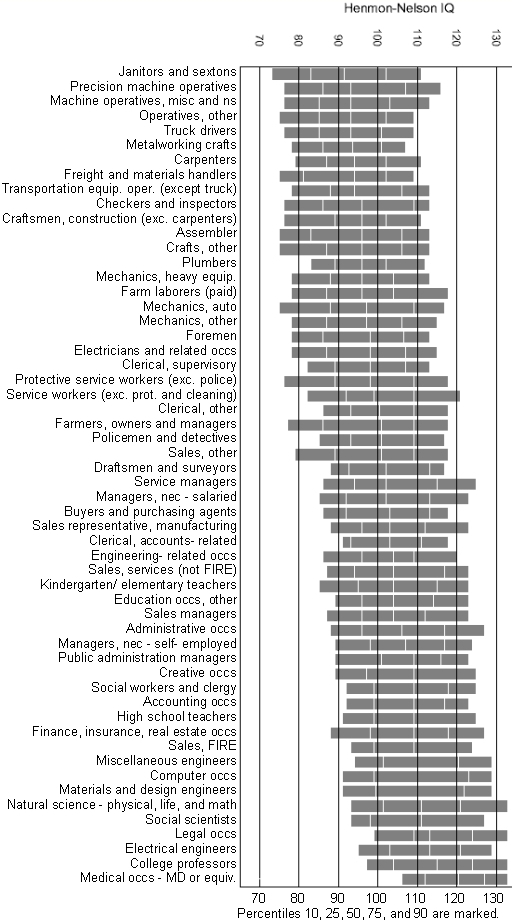
| 'Raw Smarts' is a slightly odd concept. I'm no psychologist, but I think that the majority of current research points towards the idea that ability in almost anything is essentially a consequence of practice and experience. As far as I'm aware, ability is generally considered to be something along the lines of practice x innate talent. So while it's true that ability scales with practice, it's not true that talent doesn't matter. Here is a rather famous chart which illustrates this: http://www.iqcomparisonsite.com/Images/OccsX.jpg This was very apparent when I taught college. I had plenty of students who worked hard, but it just didn't pay off. I had students working 30 hours/week on my class and still failing, but no matter how hard they worked, they just couldn't come up with proofs. Similarly, there were quite a few who just showed up, read the book once, and could do it. (Incidentally, because I fell into the latter category, I was pretty much incapable of helping people in the former category. Just one of the many reasons why researchers often make bad teachers.) Ultimately though, optimising for the top end becomes expensive quite fast, and while it's important to keep pushing the boundaries, I'd much rather the investment was put into improving the state of education for everyone, rather than fine-tuning the path for those who will be at least OK regardless. What benefit do you feel will be gained by improving education for everyone, as opposed to helping those at the top? I.e., why do you believe better educated plumbers will provide more benefit than better educated scientists, engineers, artists and business leaders? |
> As far as I'm aware, ability is generally considered to be something along the lines of practice x innate talent.
Right, but it's not a simple multiplication (AFAIK/IMO). The research suggests that ultimately practice dominates. I can't think right now as to how to cast that as an equation, but it has more non-linear terms. As to the IQ chart, I'm not convinced that that trend is statistically significant; even if it is, IQ is a pretty funny metric for 'innate talent' in most contexts.
There's also the issue of the nature and quality of the practice. I can work arbitrarily hard at something, but unless I'm targeting that effort effectively and using appropriate feedback mechanisms, it's entirely possible for me to accomplish literally nothing. How one acquires the ability to practice effectively is the meta-problem, and one which I'm still working on.
In the particular case of math proofs (which I think you're referring to) you have the additional issue that (I think - I'm not a mathematician) proofs often require intuitive leaps. This raises additional problems, because (if you're thinking in terms of acquired ability rather than talent) intuition is typically associated with high levels of expertise - e.g. in the Dreyfus model, you expect intuitive solutions from the highest two levels ('proficient' and 'expert') which you'd expect only a fairly small proportion of individuals to reach (incidentally, the Dreyfus model also suggests that you don't really want 'proficient' or especially 'expert' individuals teaching the lower levels ('novice', 'advanced beginner' and 'competent') precisely because of this qualitative difference in problem-solving style, which validates the construct inasmuch as it reflects your experience). In this scheme, intuition is (horribly simplified) superb pattern-matching, which is almost certainly not what your hard-working students will have been practicing (in my experience, stereotyped 'hard workers' focus on the mechanical aspects of a subject). Teaching intuition/pattern-matching is of course really hard.
> What benefit do you feel will be gained by improving education for everyone, as opposed to helping those at the top? I.e., why do you believe better educated plumbers will provide more benefit than better educated scientists, engineers, artists and business leaders?
Currently, where I live (UK), it's well accepted that there are massive differences between private and public education, as well as within the public education system. From what I've written, you can probably guess that I don't really hold with the idea of innate talent, and I don't believe that you can necessarily differentiate between 'future plumbers' and 'future [scientists|artists|etc]' until late adolescence or possibly even later. Combining that with the fact that I think that equality of opportunity is really important, I'm not really comfortable with significant investment in optimising for 'gifted' individuals until we've run out of ways to add resources to bringing up weaker parts of the education system.
It's really hard to predict how altering the balance of ability will affect both the average and the top end - will improving the high achievers pull everyone else up with them? Will raising the median motivate the high achievers to do even better? - so I'd rather support the strategy which has obvious direct social benefits (improve equality of opportunity) rather than one with the potential to maybe advance the leading edge a little faster.