Hacker News new | ask | show | jobs
by deaddabe 1400 days ago
TIL about GiroCode: QR codes for EU SEPA bank info.

I wonder why it is not used in major banking applications. I have manually copypasted IBAN numbers from friends so many times it gets old. I guess scan with a visual check that the numbers are correct before adding account could provide a boost in usability.

Maybe it is not done on purpose so that easier alternatives (like Paylib) are used instead, which may incur a fee while IBAN transferts are free.

5 comments

I had to install the "Don't F** With Paste" browser extension for when I'm interacting with US banks. They like to make you manually re-type things in hope that you'll make a mistake and it will lead to them assessing one of their $40 fees against you. For that reason you'll never see these codes used in the US. There is big money in human error.
I’ve worked in financial-adjacent industries and this is a very cynical view. Most banks use contractors that specialize in banking who rip off features of the big banks and up sell them on all these “features” such as preventing copy/pasting into a confirm account number field. This type of thing looks good on a proposal, execs eat this shit up because it looks like they are choosing secure products and using “tried and true” methodologies even though it’s a simple JavaScript barrier that does nothing practical. Financial institutions play everything safe because they themselves do not want to get fined and as a result, they end up all ripped each other off. My best bet is that some genius copy/paste savvy CSO/CTO thought this was a good idea and everyone else started copying it.
It's getting some traction in Germany. Two out of three of my banking apps support scanning QR Codes for payment. I had the opportunity to use it once so far with a major online retailer.
> Maybe it is not done on purpose so that easier alternatives (like Paylib) are used instead, which may incur a fee while IBAN transferts are free.

The problem with IBAN transfers compared to Paypal, Sofortüberweisung, Klarna and friends is that the merchant doesn't get instant notification of the payment. SEPA instant payments exist, but usually cost the customer ~0.50€-2€ and a lot of the banks, particularly those whose tech stacks are fossilized mainframes, don't support them [0].

And even if the merchant's bank accepts SEPA IP, there is another problem - unlike Paypal and other processors, there are no "callbacks" from the bank to the merchant, the merchant's shop system would need the credentials for online banking to poll, and obviously it's not a great idea to put the main banking credential into the biggest target for hacker attacks a company has.

[0] https://www.tagesschau.de/wirtschaft/finanzen/instant-paymen...

In France the most common barcode for payments is the TIP SEPA, a Datamatrix variety mostly used by public bodies for tax payments.

The reason they are rightly opposed is that they favor and push mobile dependency, witch means that you must own a smartphone to do something, sure that's not technically true, but that's practically true for most users. The real reason why are not widespread is people inertia in adopting anything new respect of their routine though.

Personally I found FAR easier if just both people and institution known how to damn use computers at a basic level like: "if you want some money please include immediately copy-pastable full information in clear text instead of crappy heavyweight docs that regularly lack some information".

For instance: get a France or Italian electricity bill, a gazillion of information presents, but try to find the damn address of the bill so if you have two or more houses you immediately identify it... In most case you can find written very little somewhere, sometimes is not present at all. Equally when you read an email. That's for company's side. For customer's side the same most call a callcenter "hy, I'm john, calling about something strange in your last bill". Even better: some companies add refs: .... to their communication, you call the call center, give the ref they do not know what to do because since almost no one use them no one have added a damn search by ref in their CRM/ERP/* UI.

Even worse: we have mandatory OpenBank APIs for institutions but not for customers. As a result instead of easily manage your finances with the comfort of a personal client for all banks, institutions etc auto-updated via feeds you need to login (with absurd procedures, that frequently mandate crappy mobile crapplications) to a gazillion of different sites and no easy way to concentrate your information.

>or Italian electricity bill

Usually on the top left of first page there is "Dati Fornitura", with the address where energy is provided:

https://www.servizioelettriconazionale.it/content/dam/sen/he...

Maybe it depends on the specific energy supplier?

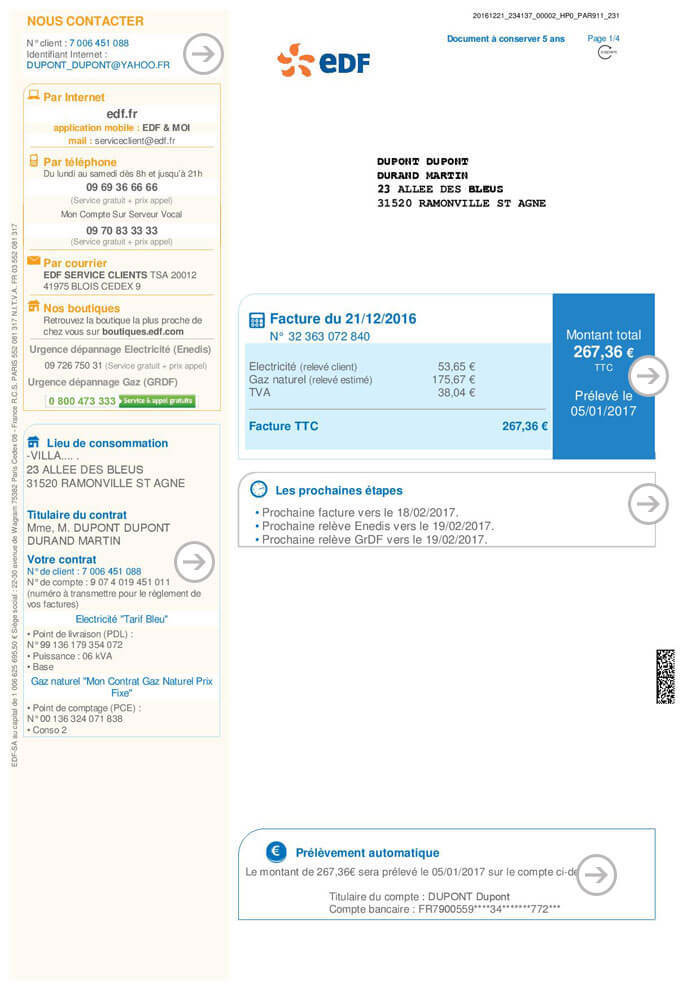
> France electricity bill

The address is in the left-hand block, under the section called "Lieu de consommation":

https://prix-elec.com/sites/prix-elec.com/files/2020-04/fact...

That's for EDF though, other providers might show it in a less obvious way I guess.

I generally agree with your comment though.

In germany HBCI/Fints is an standard quite a few banks use. I think its the oldest onlinebanking standard that is still in use. you can send money, check transactions and everything runs over https. The user only has to enter his credentials and optional an second factor. For sending money an second factor was always used.
Here in the Netherlands iDEAL is usually used. It was originally invented for e-commerce, but these days you can also send them as a private person ('Tikkie').

Btw, don't you have IBANs that you frequently send money to saved in your 'address book'? The banks here have offered such functionality since forever (even before IBAN existed)