Hacker News new | ask | show | jobs
by Surfactant7 1425 days ago
Google is still an advertising tech company. As such it's highly levered to two things:

1. The fluctuations in stock prices. Like many tech companies, Google uses its shares in place of currency. This work great when prices are going up.

2. Business spending on advertising. Despite ambitions in other areas, the company still just mostly sells ads. One of the first things companies cut back on when they start hurting is advertising.

When the stock market declines because the business cycle turns, Google gets a double whammy. In many ways, it's the canary's canary in the coal mine. Doubly levered to the business cycle.

There is such a taboo around pay cuts, that then the inevitable downturn happens, the only option is to first stop hiring and then start laying off.

I expect GOOG to be the epicenter of tech worker pain for this leg of the cycle.

During these booms, tech leaders take on a mythological quality. To even suggest that they could begin a protracted decline seems absurd. But it has happened time and again. Maybe it's this time or the next cycle that does it, but there's no version of the future where GOOG retains its dominating position.

9 comments

>There is such a taboo around pay cuts

Yes. But much less so about reduced bonuses, RSU grants (and esp. stock appreciation), and not matching inflation. At a lot of tech sector companies among others, you're already seeing pretty large effective comp decreases.

It's also the case that, as people often observe, large comp increases often come from switching jobs and that's probably going to be more difficult in general for the next few years.

ADDED: And one of the escape valves for people at smaller companies especially over the last year or two has been to try to get a job at Big Tech. (This doesn't only apply to developers.) Increasingly this looks to be a much tougher option.

I don't think your use of "levered" makes sense, and I don't think GOOG is the "canary in the coal mine" - basically the entire small-cap NASDAQ has already been obliterated - but otherwise your point stands.
> There is such a taboo around pay cuts

One side effect of inflation being ~10% is that if you want to give your staff a pay cut all you have to do is do nothing.

But it only works if you're able to raise prices for your customers. Often that's hard and sometimes impossible.
Are raised prices the very definition of inflation?
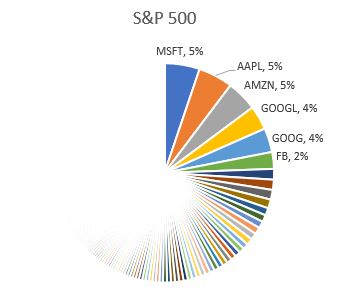
The average age of a public company has been declining for decades: 61 years in 1958, and currently 18 years. No company is immune to the practice. Google isn't going anywhere, but we should be expecting companies to come-and-go more frequently than the past. What's unusual today, and more Google-specific, is that it's one of a few companies absolutely dominating the S&P: just 6 stocks make up over one-quarter of the total capitalization.

https://austinwealthmgmt.com/wp-content/uploads/2020/05/SP-5...

And Apple is like 4% of the global investable equity market (weighted by market cap)
"time and again"? We've only had two tech booms and one was a lot more speculative than the other.

Yes, Google makes money from ads. Then again, advertising is to "describe or draw attention to (a product, service, or event) in a public medium in order to promote sales or attendance." Google is in the business of connecting people with what they want, more of a personal assistant than a billboard.

Running a campaign on Google is a lot more like having a robot salesperson than a billboard. There are different kinds of advertising, such as general brand awareness which indeed might not be worth keeping short term. But if I were in the business of selling widgets, I think I'd cut the r&d budget rather than firing salespeople who are directly in the conversion path that brings in dollars today.

>There is such a taboo around pay cuts

Huh? Every time the stock price goes down people's comp is cut since most of their comp is RSUs.

Yes, but it's mostly cuts in actual wages/base pay that are sticky. People obviously aren't happy if fairly predictable bonuses and RSUs get cut but most understand at some level those are variable and tied to company performance. And if the same thing is happening at most places they have little choice but to just deal with it.
Sure but OP claimed there are no cuts thus the only option is to stop hiring and do layoffs. In fact there are automatic cuts (via RSUs) and the follow-up approaches are hiring freezes and layoffs. I'm merely arguing that OP's point isn't valid.
"Pay cuts" via stock going down for the base company are pay cuts that do nothing to improve the company's financial position. Google-the-employer, even looking at them only as an employer, is no better off if employees have less total comp through stock losses than it is if they had stock gains. It does nothing to improve their bottom line -- and in fact, with the way that tech companies grant equity comp (by targeting a dollar amount at the time of the grant and then granting enough shares to hit that dollar amount), it actually worsens their position every time they give a grant (they have to give more shares to hit the same dollar amount).

In contrast, inflation or explicit wage cuts are things that, ceteris paribus, every employer would like to do, and does improve their bottom line. (But explicit wage cuts are such a morale killer that they're de facto impossible right now.)

Nah you record the expense over the vesting period. Google can just issue new shares. It’s not really worse unless things get really bad.
I think OP was referring to salary cuts. Stock is known to carry risk so it being "cut" isn't taboo, but salary, which is supposed to be guaranteed, is.
Sure but in the context of saving the company money to prevent layoffs they're identical. Companies don't cut salary because they have a found a better way to cut comp costs without upsetting workers as much.
They absolutely aren't identical. If you have a grant for, whatever, 1,000 shares a year, and the shares used to be worth $100, but now they're worth $50, the company is still giving you the same things it gave before (X% of the total value of the company). It will still have to go to the board and ask for more dilution to create new share pools at the same time as it did before. Its cash-on-hand situation is no better than before.
> I expect GOOG to be the epicenter of tech worker pain for this leg of the cycle.

Given what you just said about how people cut costs during a down cycle, why GOOG and not AMZN? Seems like discretionary spending (and a lot of Amazon's sales are impulse-buy junk rather than essentials) is also likely to take a huge hit.

Amazon makes most of their money from AWS. The webstore is the majority of the business - but in some ways it's irrelevant.
And AWS is expensive. Hard up businesses could cut serve costs
With inflation, they don't need actual pay cuts to have real pay cuts. That's part of the reason why it's unusual to have high unemployment and high inflation (definitely not impossible though).
What percentage of Google’s ad revenue come from (unprofitable) startups?
Yes than you probably think. This was true in the dot com era, but much less true today.