Hacker News new | ask | show | jobs
by kaitaincps 1459 days ago
Ditto for zoonosis. The problem is that people treat the zoonotic transfer hypothesis as some kind of default, the incumbent to which we must defer in the absence of compelling evidence to the contrary. This is a mistake, given the proximity to the WIV and the nature of the work being done there. If the pandemic had started in some remote village nowhere near a lab this line of argument would be far more compelling.
1 comments

To disprove zoonotic origin it would be sufficient for one person to step out and say "I made covid" and present a sample very similar to originally discovered covid strain and maybe some documentation regarding his experiments. It would immediately disprove theory of zoonotic origin of covid.

Nothing like that is possible for lab-leak theory. Even catching animal that has a virus very close to original form of covid wouldn't disprove lab-leak theory because lab-leakers would just say that the animal just got covid from humans.

As for validity of zoonotic origin hypothesis it's a default because every virus ever that troubled us came to us from other species of animals without any additional technological assistance from us. Unless you count hunting, cooking or husbandry a technological assistance.

It's now very well known that coronaviruses have huge variability, are able to mutate quicly and cross barriers of species so it's overwhelmingly more likely that sars-cov-2 came to us without any technological intervention.

We have no idea where the pandemic started. Only where it was noticed. Vast majority of covid cases give only flu-like symptoms. First cases might have happened in some village that had too few people to notice any spike in severe cases. Only when a person from the village visited market of a densely populated city and thousands of people got infected so that tens of them started landing in the city hospital the whole thing had a chance of getting noticed.

A standard serology chain through animal populations showing a plausible path to Wuhan would make the lab leak hypothesis unlikely, or at the very least redundant.

We do know that the pandemic started in Wuhan, or certainly that that’s the first major population centre it hit. Had it started elsewhere that’s where all the early hospitalizations would have been.

People have various definition what they found plausible. Majority of researchers think path leading from bats through civets is plausible enough given the evidence.

As you said, Wuhan was only the first major population centre. First human patient or even first hundred patients could be from a small village that don't even have hospital nearby to have a hospitalisation and one or two elderly village dwellers dying because of "flu" wouldn't make anyone curious or cautious.

This virus could have evolved a lot in those first few patients because there selection pressure for improving human to human transmission was the strongest and there was a lot of low hanging fruit for the virus.

> Majority of researchers think path leading from bats through civets is plausible enough given the evidence.

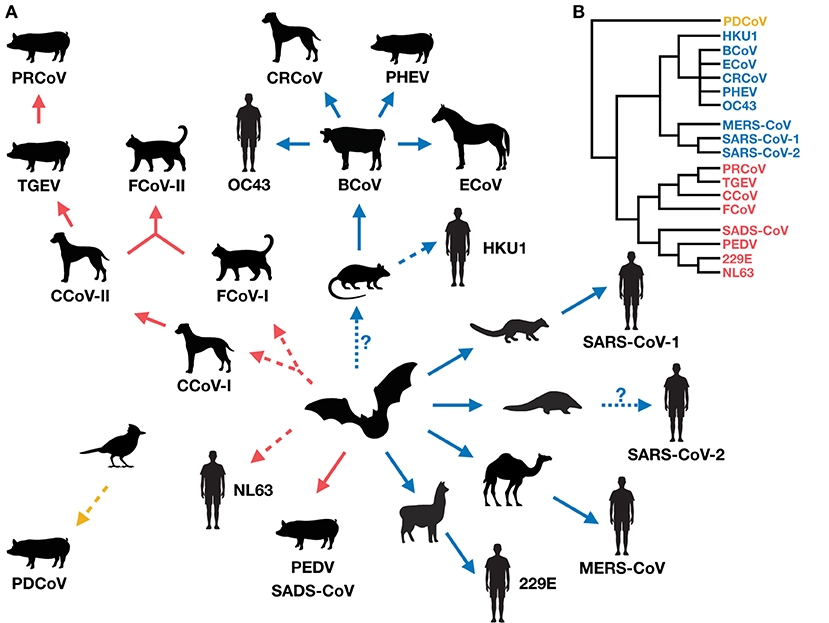
Are you thinking of SARS-1 here? There's reasonably strong evidence that SARS-1 entered humans from bats via civet cats, since infected civet cats were found in the markets. For MERS we have very strong evidence of zoonosis, since many infected camels have been found and the phylogenetic tree shows evidence of repeated introductions.

No animals infected with SARS-CoV-2 have been found, except those infected by humans. Various researchers have proposed various natural zoonotic paths, but I don't think civets are a leading contender. It's hard to say what a majority of researchers believe, since most have stayed prudently quiet.

You are right I mixed up exotic species. I meant pangolins.

And as you say the path for this particular coronavirus is still debated:

https://www.frontiersin.org/files/Articles/717941/fpubh-09-7...

Pangolins were proposed very early in the pandemic, but have been pretty much abandoned. It eventually came to light that all the pangolin papers were based on the same one batch of smuggled pangolins. This makes it more likely that those pangolins were infected by a smuggler (in the same way that housecats or mink have been infected by people), and not the other way around:

https://www.biorxiv.org/content/10.1101/2020.07.07.184374v2

Nature eventually published an extensive correction to their pangolin paper:

https://www.nature.com/articles/s41586-020-2313-x#change-his...

Lately I've seen proposals that raccoon dogs were the intermediate host, or that bats directly infected humans. All of these are speculative, since no infected animal (except animals probably infected by humans) has been found. The absence of infected animals isn't proof of unnatural origin, but it's different from SARS-1 and MERS, despite a much greater effort to search.