Hacker News new | ask | show | jobs
by byecomputer 1457 days ago
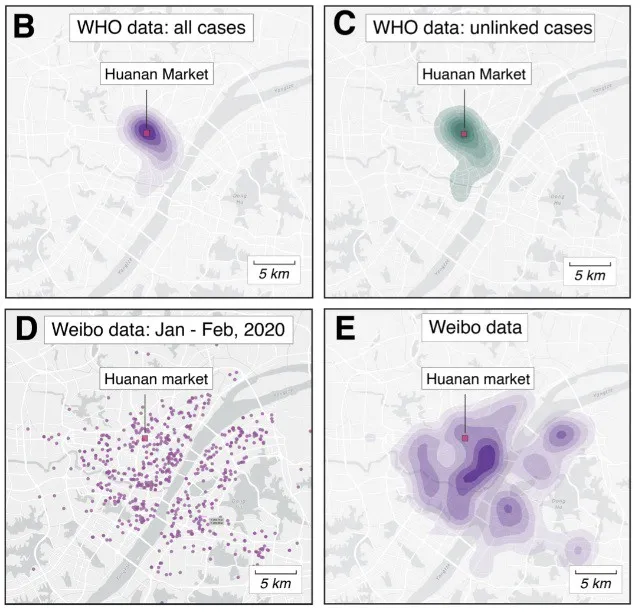
I sort of lost faith in the article's willingness to take lab leak seriously when they threw this map up[0] and inexplicably did not label where the Wuhan Institute of Virology is on it. For reference[1].

[0] https://substackcdn.com/image/fetch/w_1456,c_limit,f_webp,q_...

[1] https://www.google.com/maps/dir/Huanan+Seafood+Market,+Fazha...

It's not at all far-fetched to think the virus piggybacked 10 miles before finding a nice home for itself at a wet market, after which it went gangbusters and infected lots of people. Obviously the virus proliferated in the market, but that doesn't necessarily make the market the origin. The two bottom 'Weibo data' maps from the first link show clusters on both sides of the rivers and also very close to the lab.

That's just the most obvious bit of bias, but I'm confident that article isn't being as fair-handed as it's pretending to be.

3 comments

You do realize that your two points are in direct contradiction?

You're mad at the author for not pointing out the WIV (Which had 0 confirmed cases anywhere near it until much later in the pandemic which is what the two bottom charts are referring to) but then you also grant that it looks like the market was the center of spread?

In any case, they directly address this;

> Importantly, even pneumonia cases that had no association whatsoever with the market (no work, travel, visits, or contacts there) still centered around the Huanan market and could not have been subject to ascertainment bias. The market was the only place in Wuhan where early cases had a clear association. There are no other epidemiological links to any other place in the city, other clusters only started forming later in Jan-Feb (Weibo data, shown above) and became more representative of the city’s population density.

> It is worth mentioning here that the Wuhan Institute of Virology (the alleged ‘escape’ laboratory working on CoVs, not shown in map) is located on the other side of the Yangtze River, South West of the Dong Hu lake, more than 16km away from the Huanan market, and no sickness clusters of cases were shown anywhere close in December 2019.

As for:

> It's not at all far-fetched to think the virus piggybacked 10 miles before finding a nice home for itself at a wet market, after which it went gangbusters and infected lots of people.

You still need to explain how there are two distinct lineages at the market among the first cases!

Picking and choosing one data point to be skeptical of is useless, the totality of the evidence needs to be weighed.

> You're mad at the author for not pointing out the WIV

Yes, an article comparing two possible originating locations should obviously show both on that graphic (especially when both places are well-within the frame of the image); I can't see any good reason for the author to have omitted that.

> but then you also grant that it looks like the market was the center of spread

Yes. And that's not contradictory to the lab leak idea, because people aren't trees and they go places after work. I think it's entirely reasonable to hypothesize that the virus escaped from the lab on a person and ended up successfully taking root in a less-than-sanitary wet market just across the river. If two-headed turtles started showing up at a Popeye's 20 minutes away from the Turtle Experiment Laboratory, would you say that Popeye's was the source of the two-headed turtles?

> You still need to explain how there are two distinct lineages at the market among the first cases!

Again, there's no reason both theories can't be true here. The caged, dirty animals definitely seemed to be the virus' first stronghold, but that doesn't mean that the new bat virus couldn't have come from the New Bat Virus Laboratory 20 minutes away from the wet market.

> Picking and choosing one data point to be skeptical of is useless, the totality of the evidence needs to be weighed.

My point is that it made the bias of the author nakedly apparent. It's an pro-wet-market argument piece, not an objective look.

There are two key problems with this analysis. The first is that the data to which we have access has been subject to gatekeeping by the Chinese authorities. (Is this a conspiracy theory? Yes, very much so, and rationally so given the way the PRC operates.) The second is that workers at the WIV aren't going to leave work and then hang around on the street outside, infecting passers-by in the immediate vicinity, causing a cluster that radiates around the WIV itself. They're going to get on transit and head home, mainly westwards.
Two lineages does not preclude a lab leak. And only B was centered at the market. The market hypothesis is lacking.
> You still need to explain how there are two distinct lineages at the market among the first cases!

Actually, YOU do. You need to explain how a virus made two separate rare hops to humans in the same place, at the same time, in two different forms. This is possible, but statistically unlikely. The (vastly) more likely hypothesis is that it made only a single cross-species hop, which then spread and mutated later.

A bunch of equipment was moved from WIV to the spot next to the market a few days before the outbreak. That is the lab leak hypothesis.
武汉市疾病预防控制中心

That's the Wuhan CDC. It's across the street from the market and has a virus lab. Google Maps will not show you the correct location but you can put the address (湖北省武汉市江汉区马场路288号) and it's close enough. Or use Baidu Ditu and find it's right in the middle of the clusters in your first link, ~300m south of the market.

There's another interesting point that seems to have flown under the radar: https://www.google.com/maps/dir/Huanan+Seafood+Market,+Fazha...

Dunno if that point is just offices or whatever though.

No, there's a lab in there. This was the lab originally called out by Chinese whistleblowers.

Also you have the wrong address, put in the Chinese name on Baidu and you'll find it's in walking distance to the market. Like literally just across the street.