Hacker News new | ask | show | jobs
by lakomen 1462 days ago
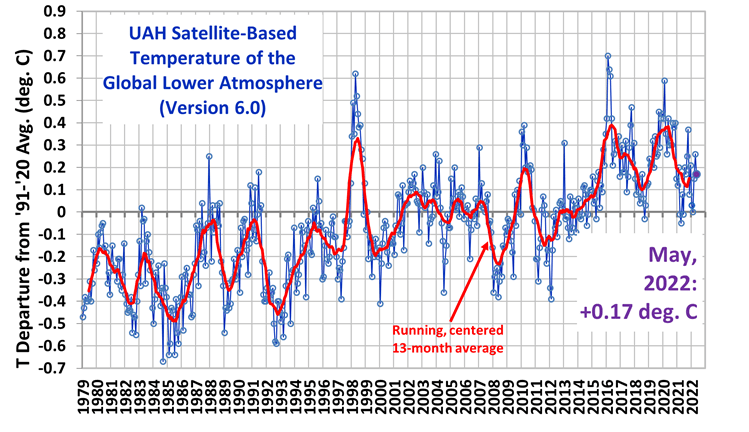
All I can say as a 47 year old who lived most of his life in Germany is that the summers when I was a teen, so 30 years ago were considered hot when they were over 25°C. This year in May we had 32°C. Deny or criticize all you want cherries blossoming on Christmas in Berlin is NOT normal. And neither is the absence of snow in winter and mild temperatures. Those graphs don't impress me at all, because I remember what it was like and see what it's like now. I'm in Croatia right now and remember where the sea level was back when I was little and also see where it's at now. If you lived on this planet for a while and are not ignorant to your surroundings you see the change, you feel it. Cold places are hot now and warm places are hotter for longer periods of time.

I wrote it before and I'll repeat myself, if you look at what changed in the last 100 years or thereabout, it's mass burning of fossil fuels, the cars, fabrics, planes etc. Yes, I know don't jump to conclusions, scientific method and all. The not ignorant person just being observant and applying some common sense can see it bright as day.

6 comments

I do think the global temperature is rising, but you can't say things like 'what I considered hot as a kid is different than what I now consider hot' and be taking seriously scientifically. Its an interesting anecdotal point but that's about it. I'm sure the data for where you grew up as a kid is available for the last 50 years, so get the data and give a real numbers to numbers comparison.

I have actually done this in terms of snow. I said to myself, it seems like there were bigger snow storms (in termps of inches of snow) when I was a kid. so I got the data to verify it, and yes, not only were the snow as a kid much higher, they were also historical high - a couple record snowfalls when I was a kid. The point of this story isn't meant to tie anything to climate change, but rather be more curious and get data to back up your thoughts.

> Its an interesting anecdotal point but that's about it

I hate quoting Bezos about this, but it's catchy and thought provoking: when the anecdotes and the data disagree, the anecdotes are usually right.

That's extremely context specific. You can imagine something like in social sciences where people have quite finely tuned but subjective personal awareness of human behavior and some data makes a coarse but objective measurement of it. It's hard for the data to be as "accurate" as the personal experience, so it can easily be wrong. But "it was colder when I was a kid" vs temperature measurements is the other way around.
I mean, we're looking at an example where the anecdotes and data are fairly in agreement. But the point is that when you encounter a metric that's at odds with recurrent anecdotes, you should strongly consider that you aren't measuring the right thing. You can get incredibly accurate measurements of a doorframe's height but if people keep telling you they're having trouble getting packages in, it might just be that they don't fit the width.
On the flip side, if you change metrics until you get one that says what you want, do your metrics really provide any value?
> when the anecdotes and the data disagree, the anecdotes are usually right.

My friend's mate's sister says the same thing and the graph shows otherwise. I guess it must be true.

;)

That's true, but this article isn't much better.
Local anecdotes are great if you are old enough to have seen changes, because they are simple and relatable examples.

In Christchurch, New Zealand, a notable example for me is that the snow line has receded since I was a child. Low lying ski fields are struggling to stay open. My parents have noticed less snow on the ground during winter at their rural place (they have been there ~30 years).

> remember where the sea level was back when I was little and also see where it's at now

I am a bit skeptical of that claim! Then again, sea level changes would be difficult to notice in Christchurch because we had fast uplift locally: “these events caused ground motion at the Lyttelton TG [tide gauge], the largest single vertical [earthquake] displacement was >50 mm (cumulative displacement ~110 mm)”[1] and slow uplift probably has occurred too “slow slip events has uplifted sites by up to 0.8 mm/year on average in Wellington and Dunedin”. 150km away the coastline uplifted 2 metres (2 yards)[2], boy was that stinky.

I think this quote is interesting: “At interannual and decadal time scales TG records typically show variations in annual means on the order of 5–10 cm and a possible 60-year oscillation of up to 3 cm. Although to estimate the long-term trend in relative sea level (RSL), five to six decades of reliable and essentially complete TG records are typically required, techniques exist that can use sparse data sets. A TG measures the RSL trend or the change in sea level relative to the adjacent land. Independent estimates of the vertical land motion (VLM) are required to estimate the absolute sea level (ASL). Such motion may occur due to tectonic movements, ice mass loading, glacial isostatic adjustment (GIA), or local site instabilities due to, for example, compaction, sedimentation, or water, oil, or gas extraction (Carter et al., ). The stability of a TG site is a critical issue that requires verification (Bevis et al., ) and needs to be considered at both local and regional scales. Historically, many TGs are located in shipping ports where harbor infrastructure is often developed on reclaimed or modified land.”[1].

[1] https://agupubs.onlinelibrary.wiley.com/doi/full/10.1029/201...

[2] https://earthobservatory.nasa.gov/images/89206/powerful-eart...

I told my kids yesterday while cleaning up when we found their sled that they are probably the last generation of Dutch kids to have used one, they don't have skates because there never is a winter long enough to make the ice safe (when I was a kid you could skate on IJsselmeer, and the ice would be 20 cm thick at the end of the winter).
Your comment reminds me of the article written in 2000 that said that by 2010 kids won’t even know what snow is.

That article was online until about 2015 until it was so widely mocked it was finally deleted. Here’s a screenshot for you.

https://wattsupwiththat.com/wp-content/uploads/2015/11/snowf...

yes, in my hometown there is no more snow in winter while 40 years ago i was happily cross-country skiing there. On the positive side - the peaches, apricots, cherries, etc. - the stuff of my childhood dreams sold back then only at farmers markets at astronomical prices by the traders from South - is now easily growing there in people's backyards/gardens. Though not oranges/mandarins nor watermelons yet - seems needing a bit more warming which looks to be just a matter of [pretty short] time.
In Christchurch we are also getting a lot more mosquitoes than I recall as a child*, which you may get with a warmer climate, so it definitely isn’t all wins.

* Lots of possible reasons for apparently more mosquitoes: perhaps they are evolving to match the environment here?

Can you give me a location so I can look at the historical snowfall record for that location?
That reminds me of this article I've read about the River Thames Frost Fairs... The last of which was done in 1814, with people preparing for one in 1870s or so but was cancelled.

Little Ice Age ended, you see...

The sea level has "dropped" where I grew up because they upgraded the beach. Are you sure you're not seeing the effects of artificial changes, natural erosion, or earthquakes? Those can easily completely dominate any climate change induced sea level rise in one area. Or perhaps when you went to the sea as a kid or adult, it was in some way connected with fishing or other activities that people timed to match the tides, which also completely dominate any lifelong changes in sea level.
This comment reminded me of when Tuvalu's foreign minister stood in the water while giving a speech, to give the impression that the land was lost due to rising sea levels caused by climate change, but then it turned out it was really just due to erosion.
You can notice ~10cm difference in sea level?

https://sealevel.nasa.gov/faq/13/how-long-have-sea-levels-be...

You don't notice the vertical differences, you notice the horizontal distances (land that is covered which was not previously covered).
I'm a little bit younger than OP (~10 years) - I grew up on an island in Croatia and I noticed no difference in beaches that I visited when I was a kid. The shallow rock peers are all in the same place, beaches are the same size.

Only difference I see is a slew of tourists packing every cm2 where there were far fewer while I was growing up, a lot of them getting off on how they are participating in "sustainable tourism" because their hotel has solar panels or whatever bullshit is trendy these days.

If the beach gradient is extremely shallow it will show up, if it steep you won't see any change at all for a really long time.
Croatia is certainly not a paragon of flat beach terrain like the other side of the Adriatic, or the Atlantic coast in North America.
Not everywhere has the same beaches. Do a GIS for, say, Mont-Saint-Michel in France at low tide, and you'll see the water receeds miles. It'll be more apparent in these locations; a 10cm difference might mean hundreds of feet less beach at low tide.
> Deny or criticize all you want cherries blossoming on Christmas in Berlin is NOT normal.

In case anyone was curious, the cherry blossoms were first planted in Berlin in November 1990.

>Those graphs don't impress me at all, because I remember what it was like and see what it's like now.

This is about as anti-science a stance as you can take. Why believe data when you've got your lyin' eyes?

Climate change deniers can use the exact same argument, so how do we get anyehere?

Reality really doesn't care though.