Hacker News new | ask | show | jobs
by hunglee2 1539 days ago
A.K.A 'Snot Cannon'

I can see this has having the similar type of negative public health impact as the Dyson Blade dryers in public toilets, simply circulating fecal matter further in an enclosed space.

Naomi Wu with the critique: https://twitter.com/RealSexyCyborg/status/150912514143903334...

5 comments

What's the issue with the dryers? You use them to dry already-washed hands and the dryers themselves aren't very close to the toilets.
No one washes their hands perfectly (e.g., ready for surgery), so when you dry them there’s still a lot of bacteria present. Dyson dryers aerosolize those particulates, and they do it far more than other dryers.

Think of it this way — they don’t dry your hands, they blow the water off. Where does the water go? All over the bathroom. Dyson dryers disperse fluids up to 3 meters away.

https://arstechnica.com/science/2016/04/dyson-dryers-hurl-60...

To be fair, other hand dryers only do better on this metric because they don't actually remove the water from your hands.
Regular hand dryers (hot/dry airflow) literally make the water evaporate off your hands. How is the water not removed?
Ask my wet pants and the line of people behind me every time waiting to do the same move.
That assumes everyone thoroughly washes their hands, which is unlikely. Dyson hand dryers, specifically, always have a nasty puddle of water at the bottom of their drying "crevice" in busy bathrooms.
The sheer number of people I've seen running their hands through water for a second before moving onto the drier was alarmingly high in 2019 (pre-covid).

I don't know how much that's changed, but I wouldn't expect the change to be particularly meaningful, sadly.

Don't worry, that number hasn't changed
> Dyson hand dryers, specifically, always have a nasty puddle of water at the bottom of their drying "crevice" in busy bathrooms.

That's just a bonus, the main issue with them as other comments have noted is that they shove the water off of your hands using their "air blades".

This aerosolises a significant fraction of that water (the rest goes and collects in the puddle you speak of), spreading it all over the room.

More classic driers primarily work by evaporation, and furthermore direct the air stream downwards (to the floor) rather than sideways (across the room).

Doesn't matter how well you wash your hands, you still have to touch the door handle to get out (they usually open inwards) and some grotty germbags will have poopified that handle 50 times over before you get to touch it.
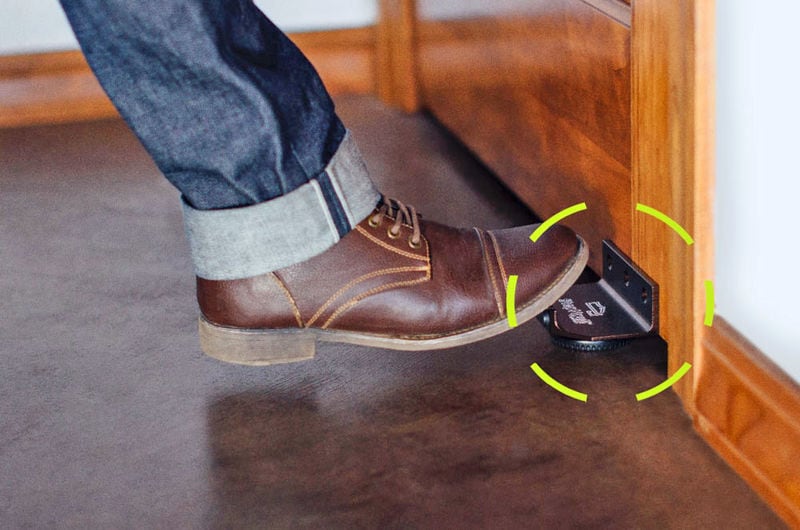
The bathrooms with Dyson driers near me open inwards but have foot openers,¹ as well as the other bathrooms with paper towels inside and waste baskets just outside (so you can use the towel to open the door before tossing it).

¹similar to this: https://cdn.trendhunterstatic.com/thumbs/426/foot-door-handl...

I was hoping that COVID would trigger a contactless revolution in bathrooms where I don't need to touch a pooped up door handle to get out... But sadly seems not a thing
Bacteria -> Your hands

Your hands -> Windstream

Windstream -> Goes everywhere

It's not even about Dyson dryers, but dryers in general

It's meant for hands that were just washed. I understand that not everyone does a great job washing, but I have a hard time believing this poses a real threat..
Let's look at some studies:

> Participants washed their gloved hands with a suspension of MS2 bacteriophage and hands were dried with one of the three hand-drying devices. [...] Over a height range of 0·15–1·65 m, the JAD [jet air dryer] dispersed an average of >60 and >1300-fold more plaque-forming units (PFU) compared to the WAD [warm air dryer] and PT [paper towels] (P < 0·0001), respectively.[1]

Okay, but I'm sure just-washed hands aren't all that dirty, right?

> This observational study was conducted to evaluate [...] hand hygiene practices among college students. [...] Overall, 72.9% of students washed their hands, 58.3% practiced hand hygiene (using either soap or hand sanitizer), and 26.1% washed their hands adequately.[2]

I couldn't find any epidemiological studies, but this feels like good enough of a reason to stick to other options considering these things are a solution in search of a problem anyway.

[1]: https://sfamjournals.onlinelibrary.wiley.com/doi/10.1111/jam...

[2]: https://pubmed.ncbi.nlm.nih.gov/18538703/

But you just washed your hands. Where are the bacteria coming from?
You’re lucky if people even make a show of washing their hands. If they wash them well, then you have just met a unicorn. And even people who do normally wash their hands well sometimes run into issues like there not being any goddamn soap stocked (in the same bathroom, 3 days in a row).

Don’t use the air blowers; just let your hands air dry if there’s no paper towels. It doesn’t take very long and has been basically my standard practice for about 10 years now.

"washed"

Have you seen people in the real world?

Even assuming they're washed correctly (entire song thing with all the trimmings), a bathroom sink is not a steriliser.
I cannot even count all the times when I went to use these dryers at always-packed IKEA and immediately got a mouthful of water droplets. No idea if they came from my hands or somebody else’s. TBH I don’t want to know. I just dry my hands on my clothing now.
The blade dryers also make an excellent place to capture palm prints. People slowly push their clean hands spread wide in and out. I'd recommend against using such a device at a hacker conference...
Came here for this :-) Naomi is really not happy LOL.
This just sounds extremely manipulative and I don't see how I can trust this opinion. It also seems wrong:

the average person expels 300-500ml of this fluid a day in the form of a fine mist- an aerosol. You can see it in cold weather.

That's condensation from humidity in the air you breathed out. That's why you can only see it in cold weather. Does it really contain viruses? Any data on this?

Is this a joke? Where have you been the last two years?
Do you know something I don't? My understanding it that aerosols that leave your mouth when you speak can obviously contain virus. But there's no logical reason why simple warm air that has no aerosols suspended in it that gets cooled down and condenses into particles would contain virus.
Your breath (what you exhale) always contains substantial amounts of moisture (and yes, potentially virions). It does not matter if you speak or not. It does not matter if the environment is cold or not. There is no "simple warm air" out of your lungs.

I agree with mtn_nerd, you must be trolling. Considering your choice of words, you're probably well aware of that.

The breath you see in cold weather is not aerosols but condensed moisture. I don't know how pointing out this trivial fact can be construed as trolling.
Moisture floating out of your mouth is aresolized moisture.
There is a large, whiny portion of HN who were so severely injured by the COVID-19 fear porn that they uncritically consumed that they see viruses in their sleep still, two years later. It’s quite sad.
This seems like a stretch. Barring some rather unexpected effect, this device will not change the amount of aerosolized pathogen emitted by a person. At most it will change the distribution — the aerosols will be presumably be mixed into a larger volume of air. So maybe they will spread somewhat father, but, if so, they’ll be more dilute.

[0] To the extent the wearer’s breath is sucked back through the filter, the total emitted pathogen load will be reduced.

It is not a stretch. This is why many hospitals require staff to wear an N95 (a hard shell mask—not a surgical mask—in order to prevent as little leakage as possible) underneath a PAPR. PAPRs (with the exception of the CleanSpace Halo if using a special adapter) do not have source control. (I personally use an Optrel e9000x PAPR with an N95 underneath for source control. If not able to use a PAPR such as on an airplane, I wear a valve-free P100 mask [MSA Advantage 900] over an authentic KF94 mask [see: https://behealthyusa.net/ for KF94]. Yes, I am immunocompromised...)

This Dyson device does not have source control, and yes, it is a super-spreader device.

There is proof that such devices are super spreading tools: hospital administrators wore a blow up costume in to a Kaiser Hospital ER and caused a huge COVID-19 outbreak.

This was when contact tracing was in effect in California.

See: https://www.nytimes.com/2021/01/03/us/kaiser-san-jose-outbre...

Comments on r/Medicine subreddit: https://old.reddit.com/r/medicine/comments/kpjs8s/inflatable...

> This Dyson device does not have source control, and yes, it is a super-spreader device.

By this standard, my unmasked mouth is a super-spreader device. (Of course it is! Most super spreader events occurred without the assistance of any particular technology except perhaps walls and a ceiling. Sometimes technology is involved. For example, COVID pretty clearly spreads through inadequately filtered HVAC systems, but that seems to be just because it moves air to people that otherwise wouldn’t have gotten there.)

> There is proof that such devices are super spreading tools: hospital administrators wore a blow up costume in to a Kaiser Hospital ER and caused a huge COVID-19 outbreak.

What proof? I see no evidence whatsoever that exactly the same superspreader event wouldn’t have occurred with the same infected person without the suit.

The issue is that the Dyson device aerosolizes exhaled breath, including virus particles, immediately, and at much higher pressure than HVAC.

As for the inflatable costumes incident there was contact tracing in effect in California when this happened. This was in a Californian hospital and no other incident like this happened before. This was due to the aerosolizing of the costume wearer’s COVID-19 infected breath.

This comment should NOT be downvoted. We are not comparing this device to somebody wearing a mask. We're comparing two mask-less people - one with, one without this device. In which case the quantity of virus expelled in their breath is equal, but the distribution of air is different. How this affects spread of disease is far from obvious.

It could spread more:

- it reaches more people

- it reaches people faster

It could spread less:

- much more diluted

- will dry droplets faster

- it works as a portable filter which filters part of the volume of air in that space