Hacker News new | ask | show | jobs
by ffreire 1551 days ago
> I saw a crow (or a raven, never quite sure)

Assuming you mean it's difficult to tell the difference, as opposed to just in this case:

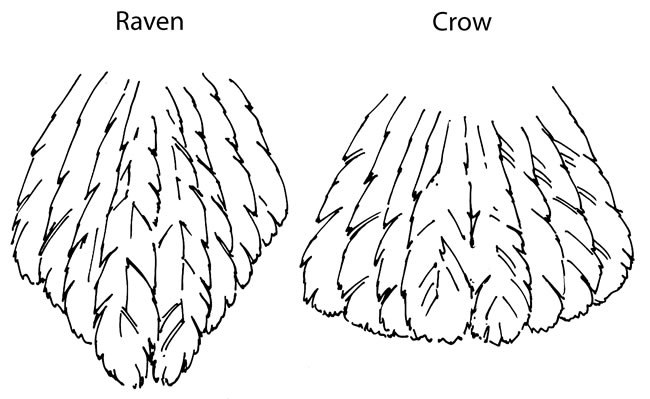
Telling them apart is fairly straightforward! Crows are smaller, have a flatter tail, and typically flap quite a bit during flight. Ravens, by comparison, are much larger in size, have a diamond-shaped tail that moves quite a bit during flight, and typically glide during flight.

Love the whole family of corvids :D as well as your story!

8 comments

> Telling them apart is fairly straightforward!

I would like to point out that your description of how straightforward it is to tell them apart very humorously belies how it is not at all straightforward because all of your proposed evaluations are implicitly relative to something not seen.

> Crows are smaller, have a flatter tail, and typically... Ravens, by comparison...

If you see one bird, is that bird smaller or larger? Is its tail more flat or less? Smaller than what? Flatter than what? Flappier than what? Without seeing both, a lay individual can't easily evaluate "by comparison".

If you think woah that is one huge crow, than it’s probably a raven I find the easiest tell. Also the sound is a bit off and on the higher end I believe. And also their beak is more curved but that’s often hard to spot and not too reliable
You're doing it too. "bigger", "more curved", "higher sound". All of those are comparative. None of them help you know a raven or a crow except in relation to some idealized specimen of the other, which one likely doesn't have in front of them.
I'll take the bait. Ravens' beaks are hooked s.t. the top curves slightly around the bottom, an over beak if you will. The crow's beak is roughly conical and does not hook in this manner.

Additionally the raven's beak is is longer than it's head is wide (in profile). A crow's beak from the same view is approximately the same length as it's head.

> Ravens' beaks are hooked

This one sounds pretty good. Thanks (finally)! From a cursory search on the subject, it seems like one might need to be relatively close to be able to tell?

Maybe. A challenge in birding is getting close enough to look at things without scaring them away. The thing about both crows and ravens is they are (relatively) unafraid of humans. So, you shouldn't struggle much to get a good enough look to differentiate.

That's assuming Ravens are present in your area. One of the first things the guide books teach is to differentiate based on range. E.g. a candidate crow/Raven in Iowa is most likely a crow, since Ravens' range doesn't include the great plains.

Let me finish by plugging birding as a relaxing pastime that doesn't require much investment (just a $25 guide book for your area), and can really enhance any time spent out doors.

How could you tell apart an adolescent raven from a crow that had injured its beak, though? Each of you is making something relative to something else. The beaks are hooked. How hooked? Conical as opposed to what?
Well bigger in the sense that’s it’s easy to have the feeling of awe when looking at a black bird. If in awe it’s probably a raven.
"Feeling of awe" is an assessment of you, not the bird. I feel awe from sparrows, and there are some absolutely gorgeous black chickens out there.
In this case a better indicator is that Ravens can use thermal winds to effectively float in the air, while crows can't and have to flap.
"Can/can't" isn't a great general indicator, because "doesn't" doesn't imply "can't" except circumstantially. If you see a bird floating, it might be a raven. If you see a bird not floating, you still have no idea.
Personally, when I see crows or ravens flying I often can't see their tail and I often can't quite tell how large they are. I find it easier to distinguish their call, a crow sounds like "caw" and a raven sounds like "gronk".
Indeed, Edmund Cooper wrote a sci-fi novel called Kronk, after an utterance by a raven.
The difference is a matter of a pinion - one has one more pinion feather than the other.

No, I don't know which. Heck, I don't even know what distinguishes a pinion from other feathers on the wing.

Uh well, along with others I'll just share how I differentiate them since both are common where I live.

3 Ways

1) if you can get a good look at the tail, think croW = wider/more or less even at the bottom, raVen = V like at the bottom (or diamond as a whole) but it's just a mnemonic and makes more sense if you see this http://naturemappingfoundation.org/natmap/images/drawings/ra...

2) Their calls are very distinct, hear one then hear the other and you won't confuse them at all but that requires having heard both and knowing which is which and I won't even bother to try to explain, you can find a million videos/etc. demonstrating if you really care.

3) Beak, ravens have a slightly curved tip usually and crows... don't but it's hard to see this because of the color, so again, depends on what you can observe

I can tell the crows and ravens apart in my region but I have to wonder how relativistic comparisons are. From what I've seen of hooded crows, I would be more inclined to categorize them as ravens, but there are probably larger ravens in their regions.
I live in an area with hooded crows and ravens. The ravens are a bit larger, but they aren't massively larger.

On the other hand, as long as there is enough light, you can always tell them apart because the hooded crows have a lot of grey so long as they are fully grown (young hooded crows are darker than adults)

I grew up in a forestland environment. Most of the adult ravens I saw along the roadside out-of-town (usually not bothered by cars driving by) were about the size of a chicken. Crows, as a rule ... were a lot smaller.
"if you think its a raven, its a crow, and if you think its a crow its a raven" so goes the classic quote.

one recent quote i heard on the bus: "ravens are near humans, crows are in the country"

Absolutely the opposite, loads of crows in the city, few ravens if any.

Above holds true in Western US and Eastern Canada at least.

In my area, I see crows all the time, sitting on power lines and messing with posters on the street and so on. These are hooded crows and easy to distinguish from ravens. I see ravens as well, but not quite as often - though one of my local grocery stores has a small flock (murder!) of ravens that likes to forage in the parking lot. And to be fair, I live in a decently sized city of around 180,000.
> Ravens, by comparison, are much larger in size

The problem is, they are rarely sitting next to each other so I can tell which one is larger.

I used to feel like I could always tell them apart, but the crows (I think?) in SF are very large
I think the Northern California crows are larger than their east coast counterparts, so I agree, it is harder to tell them apart by size here. Ravens are larger still, though. If you see one in San Francisco, it's probably a crow. Occasionally you get a raven in Oakland but those are usually crows as well. If you get out to Mount Diablo you'll see both crows and ravens out there.