Hacker News new | ask | show | jobs
by jchmrt 1546 days ago
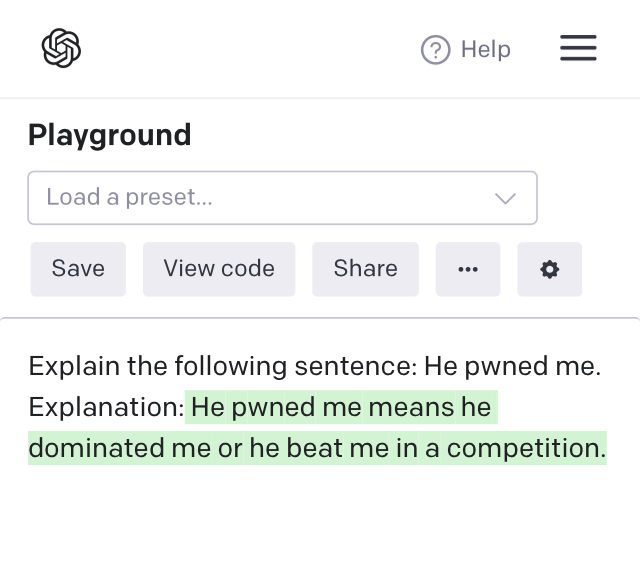
You're missing the point of the parent comment: GPT-3 can understand this idiom because it was trained on a corpus in which the context for this idiom already existed. If a new idiom would emerge, the system would not necessarily be able to handle it if it can not understand it from the context it was trained on. Therefore, a translating AI needs to be continuously updated.
1 comments

Is that any different than a human? They can be pwnded by new idioms.
I think Humans are pretty good at at least recognizing that a particular phrasing doesn't make sense as a literal statement and so must be a reference to something. Often you can get an idea of what it's meant to mean just by context. Sometimes if you see a dozen or so usages, you get the idea of what it means without ever having it explicitly explained.
One of the main differences between humans and ML is that humans learn in far fewer examples than machines.

"Poverty of the stimulus"

https://en.wikipedia.org/wiki/Poverty_of_the_stimulus

Until the models become more sophisticated than human brains. Then humans will need more examples than a machine would to learn the same thing.
No it isn't of course, but that speaks for the argument that AGI is necessary for human-level translation :)
Or just an up-to-date GPT?
Good luck accurately machine translating the infinitely growing idiom of jokey Twitter conversation, which most native speakers can pick up pretty quickly.
Like, for example, “to be pwned”, which I believe is not going to be understood by majority of English speakers.
And even fewer ML proggies.